
BPC-157 vs Wolverine (BPC-157 + TB-500): Single Peptide vs Pre-Mixed Blend
BPC-157 is one synthetic 15-amino-acid peptide (1,419.5 g/mol). Wolverine is a pre-mixed research blend of BPC-157 and TB-500 in one 20mg vial, 10 mg of each on the label. No published study has used the blend itself; one exploratory 2026 rat study compared the pair with each peptide alone. Both are sold for laboratory research only.
This page compares a single compound with a two-peptide blend. For the two compounds against each other, see BPC-157 vs TB-500; for two blends side by side, see KLOW vs Wolverine.
Below: a 19-row comparison, what each component is, how many milligrams and micromoles of each a Wolverine vial holds according to two independent lab reports, what the published literature does and does not cover, how to check both peptides on a certificate of analysis (COA), and a factual FAQ. Every number is tied to a numbered reference or to a named lab report.
BPC-157 and Wolverine from Prime Peptide Solutions are sold strictly for in-vitro laboratory research. They are not FDA-approved for any use in people and are not for human or animal consumption.
BPC-157 vs Wolverine at a Glance
| Property | BPC-157 | Wolverine (BPC-157 + TB-500) |
|---|---|---|
| What it is | One synthetic linear peptide | Two synthetic peptides pre-mixed as one lyophilized powder |
| Components | BPC-157 | BPC-157 + TB-500 |
| Length | 15 amino acids | 15 (BPC-157) + 7 (TB-500, an acetylated fragment matching residues 17-23 of 43-residue thymosin beta-4) [1][2] |
| Sequence | H-Gly-Glu-Pro-Pro-Pro-Gly-Lys- | BPC-157 as left + Ac-Leu-Lys-Lys- |
| Formula and molecular weight | C62H98N16O22, 1,419.5 g/mol [3] | No single value for a blend: BPC-157 1,419.5 g/mol; TB-500 C38H68N10O14, 889.0 g/mol [3] |
| CAS number | 137525-51-0 [3] | 137525-51-0 (BPC-157) and 885340-08-9 (TB-500). Full-length thymosin beta-4 is a different molecule, CAS 77591-33-4 [3] |
| Labeled vial contents | 10mg | 20mg total (10 mg + 10 mg labeled) |
| Measured contents, lot report | 10.21 mg net peptide (ILS Labs, batch PRIME1026) | 20.57 mg: 10.38 mg BPC-157 + 10.19 mg TB-500 (ILS Labs, batch PRIME1026) |
| Mass and molar ratio | Not applicable (one compound) | About 1:1 by mass; about 1:1.6 BPC-157 to TB-500 by moles, because TB-500 is the smaller molecule |
| Molecules per vial (calculated) | About 7.2 µmol | About 7.3 µmol BPC-157 + 11.5 µmol TB-500 |
| What studies report it acting on | Cell-signaling readouts such as FAK-paxillin and VEGFR2-Akt-eNOS in cultured cells [4][5] | BPC-157 as left; TB-500 is a fragment of the actin-binding region of thymosin beta-4, and its own effects "have not been documented" [6][7] |
| Reported half-life in animal studies | Parent peptide under 30 minutes in rats and beagle dogs [8] | BPC-157 as left; no half-life found for TB-500. A rat metabolism study detected its fragment Ac-LKK in urine up to 72 hours [7] |
| Research areas in the literature | Rodent and cell-culture models: cell migration, blood-vessel formation, gastrointestinal models [9][4][5] | Those of each component; for thymosin beta-4: actin sequestration and cell migration [10][11] |
| First described | 1993: a 15-amino-acid fragment of a gastric-juice protein named BPC [9] | Thymosin beta-4 sequenced in 1981 [1]; TB-500 characterized by mass spectrometry in 2012 [2][6] |
| PubMed records (Nov 24, 2026) | 241 for "BPC 157" OR "BPC-157" OR BPC157 | 37 for TB-500 OR TB500; 1,212 for "thymosin beta 4" OR "thymosin beta-4" OR "thymosin beta4"; 16 for the pairing query shown under "Has the Combination Been Studied?" |
| Controlled studies of the combination | Not applicable | One exploratory rat study with all four arms (control, each peptide, both); it describes its TB-500 as synthetic thymosin beta-4 and does not state the sequence [12] |
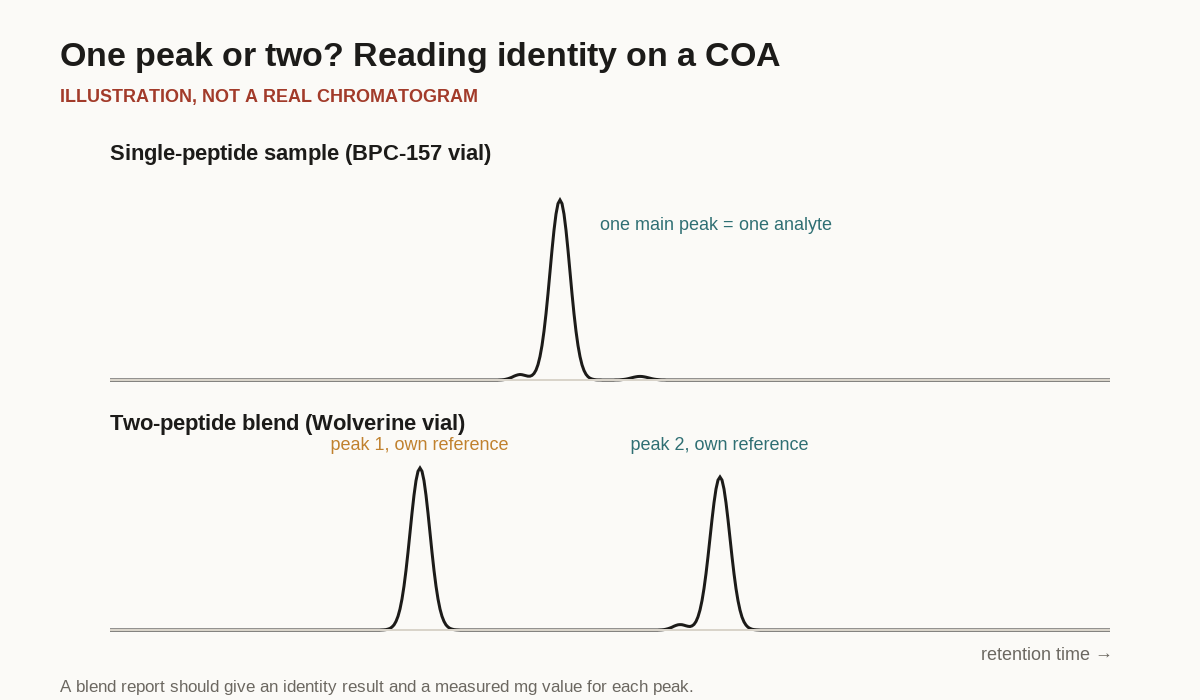
| How identity shows on a COA | One peak at the reference retention time, or one expected mass | Two peaks, one per component, each confirmed by retention time or by LC-MS, with a measured amount for each |
| Current lot COA | 99.49% HPLC purity, ILS Labs, Oct 12, 2026 | 99.19%, ILS Labs, Oct 12, 2026; earlier lot 99.509%, Kovera Labs, May 29, 2026 |
| Storage and status | Lyophilized; 2-8 °C, or -20 °C long term. Not FDA-approved for any use in people [13] | The same storage. Not FDA-approved for any use in people [13] |
Numbers in brackets are the References at the end of the page. Micromoles are calculated: the reported milligrams divided by the PubChem molar mass. Lot figures belong to the batch named; newer batches are added to the COA library.
What Is the Difference Between BPC-157 and Wolverine?
The difference is composition. A BPC-157 vial holds one analyte. A Wolverine vial holds two, BPC-157 and TB-500, at a ratio fixed when the batch was made, so every solution prepared from it carries both peptides together.
Key differences
- Number of compounds: one in BPC-157; two in Wolverine.
- What the label means: 10mg of one peptide, against 20mg of the two combined.
- Molecules per vial: about 7.2 µmol of BPC-157 in the single vial; about 7.3 µmol of BPC-157 plus 11.5 µmol of TB-500 in Wolverine (batch PRIME1026 reports).
- What the purity figure covers: one peptide, against one figure for the whole blend.
- Literature: BPC-157 has its own record of 241 PubMed entries; the pre-mixed blend has none, and only one controlled study pairs BPC-157 with a material sold as TB-500 [12].
- Role in an experiment: a single-variable arm, against a combined arm at a fixed ratio.
Key similarities
- The same BPC-157: both product pages list the same CAS number (137525-51-0), molecular formula and molecular weight.
- The same form and storage: lyophilized powder in a sealed vial, 2-8 °C or -20 °C long term.
- The same lab and method for the current lots: ILS Labs, tested Oct 12, 2026, reverse-phase HPLC purity at 214 nm, identity by retention time against a reference standard, and quantitation.
- The same status: research materials only, not FDA-approved for any use in people.
Is Wolverine Just BPC-157 and TB-500?
Yes: the label lists two components, and both lab reports identify and measure those two labeled components. The reports measure only the labeled peptides; they do not screen for other substances. The ILS Labs report for batch PRIME1026 gives a "Net Blend Peptide Content" of 20.57 mg, split by individual peak integration into 10.38 mg of BPC-157 and 10.19 mg of TB-500, and confirms both identities by retention time (Wolverine batch PRIME1026 report). The Kovera Labs report for batch 0501 identifies BPC-157 and TB-500 by LC-MS and measures 11.04 mg and 11.59 mg (Wolverine batch 0501 report). ILS adds a standard note that "not all labeled components may be present", which is why the per-component lines matter: they are what show that both peptides are in the vial.
Which TB-500? The name causes confusion. On this site, and in the mass-spectrometry papers that first characterized it, TB-500 is the seven-residue acetylated peptide Ac-LKKTETQ, which matches residues 17-23 of thymosin beta-4 [2][6]. Full-length thymosin beta-4 is a 43-residue protein of about 4,963 g/mol in PubChem, with its own CAS number [3]; 4,982 was the figure first reported for the bovine protein in 1981 [1]. Articles that use the two names interchangeably attribute the larger molecule's findings to the fragment. The difference is laid out on TB-500 vs thymosin beta-4.
What Is BPC-157?
Origin. BPC-157 was described in 1993 as a 15-amino-acid fragment of a gastric-juice protein of about 40,000 Da named BPC [9]. The synthetic peptide is linear with free ends: Gly-Glu-Pro-Pro-Pro-Gly-Lys-Pro-Ala-Asp-Asp-Ala-Gly-Leu-Val. PubChem lists it as C62H98N16O22, 1,419.5 g/mol, CAS 137525-51-0 [3]. Four of its 15 residues are proline, and it has no cysteine and no aromatic residue.
What studies report. In cultured rat fibroblasts, BPC-157 did not directly change proliferation but increased cell migration, spreading and F-actin formation, with higher FAK and paxillin phosphorylation and unchanged total protein [4]. In vascular endothelial cells it raised VEGFR2 expression, promoted VEGFR2 internalization and activated VEGFR2-Akt-eNOS signaling over time; the endocytosis inhibitor dynasore suppressed those effects [5]. These papers describe signaling pathways rather than a binding receptor, and we found no study that identifies one. In a pharmacokinetic study in rats and beagle dogs, the elimination half-life of the intact peptide was under 30 minutes, and labeled BPC-157 was broken down into small peptide fragments and then amino acids [8]. More: BPC-157 mechanism and research overview.
What Is TB-500?
Identity. TB-500 is Ac-Leu-Lys-Lys-Thr-Glu-Thr-Gln-OH: C38H68N10O14, 889.0 g/mol, CAS 885340-08-9 [3]. An analytical laboratory identified this acetylated fragment in a product sold as TB-500 by high-resolution mass spectrometry in 2012 [2], and a second laboratory described it the same year as a synthetic version of the 17LKKTETQ23 segment, the actin-binding region of thymosin beta-4, with an added N-terminal acetyl group [6].
The parent protein. Thymosin beta-4 was sequenced in 1981 as a 43-residue peptide with an acetylated N-terminus [1]. In 1991 it was shown to be identical to Fx, a peptide that binds actin monomers in a 1:1 complex and inhibits their polymerization [10], and beta-thymosins are now described as the main intracellular G-actin-sequestering peptides [11].
What is known about the fragment itself. Much less. A 2024 metabolism study states that "the biological effects of TB-500, however, have not been documented". It found Ac-LK to be the main metabolite in rats over the first 6 hours and Ac-LKK to be detectable for up to 72 hours, and in fibroblast scratch assays only the metabolite Ac-LKKTE differed significantly from control [7]. Findings for full-length thymosin beta-4 should not be read as findings for TB-500. More: TB-500 and thymosin beta-4 research overview.
How Much of Each Peptide Is in a Wolverine Vial?
About 10 mg of each, but more molecules of TB-500. The batch PRIME1026 report lists 10.38 mg of BPC-157 and 10.19 mg of TB-500. Divided by the molar masses, that is about 7.3 µmol of BPC-157 and 11.5 µmol of TB-500, roughly 1.6 TB-500 molecules for every BPC-157 molecule. The earlier batch 0501 measured 11.04 mg and 11.59 mg (about 7.8 and 13.0 µmol), a total of 22.63 mg for a 20mg label. The standalone BPC-157 vial (batch PRIME1026) measured 10.21 mg, about 7.2 µmol, so a Wolverine vial holds roughly as much BPC-157 as the single vial; the extra mass is TB-500.
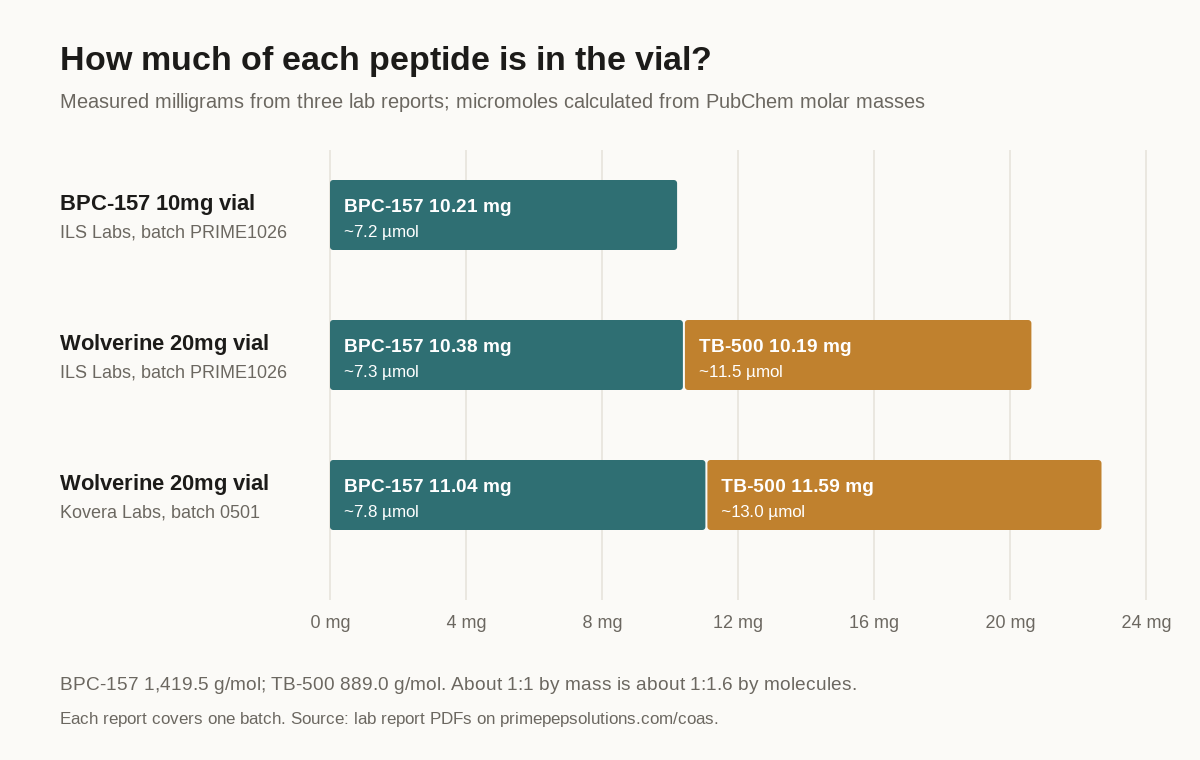
Why the lot report, not the label, sets the numbers. The two Wolverine lots differ by about 2 mg in total content. When an experiment matches a BPC-157-only arm to a Wolverine arm, the matching figure is the BPC-157 line of the report for the lot in use, not the 20mg label. HPLC peak areas are not masses either: at 214 nm the peptide bond absorbs at 923 M-1 cm-1 and an internal proline about three times more [14], so two peptides of equal mass do not give equal peak areas. The per-peptide milligrams on a blend report come from each peptide's own peak against its own reference; see net peptide content vs HPLC purity.
Has the Combination Been Studied?
Barely. A PubMed search on Nov 24, 2026 for ("BPC 157" OR "BPC-157") AND (TB-500 OR "thymosin beta-4" OR "thymosin beta 4") returns 16 records, most of them reviews and commentaries. One is a controlled comparison: an exploratory 2026 study in 32 rats with a four-arm design, eight animals per group (control, BPC-157, TB-500, both), split four for biomechanical testing and four for histology, so each measurement compares four animals per group. It reported no additional difference for the combined group compared with either peptide alone; the authors call the work exploratory, and its findings are preliminary and have not been replicated [12].
Which TB-500 did that study use? The study describes its TB-500 as synthetic thymosin beta-4 from a commercial supplier and does not state its sequence, so it is not known whether it was the Ac-LKKTETQ fragment that this page calls TB-500 [12].
The evidence gap
- No published study used a pre-mixed BPC-157 and TB-500 vial.
- No study tested a fixed 1:1 mass ratio as a variable.
- We found no cell-culture study that combines the two peptides.
- We found no published stability data for the two peptides held together in one solution.
- The biological effects of TB-500 itself are described as undocumented [7].
Why the two are paired anyway, and what each brings, is covered in the Wolverine blend article.
Single Vials or a Blend: Which Fits a Study Design?
It depends on the question. A two-by-two factorial design crosses BPC-157 (absent or present) with TB-500 (absent or present) into four arms: vehicle, BPC-157 alone, TB-500 alone and both. Crossing every level is what lets each effect and the interaction be estimated; when arms are dropped, effects are aliased and only their sum can be estimated [15]. A study with only a vehicle arm and a Wolverine arm is that reduced case.
| Research question | Vials that fit | Why |
|---|---|---|
| Attribute a readout to BPC-157 | BPC-157 | One analyte on the report and in the solution |
| Attribute a readout to TB-500 | TB-500 | The same logic for the other component |
| Test whether the pair interacts | BPC-157, TB-500 and Wolverine (or the two single vials mixed at a ratio the design sets) | All four arms of the factorial [15] |
| Reproduce the pre-mixed condition | Wolverine | The report states each component's measured amount |
| Vary concentration | Single vials | Diluting a blend moves both peptides together at its fixed ratio |
| Develop a two-component HPLC method | Wolverine, with each single vial as a reference | Two peaks to resolve in one run |
Trade-offs in plain terms. A blend means fewer vials and one shared preparation, so both peptides share one solvent, one pH and one storage history. Single vials mean more handling, but every ratio and every concentration is the researcher's choice, and every arm of the design is available.
How Do You Verify Both Peptides on a COA?
- Match the batch. The lot number on the vial should match the report.
- Look for one line per component. A blend report should give a measured amount for BPC-157 and for TB-500, not only a total.
- Check identity for each. Two retention times matched to reference standards, or two masses by LC-MS. The monoisotopic masses are 1,418.70 Da for BPC-157 and 888.49 Da for TB-500 [3].
- Read what the purity figure covers. On the ILS reports it is RP-HPLC area normalization at 214 nm: the target peptide as a share of all peptide-related peaks, with non-peptide impurities excluded.
- Verify the report with the lab. Each report page lists the report number and the lab's verification page.
More: how to verify a peptide COA and HPLC and mass spec explained.
What Do Our COAs Show?
| Report | Lab and date | HPLC purity | Content | Identity | Other |
|---|---|---|---|---|---|
| BPC-157 10mg, PRIME1026 | ILS Labs, Oct 12, 2026 | 99.49% (spec ≥95.0%) | 10.21 mg | HPLC retention time | - |
| Wolverine 20mg, PRIME1026 | ILS Labs, Oct 12, 2026 | 99.19% (spec ≥95.0%) | 20.57 mg: 10.38 + 10.19 | Retention time, both peptides | Fentanyl immunoassay (50 ng/mL cutoff): not detected |
| Wolverine 20mg, 0501 | Kovera Labs, May 29, 2026 | 99.509% (spec >98%) | 22.63 mg: 11.04 + 11.59 | LC-MS, both peptides | - |
| TB-500 10mg, PRIME1026 | BT Labs, Oct 26, 2026 | 99.6% (spec ≥98%) | 11.4 mg by HPLC potency (113.6% of label; lab spec 90-110%) | FTIR | Contains excipient (1:5.4 peptide:excipient) |
None of these reports tests for endotoxin, sterility, heavy metals or residual solvents; HPLC purity cannot detect those. What those tests measure is explained in endotoxin and sterility testing for research peptides. All reports: COA library and lab reports by product.
How Should Both Be Stored?
The same way: sealed, at 2-8 °C, or at -20 °C for longer storage, dry and away from light (product pages). Once in solution, keep it refrigerated; in a blend solution both peptides share the same conditions. See the peptide storage guide and why peptides are freeze-dried.
Wolverine vs GLOW vs KLOW
All three are pre-mixed blends built on BPC-157 and TB-500. Wolverine has those two only. GLOW adds GHK-Cu, a copper-binding tripeptide (GLOW explained). KLOW adds GHK-Cu and KPV (KLOW explained). Each added component is another variable in every solution. Side by side: KLOW vs Wolverine and KLOW vs GLOW. Related single-compound pages: KPV vs BPC-157 and BPC-157 vs GHK-Cu.
Lab What-Ifs
- A blend report shows only one main peak. Then it does not show both components. Ask the lab for the per-component lines, or have the lot tested; see independent testing labs compared.
- The lot number on the vial does not match the report. The report describes a different batch. Look up the matching batch in the COA library or contact support with the lot number.
- A vial arrives warm. Record it, move the sealed vial to 2-8 °C, and if the study is sensitive to it, compare a retained sample against the lot report by HPLC. See how peptides degrade.
- The freeze-dried cake looks collapsed or shrunken. Appearance varies with fill and freeze-drying and is not a purity measure on its own; purity and content are. See lyophilization explained.
How We Researched This Page
Sources: PubMed records retrieved and checked on Nov 24, 2026 (title, authors, journal and year of each cited paper were matched against PubMed), PubChem compound records for formulas, molar masses and CAS numbers, the FDA compounding page cited below, and the full PDF of each lab report linked above. Micromole figures are our calculation. Left out on purpose: animal study amounts, outcome claims for people, and any use other than laboratory research. Last reviewed Nov 24, 2026, by the Prime Peptide Solutions editorial team under our editorial policy. More comparisons: research peptide reference table.
Frequently Asked Questions
Is Wolverine the same as BPC-157?
No. BPC-157 is one peptide. Wolverine is BPC-157 pre-mixed with TB-500 in one 20mg vial, so every solution made from it holds both peptides.
Is Wolverine just BPC-157 and TB-500?
Yes. Its label lists those two, and both published lab reports identify and measure those two labeled components: 10.38 mg and 10.19 mg (ILS Labs, batch PRIME1026), and 11.04 mg and 11.59 mg (Kovera Labs, batch 0501). The reports measure only the labeled peptides; they do not screen for other substances.
How many mg of each peptide are in a Wolverine vial?
About 10 mg of each on a 20mg label; the exact figures are on the report for each lot. Because TB-500 is the smaller molecule, that is about 1.6 TB-500 molecules for each BPC-157 molecule.
Has BPC-157 been studied together with TB-500?
In one controlled study: an exploratory 2026 rat study with four groups of eight (four per group for each measurement), which reported no additional difference for the combined group compared with either peptide alone. That study describes its TB-500 as synthetic thymosin beta-4 from a commercial supplier and does not state its sequence, so it is not known whether it was the Ac-LKKTETQ fragment. No study has used a pre-mixed vial.
Why would a lab choose separate vials over a blend?
To assign a result to one peptide, to vary one concentration at a time, or to run all four arms of a factorial design. A blend fixes the ratio and gives only the combined arm.
How do you confirm that both peptides are in a Wolverine vial?
On the COA, look for a measured amount and an identity result for each component: two peaks matched to reference retention times, or two masses by LC-MS. A single blend purity figure alone does not show both.
What is the difference between Wolverine, GLOW and KLOW?
Wolverine holds BPC-157 and TB-500. GLOW adds GHK-Cu. KLOW adds GHK-Cu and KPV. Each extra component is another variable in the solution.
Are BPC-157 or Wolverine approved for use in people?
No. Neither is FDA-approved for any use in people. Both are sold strictly for in-vitro laboratory research and are not for human or animal consumption.
References
- Low TL, Hu SK, Goldstein AL. Complete amino acid sequence of bovine thymosin beta 4. Proc Natl Acad Sci U S A. 1981;78(2):1162-1166. doi:10.1073/pnas.78.2.1162. PubMed 6940133
- Esposito S, Deventer K, Goeman J, et al. Drug Test Anal. 2012;4(9):733-738. doi:10.1002/dta.1402. PubMed 22962027
- PubChem compound records: BPC-157 (CID 9941957), TB-500 (CID 62707662) and thymosin beta-4 (CID 16132341). Accessed Nov 24, 2026.
- Chang CH, Tsai WC, Lin MS, et al. J Appl Physiol (1985). 2011;110(3):774-780. doi:10.1152/japplphysiol.00945.2010. PubMed 21030672
- Hsieh MJ, Liu HT, Wang CN, et al. J Mol Med (Berl). 2017;95(3):323-333. doi:10.1007/s00109-016-1488-y. PubMed 27847966
- Ho EN, Kwok WH, Lau MY, et al. J Chromatogr A. 2012;1265:57-69. doi:10.1016/j.chroma.2012.09.043. PubMed 23084823
- Rahaman KA, Muresan AR, Min H, et al. J Chromatogr B Analyt Technol Biomed Life Sci. 2024;1235:124033. doi:10.1016/j.jchromb.2024.124033. PubMed 38382158
- He L, Feng D, Guo H, et al. Front Pharmacol. 2022;13:1026182. doi:10.3389/fphar.2022.1026182. PubMed 36588717
- Sikirić P, Petek M, Rucman R, et al. J Physiol Paris. 1993;87(5):313-327. doi:10.1016/0928-4257(93)90038-u. PubMed 8298609
- Safer D, Elzinga M, Nachmias VT. Thymosin beta 4 and Fx, an actin-sequestering peptide, are indistinguishable. J Biol Chem. 1991;266(7):4029-4032. PubMed 1999398
- Huff T, Müller CS, Otto AM, et al. beta-Thymosins, small acidic peptides with multiple functions. Int J Biochem Cell Biol. 2001;33(3):205-220. doi:10.1016/s1357-2725(00)00087-x. PubMed 11311852
- Biçer O, Adanir O, Güleryüz Y, et al. Jt Dis Relat Surg. 2026;37(3):822-837. doi:10.52312/jdrs.2026.2951. PubMed 42542926
- U.S. FDA. Certain bulk drug substances for use in compounding that may present significant safety risks (lists BPC-157 and thymosin beta-4 fragment LKKTETQ, TB-500). Content current as of Apr 22, 2026; accessed Nov 24, 2026.
- Kuipers BJ, Gruppen H. J Agric Food Chem. 2007;55(14):5445-5451. doi:10.1021/jf070337l. PubMed 17539659
- Collins LM, Dziak JJ, Li R. Psychol Methods. 2009;14(3):202-224. doi:10.1037/a0015826. PubMed 19719358
Disclaimer: This page is provided for educational and research purposes. It summarizes published scientific literature and lab reports and is not medical advice. BPC-157, Wolverine and all peptides sold by Prime Peptide Solutions are intended strictly for laboratory research, are not FDA-approved for any use in people, and are not for human or animal consumption. Researchers are responsible for compliance with the regulations that apply to them.
Shop these products
- Ships the same business day
- Free US shipping on $149.99+
- 7-day money-back guarantee on damaged items