

What Does It Mean to Verify a Peptide COA?
A certificate of analysis (COA), also called a lab report or test report, is the document a testing laboratory issues for one batch of material. Verifying a COA is a different job from reading it. Verifying asks three questions: was the report really issued by the lab named on it, does it describe the batch you hold, and do its pages agree with each other and with reference data?
This guide covers only those checks. For what each section of a COA means, see how to read a peptide COA and what COA purity numbers mean; for the methods themselves, see HPLC and mass spec explained.
This article is a scientific overview for laboratory researchers. The research-grade peptides supplied by Prime Peptide Solutions are sold strictly for in-vitro laboratory research. They are not approved for human use and are not for human or animal consumption.
Why Verification Matters
A report is only useful if it belongs to the material it is attached to. A Belgian study screened falsified peptide products acquired from suspected illegal websites and found a high variation in how much peptide each item contained, purities between 5% and 75% for the cysteine-containing peptides, and contamination with arsenic and lead (Janvier et al., 2018). None of that is visible on a label.
Synthetic peptides also carry a predictable set of related impurities. A review lists deletion and insertion sequences, diastereomers, protecting-group adducts, oxidized side chains, dimers, trifluoroacetate counter-ions, unrelated peptides and degradation products such as pyroglutamate and succinimide species (D'Hondt et al., 2014).
Step 1: Match the Report to the Vial
Put the vial and the report side by side. Every field that can be compared should agree:
- Product. The same compound or blend, with every blend component listed.
- Batch or lot number. If the vial or its paperwork carries a lot number, it should match exactly.
- Labeled quantity and form. A 10mg vial needs a report for a 10mg batch.
- Vial details. Some labs record cap and crimp colors and photograph the tested vial; a different cap or label is worth a question.
- Client name. The seller, not another business.
A report that matches on product but not on batch may be genuine, but for a different production run.
Step 2: Confirm the Report With the Issuing Lab
Some independent labs, including the one behind the reports below, give each report a report number and a separate access code, and host a lookup page where the two retrieve the lab's own copy. This is the strongest single check: it asks whether the lab holds the same record.
- Find the lab yourself. Reach its verification page by typing the address or searching the lab's name, not only through a link or QR code inside the document being checked.
- Enter the report number and access code exactly as printed.
- Compare field by field. Product, batch, client, date, purity and chromatogram should all match. A different product or date is a failed check.
- Know what it proves. A match shows the lab issued that report for that batch, not that a given vial came from it. That is Step 1's job.
If there is no lookup, contact the lab with the report number and ask whether it issued the report.
Step 3: Check the Dates
- The test or certification date should fall after the batch was made and before the material reached you.
- Different batches should have different reports. The same report number, date and purity figure presented for several batches is a sign that one report is being reused.
- An old report says nothing about later batches.
Step 4: Sanity-Check the Chromatogram
The HPLC trace is the raw evidence behind the purity figure.
- Method line. Look for the separation mode, column and detection wavelength, for example reversed-phase HPLC on a C18 column with detection at 214 nm. Detection near 214 nm suits peptides because the peptide bond absorbs there: one study measured a molar extinction coefficient of 923 M-1 cm-1 per peptide bond at 214 nm, with tryptophan about 30 times higher and phenylalanine, tyrosine and histidine about six times higher (Kuipers and Gruppen, 2007). That is also why an area percentage is a UV-absorbance ratio, not a mass ratio.
- Labels and axes. Expect labeled axes (absorbance against retention time) and a labeled main peak. If a sample or report ID is printed above the trace, it should match the report.
- Peaks against the claim. A purity above 99% needs one dominant peak and very little else above the baseline.
- Blends. One labeled peak per component.
- Reused or edited images. Two different compounds should not share an identical trace. Duplication can be caught by eye: visual screening of 20,621 journal papers found problematic duplicated images in 3.8%, at least half suggesting deliberate manipulation (Bik et al., 2016).
Step 5: Check the Identity Data Against the Expected Mass
HPLC purity does not say what the main peak is. Identity comes from mass spectrometry, often LC-MS. In electrospray ionization, large molecules appear as a series of multiply charged ions, each peak differing from its neighbor by one charge (Fenn et al., 1989). A peptide of mass M therefore shows up at roughly (M + n × 1.007) / n for charge state n.
A worked example: PubChem lists MOTS-c at an average molecular weight of 2174.6 g/mol (CID 146675088), so its doubly and triply protonated ions fall near m/z 1088.3 and 725.9. Reported mass data should be consistent with the expected mass.
Check the printed formula and CAS number too, remembering that salts, metal complexes and free forms carry different CAS numbers. Copper peptides are a common case: PubChem lists the free tripeptide GHK under CAS 49557-75-7 (CID 73587) and its copper complex under 89030-95-5 (CID 71587328); supplier documents use both.
What the Published Prime Peptide Solutions Reports Show
The list below gives six of the published reports, all issued by Kovera Labs and certified on May 29, 2026. Every published report is listed on the lab reports by product page.
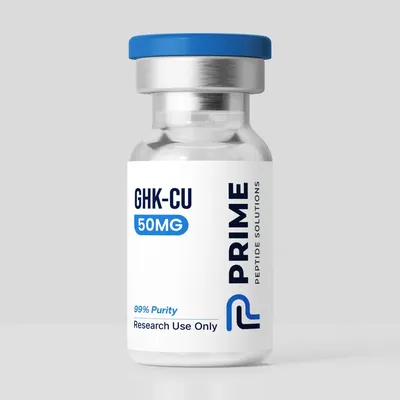
- GHK-Cu 50mg: BATCH-0425, report KVR-2026-659B6A, HPLC purity 99.311% (report page)
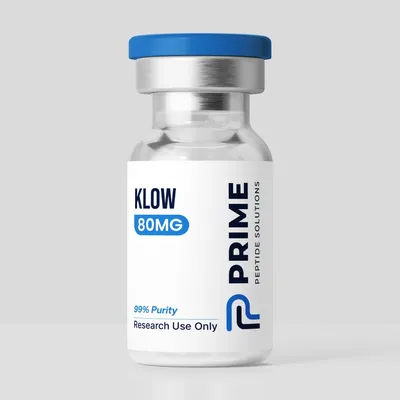
- KLOW 80mg: BATCH-0502, report KVR-2026-F1227A, HPLC purity 99.849% (report page)
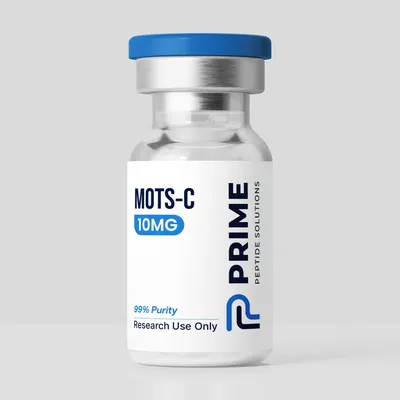
- MOTS-C 20mg: BATCH-0423, report KVR-2026-0A14C4, HPLC purity 99.659% (report page)
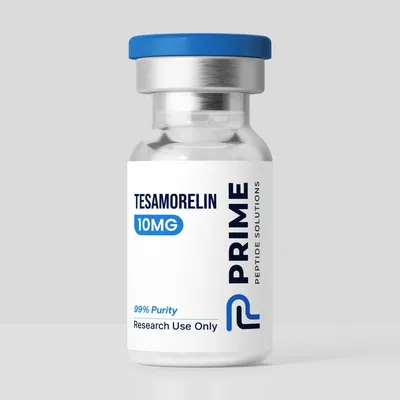
- Tesamorelin 10mg: BATCH-0422, report KVR-2026-CF8C23, HPLC purity 99.384% (report page)
- Wolverine (BPC-157 + TB-500) 20mg: BATCH-0501, report KVR-2026-384D17, HPLC purity 99.509% (report page)
- CJC-1295 no DAC + Ipamorelin 10mg: BATCH-0426, report KVR-2026-4757D4, HPLC purity 99.248% (report page)
Each report lists the client, certification date, product, batch, form, labeled quantity, cap and crimp colors, and a photo of the tested vial; single-compound reports add a formula and CAS number. The test table gives HPLC purity and net content against reference standards (for purity, greater than 98%) and identity by LC-MS. The chromatogram states its method (reversed-phase HPLC, C18 column, diode-array detection at 214 nm), and the label above each trace carries the report number. The footer gives the report number, an access code and the lab's verification address. Each report page also lists the key facts in text (HPLC purity, lab, batch, size, test date and report number) beside images of the report, with a link to verify it with the lab.
The KLOW, Wolverine and CJC-1295 no DAC + Ipamorelin reports give blend averages, a blend identification and a table of labeled versus measured component amounts, with one labeled peak per component. The reports cover purity, net content and identity only; they do not include endotoxin, sterility or heavy-metal tests.
Red Flags at a Glance
- No report number, or no way to confirm the report with the lab.
- A batch, quantity or client name that does not match.
- One report, date or purity figure reused across batches.
- A chromatogram without axes, labels or method, or copied from another product.
- A purity figure the trace cannot support.
Supplier-level warning signs, such as no physical address or prices far below the market, are covered in the sourcing and quality checklist.
Handling and Record-Keeping
Record the product, batch, report number and arrival date for each vial, and save the report with the lab's confirmation. Keep lyophilized vials sealed, cold, dry and dark, and let a cold vial reach room temperature before opening. Set aside any vial with a broken seal or a label that does not match the report photo. General conditions are covered in the peptide storage guide and the lyophilization explainer.
Key Studies
- Janvier et al., 2018 (Talanta): falsified peptide products from suspected illegal websites; peptide content that varied from item to item, low purity, arsenic and lead. PubMed 30029448
- D'Hondt et al., 2014 (J Pharm Biomed Anal): review of synthesis- and degradation-related peptide impurities. PubMed 25044089
- Kuipers and Gruppen, 2007 (J Agric Food Chem): molar extinction of the peptide bond and amino acids at 214 nm. PubMed 17539659
- Fenn et al., 1989 (Science): electrospray ionization and multiply charged ion series. PubMed 2675315
- Bik et al., 2016 (mBio): prevalence of duplicated images found by visual screening. PubMed 27273827
Frequently Asked Research Questions
How can I tell if a peptide COA is fake?
Look it up with the issuing lab using the report number and access code, and compare its copy with yours. Then check the batch, dates, chromatogram and mass data.
What are the report number and access code for?
Together they retrieve the lab's own copy of the report on its verification page. A match shows the lab issued it.
Does a verified COA prove my vial is genuine?
Not on its own. It proves the report is genuine for a batch; matching the batch and vial details connects it to your vial.
Why can a COA list a different CAS number from a database?
Salts, metal complexes and free forms have separate CAS numbers. Identity rests on the mass data, not the CAS number.
Do the published reports include endotoxin or sterility testing?
No. They cover HPLC purity, net content and identity by LC-MS only.
What are the peptides sold here intended for?
Only in-vitro laboratory research. They are not for human or animal consumption and are not equivalent to any approved medicine.
Conclusion
Verifying a COA comes down to five checks: the report matches the vial, the lab confirms it, the dates make sense, the chromatogram supports the purity, and the mass data fit the molecule. A report that fails any of them is not evidence about your batch.
Disclaimer: This article is provided for educational and research purposes only. It summarizes publicly available scientific literature and does not constitute medical advice. All peptide compounds sold by Prime Peptide Solutions are intended strictly for laboratory research, are not approved for human use, and are not for human or animal consumption. Researchers are responsible for compliance with all applicable regulations in their jurisdiction.
Shop these products
- Ships the same business day
- Free US shipping on $199.99+
- 14-day money-back guarantee on damaged items
References & Further Reading
- PubMed: Peptide impurities and HPLC analysis
- Related: How to read a peptide COA
- Related: What COA purity numbers mean
Lab Reports at Prime Peptide Solutions
Published batch reports are listed on the lab reports page and the COAs page, each with a link to verify it with the lab.
Sold strictly for in-vitro laboratory research. Not for human or animal consumption.