

What Is Cagrilintide?
Cagrilintide is a synthetic, lipidated analogue of the pancreatic peptide hormone amylin, also known by the development codes AM833 and NN0174-0833, often shortened to 0833 (Fletcher et al., 2021; Gabery et al., 2025). It is a 37-residue peptide built on the backbone of pramlintide, an earlier amylin analogue, and its N-terminus carries a C20 diacid attached through a gamma-glutamic acid linker (Cao et al., 2025). In receptor pharmacology it is a nonselective agonist of the amylin receptors and the calcitonin receptor, a profile also called a dual amylin and calcitonin receptor agonist, or DACRA (Fletcher et al., 2021; Gu et al., 2026).
It was reported in 2021 as the product of structure-activity work aimed at a stable, lipidated amylin analogue, a hard design problem because native amylin has a high propensity to form amyloid fibrils (Kruse et al., 2021). Below: its structure, receptors, study findings and lab handling.
This article is a scientific overview for laboratory researchers. The research-grade cagrilintide supplied by Prime Peptide Solutions is sold strictly for in-vitro laboratory research. It is not approved for human use and is not for human or animal consumption.
Structure and Identity
From amylin to pramlintide to cagrilintide
Human amylin is a 37-residue peptide with a Cys2-Cys7 disulfide bond and an amidated C-terminal tyrosine (UniProt P10997). Pramlintide is human amylin with proline at positions 25, 28 and 29 (da Silva et al., 2016). Cagrilintide keeps that backbone and changes it in four places (Cao et al., 2025):
- N14E and V17R: a pair of helix-stabilizing substitutions added to counteract amyloid fibril formation, predicted to stabilize the N-terminal alpha-helix (residues 5-18) through an intramolecular salt bridge.
- Y37P: an amidated proline in place of the amidated tyrosine. In rat amylin, the same swap increased affinity and activity at both the calcitonin receptor and the amylin receptors, in some cases with reduced selectivity between them.
- N-terminal lipidation: a gamma-Glu linker carrying a C20 diacid.
PubChem shows the lysine side-chain amine as free, so the lipid sits on the alpha-amine of Lys1, not on the lysine side chain.
Molecule at a Glance
- Other names: AM833, NN0174-0833 (0833), cagrilintide [INN]
- Length: 37 amino acids
- Sequence:
KCNTATCATQRLAEFLRHSS NNFGPILPPT NVGSNTP-NH2 - N-terminal group: 19-carboxynonadecanoyl (C20 diacid) joined through L-gamma-glutamyl to the alpha-amine of Lys1
- Disulfide bond: Cys2-Cys7
- C-terminus: prolinamide (amidated Pro37)
- Molecular formula: C194H312N54O59S2
- Molecular weight: 4409 g/mol (computed)
- Monoisotopic mass: 4406.25 Da
- CAS number: 1415456-99-3
- PubChem CID: 171397054
- UNII (FDA GSRS): AO43BIF1U8
These identity values come from PubChem and describe the neutral peptide; a salt form such as an acetate has a higher formula mass. Our research peptide reference table explains the notation, and the guide to peptide modifications covers C-terminal amides.
Proposed Mechanism of Action
The calcitonin receptor and its RAMP partners
The calcitonin receptor (CTR) was cloned in 1991 as a G protein-coupled receptor with high affinity for salmon calcitonin, coupled to increases in intracellular cyclic AMP (cAMP) (Lin et al., 1991). In 1999, co-expressing RAMP1 or RAMP3, small single-transmembrane receptor activity-modifying proteins, with the human calcitonin receptor in COS-7 cells produced specific amylin binding and matching cAMP responses (Christopoulos et al., 1999). Current nomenclature names three amylin receptors, AMY1, AMY2 and AMY3: the calcitonin receptor paired with RAMP1, RAMP2 or RAMP3 (Hay et al., 2018). Without a RAMP, the calcitonin receptor responds potently to calcitonin peptides but weakly to amylin; the amylin receptors respond potently to amylin but weakly to human calcitonin (Cao et al., 2025).
A nonselective agonist
A 2021 study profiled AM833 (cagrilintide) across 25 endpoints of receptor binding, activation and regulation, against pramlintide (amylin-receptor-selective), salmon calcitonin (nonselective), two lipidated research analogues (AM1213 and AM1784), human calcitonin and rat amylin. It concluded that cagrilintide has a unique pharmacological profile among these calcitonin-family agonists (Fletcher et al., 2021). "Dual agonist" does not mean identical balance: beside KBP-336, a dual agonist built on salmon calcitonin, cagrilintide activated both receptor types while KBP-336 was more potent and biased toward the calcitonin receptor (Larsen et al., 2022).
How it binds: cryo-EM structures
In active amylin receptor structures, amylin-bound complexes were similar across AMY1, AMY2 and AMY3, constrained by the RAMP and an ordered mid-peptide motif called the bypass motif, while calcitonin-bound amylin receptor complexes overlapped with calcitonin-bound calcitonin receptor complexes (Cao et al., 2022). Structures of cagrilintide with Gs-coupled AMY1, AMY2, AMY3 and calcitonin receptors, at 2.2 to 3.0 Å, showed an amylin-like binding mode with distinct conformational dynamics compared with rat amylin, salmon calcitonin and other amylin-based peptides; density for the lipid was limited (Cao et al., 2025). A second group found a similar bypass binding mode at AMY1 and the calcitonin receptor, with Phe23 anchoring the peptide at the transmembrane bundle and the micelle, the Glu14-Arg17 salt bridge reinforcing the helix, and Pro37 contacting the receptor extracellular domain (Gu et al., 2026).
Findings by Study Model
Cell-based assays
- Receptor pharmacology panel: a profile of its own among seven calcitonin-family agonists (Fletcher et al., 2021).
- Receptor balance: activation of both receptor types, with less calcitonin-receptor bias than KBP-336 (Larsen et al., 2022).
- Gs signalling: non-selective activation of Gs pathways through the calcitonin receptor and AMY1 (Gu et al., 2026).
Rodent and in-vitro metabolism studies
For mode-of-action work in mice and rats, a tool compound, 0839, has been described: it shares 95% sequence homology with cagrilintide and carries an identical acylation side chain (Gabery et al., 2025). Whole-animal studies are outside the scope of this page. In in-vitro metabolism models, cagrilintide was degraded from both termini, and metabolites predicted in vitro were also found in rat plasma samples (Alhalabi et al., 2026).
Human studies
Cagrilintide has been evaluated in phase 1 and phase 2 clinical trials (Cao et al., 2025). The clinical literature is outside the scope of this page.
Key Studies
- Kruse et al., 2021, J Med Chem (PMID 34288673): development of cagrilintide (compound 23), a stable, lipidated amylin analogue.
- Fletcher et al., 2021, J Pharmacol Exp Ther (PMID 33727283): 25-endpoint receptor pharmacology against six other agonists.
- Cao et al., 2025, Nat Commun (PMID 40204768): cryo-EM at AMY1, AMY2, AMY3 and the calcitonin receptor; design rationale.
- Gu et al., 2026, Acta Pharmacol Sin (PMID 40847076): AMY1 and calcitonin receptor structures; Phe23, Glu14-Arg17 and Pro37.
- Larsen et al., 2022, Biomed Pharmacother (PMID 36242844): receptor balance compared with KBP-336.
Stability and Laboratory Handling
Storing the lyophilized powder
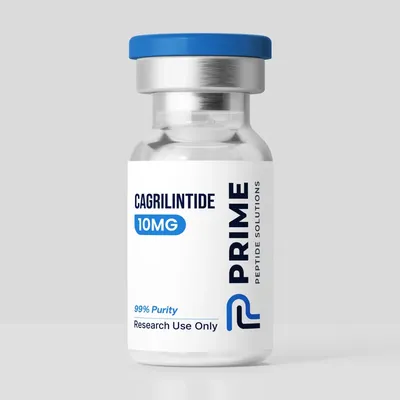
The cagrilintide in our catalog is a lyophilized (freeze-dried) powder in a sealed 10mg vial. Proteins are often freeze-dried to reach an acceptable shelf life, though even the dried solid can have limited long-term storage stability (Wang, 2000). Keep vials sealed, cold, dry and dark, let a cold vial reach room temperature before opening, and avoid repeated warming and re-cooling. See our guides to storing research peptides and lyophilization.
Chemically sensitive sites
No forced-degradation study of cagrilintide itself was found for this overview, but its backbone has been studied through pramlintide. In pramlintide stressed at 40 °C for 45 days at pH 4.0, deamidation accounted for about 64% of thermal degradation, cyclic imides about 20%, and backbone hydrolysis the rest (Hekman et al., 1999), including cleavage at His18-Ser19 and Ser19-Ser20 (Hekman et al., 1998). Cagrilintide keeps five of pramlintide's six asparagines (Asn14 became Glu), Gln10 and the His18-Ser19-Ser20 stretch, so the same degradation products are plausible analytical targets for cagrilintide in solution, although this is an inference rather than a measured result. Fibril formation can be followed with thioflavin T, the dye used to show pH-dependent fibril formation by pramlintide in vitro (da Silva et al., 2016).
Verifying identity and purity
A batch Certificate of Analysis normally reports HPLC purity and a mass-spectrometry identity check. The observed mass should match the lipidated peptide (average 4409 g/mol, monoisotopic 4406.25 Da), not the bare chain. Validated LC-MS/MS methods for cagrilintide and its breakdown products have been published (Alhalabi et al., 2026). See our guides to HPLC and mass spectrometry, reading a COA and verifying a COA. Batch lab reports are listed by product and batch on our lab reports page as they become available.
Frequently Asked Research Questions
What is cagrilintide?
A 37-residue amylin analogue built on pramlintide, with N14E, V17R and Y37P substitutions and an N-terminal C20 diacid on a gamma-Glu linker. It is a nonselective agonist of AMY1, AMY2, AMY3 and the calcitonin receptor.
Is cagrilintide a GLP-1 receptor agonist?
No. The studies above describe it as an agonist of the calcitonin and amylin receptors, and none of the sources reviewed here reports GLP-1 receptor activity. Semaglutide, listed here as GLP-1 SM (semaglutide), is described in the 2025 cagrilintide structure paper as a selective GLP-1 receptor agonist. See also retatrutide vs cagrilintide.
How does cagrilintide differ from pramlintide?
Pramlintide is human amylin with prolines at 25, 28 and 29. Cagrilintide adds Glu14, Arg17, a C-terminal prolinamide and the N-terminal lipid. A 2021 study described pramlintide as amylin-receptor-selective and cagrilintide as nonselective.
What do AMY1, AMY2 and AMY3 mean?
The three amylin receptors: the calcitonin receptor paired with RAMP1, RAMP2 or RAMP3.
What is the research-grade cagrilintide sold here intended for?
The research-grade cagrilintide sold by Prime Peptide Solutions is not approved for human use. It is supplied only for in-vitro laboratory research and is not for human or animal consumption. It is not equivalent to any approved medicine.
Conclusion
Cagrilintide is pramlintide re-engineered: two helix-stabilizing substitutions against fibril formation, a C-terminal prolinamide and an N-terminal C20 diacid. Receptor studies place it as a nonselective agonist of the calcitonin receptor and all three amylin receptors, and cryo-EM shows an amylin-like bypass binding mode.
Disclaimer: This article is provided for educational and research purposes only. It summarizes publicly available scientific literature and does not constitute medical advice. Cagrilintide and all peptide compounds sold by Prime Peptide Solutions are intended strictly for laboratory research, are not approved for human use, and are not for human or animal consumption. Researchers are responsible for compliance with all applicable regulations in their jurisdiction.
Shop these products
- Ships the same business day
- Free US shipping on $199.99+
- 14-day money-back guarantee on damaged items
References & Further Reading
- Lin HY et al., 1991. Science. PMID 1658940.
- Hay DL et al., 2018. Br J Pharmacol. PMID 29059473.
- Cao J et al., 2022. Science. PMID 35324283.
- Gabery S et al., 2025. Life Sci. PMID 40628316.
- Alhalabi H et al., 2026. J Pharm Biomed Anal. PMID 41702251.
- da Silva DC et al., 2016. Biophys Chem. PMID 27665170.
- Hekman C et al., 1998. Pharm Res. PMID 9587964.
- Hekman CM et al., 1999. J Pharm Biomed Anal. PMID 10701984.
- Wang W, 2000. Int J Pharm. PMID 10967427.
- PubChem: Cagrilintide, CID 171397054
Research-Grade Cagrilintide
In our catalog, research-grade cagrilintide is listed as Cagrilintide, supplied as a lyophilized powder in one size, a 10mg vial. Batch lab reports are listed by product and batch on our lab reports page as they become available; check it for a cagrilintide report. For a peptide from a different receptor family, see retatrutide vs cagrilintide, which compares it with GLP-3 RT (retatrutide).
Sold strictly for in-vitro laboratory research. Not for human or animal consumption.