
Retatrutide vs Cagrilintide: Triple Receptor Agonist vs Amylin Analog
Retatrutide and cagrilintide are both lipidated peptides built on hormone-derived templates (a GIP backbone and the amylin analog pramlintide), but they come from different peptide families and act at different receptors. Retatrutide is a single peptide that acts as an agonist at three receptors: the glucose-dependent insulinotropic polypeptide receptor (GIPR), the glucagon-like peptide-1 receptor (GLP-1R) and the glucagon receptor (GCGR). Cagrilintide is a long-acting amylin analog that acts as a nonselective agonist at the amylin receptors (the calcitonin receptor paired with a RAMP) and at the calcitonin receptor itself.
All of these targets belong to the same G protein-coupled receptor 2 family (class B, secretin-like), yet the two compounds share no receptor target in the sources reviewed for this page. This comparison covers structure, receptor pharmacology and the signalling pathways studied in cell and animal models.
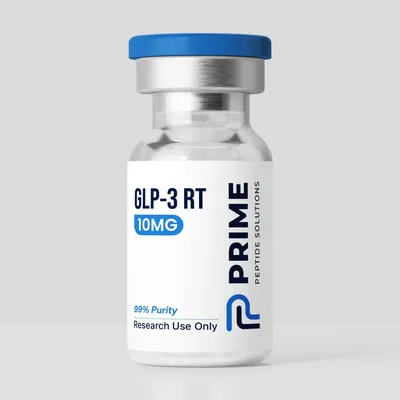
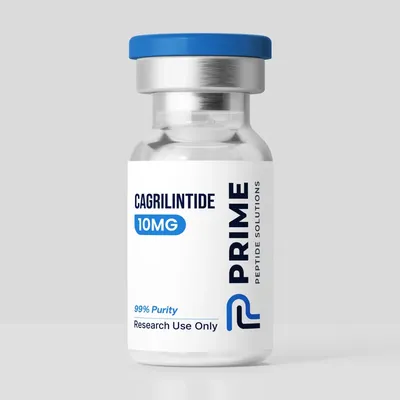
Retatrutide is listed in this catalog as GLP-3 RT (retatrutide). Cagrilintide is listed in this catalog as Cagrilintide 10mg. The research-grade material sold here is not approved for human use and is not for human or animal consumption.
| Property | Retatrutide | Cagrilintide |
|---|---|---|
| Peptide template | GIP backbone | Pramlintide backbone (amylin analog) |
| Receptor targets | GIPR, GLP-1R and GCGR (triple agonist) | Amylin receptors AMY1, AMY2, AMY3 and the calcitonin receptor (dual amylin and calcitonin receptor agonist) |
| Receptor family | G protein-coupled receptor 2 family (class B) | Same family; calcitonin receptor alone or paired with RAMP1, 2 or 3 |
| Receptor balance in vitro | Balanced at GCGR and GLP-1R, more GIPR activity; more potent than native GIP at GIPR, less potent than the native ligands at GLP-1R and GCGR | Nonselective across amylin receptors and the calcitonin receptor, unlike the amylin-receptor-selective pramlintide |
| Chain length | 39 amino acids | 37 residues; Cys2-Cys7 disulfide; C-terminal prolinamide |
| Formula and molecular weight | C221H342N46O68; about 4731.4 Da | C194H312N54O59S2; about 4409 Da |
| Lipidation | C20 fatty diacid; reversible albumin binding | C20 fatty diacid on the N-terminal lysine via a gamma-Glu linker; described as long-acting |
| Second messenger | cAMP; GCGR also signals via phosphatidylinositol-calcium | cAMP via Gs coupling |
| Signalling studied in cell and animal models | In vitro activity at GIPR, GLP-1R and GCGR; in mice, the glucagon-receptor component studied alongside incretin-receptor signalling through GIPR and GLP-1R | Neuron activation (cFos) in the area postrema, dorsal vagal complex and lateral parabrachial nucleus in mice |
| In this catalog | GLP-3 RT, 10mg, 20mg and 30mg vials | Cagrilintide, 10mg vial |
About Retatrutide
Structure. Retatrutide is a 39-amino-acid peptide derived from a GIP backbone, with the molecular formula C221H342N46O68 and a molecular weight of about 4731.4 Da. A C20 fatty diacid moiety promotes reversible, noncovalent binding to serum albumin.
Receptor profile. Its discovery paper reports balanced GCGR and GLP-1R activity in vitro, with more GIPR activity. Retatrutide is reported to be more potent than native GIP at the GIP receptor and less potent than the native ligands at the GLP-1 and glucagon receptors. GIP and GLP-1 are the two primary incretin hormones: binding to their receptors raises intracellular cAMP in pancreatic beta cells, which stimulates insulin secretion in a glucose-dependent way. UniProt describes the glucagon receptor as regulating the rate of hepatic glucose production through glycogen hydrolysis and gluconeogenesis, acting through adenylate cyclase and a phosphatidylinositol-calcium second-messenger system.
Animal models. In mouse studies reported in the discovery paper, the glucagon-receptor component was studied alongside incretin-receptor signalling through GIPR and GLP-1R. More background is in the retatrutide research overview and a retatrutide PubMed search.
About Cagrilintide
Cagrilintide is listed in this catalog as Cagrilintide 10mg, a lyophilized powder for in-vitro laboratory research only.
Design. Cagrilintide came out of structure-activity work aimed at a stable, lipidated, long-acting amylin analog; the design problem was native amylin's high propensity to form amyloid fibrils. Pramlintide is the backbone peptide. Two helix-stabilizing substitutions, N14E and V17R, are predicted to form an intramolecular salt bridge that stabilizes the N-terminal alpha-helix. The C-terminal residue is an amidated proline (P37) where rat amylin has an amidated tyrosine; in rat amylin, that swap increased affinity and activity at both the calcitonin receptor and amylin receptors, in some cases with reduced selectivity between them.
Structure. PubChem lists the molecular formula C194H312N54O59S2 and a computed molecular weight of about 4409 Da. The 37-residue chain keeps the Cys2-Cys7 disulfide and C-terminal amide shared by amylin-based peptides, and its N-terminal lysine is acylated through an L-gamma-glutamyl linker with a C20 fatty diacid (19-carboxynonadecanoyl).
Receptor profile. Native amylin is a 37-residue glucoregulatory hormone co-secreted with insulin from pancreatic beta cells. Its receptors (AMY1, AMY2 and AMY3) are heterodimers of the calcitonin receptor with RAMP1, RAMP2 or RAMP3; without a RAMP, the calcitonin receptor responds potently to calcitonin peptides but weakly to amylin. Cagrilintide is classed as a dual amylin and calcitonin receptor agonist (DACRA). A receptor-pharmacology study that profiled it alongside pramlintide, salmon calcitonin, human calcitonin and rat amylin concluded that it has a unique profile among these calcitonin-family agonists. In another in vitro and rodent study, a salmon-calcitonin-based DACRA was more potent and biased toward the calcitonin receptor, so cagrilintide and that salmon-calcitonin-based DACRA differ in receptor-activation balance.
Structural biology. Cryo-EM structures show cagrilintide bound to Gs-coupled AMY1, AMY2 and AMY3 receptors and to the calcitonin receptor, in an amylin-like mode but with distinct conformational dynamics compared with rat amylin and salmon calcitonin. A second study describes a similar "bypass" binding mode at AMY1R and CTR: F23 anchors the peptide at the transmembrane bundle, the E14-R17 salt bridge improves helical stability and P37 contacts the receptor extracellular domain.
Animal models. In mice, cagrilintide activated neurons (cFos signal) in the dorsal vagal complex and the lateral parabrachial nucleus of the brainstem. In RAMP1/RAMP3 knockout mice, which lack AMY1 and AMY3 receptors, the area postrema cFos signal after cagrilintide was lower than in wild-type mice, pointing to a role for AMY1 and AMY3 receptors in that neuronal response. See a cagrilintide PubMed search.
Which Should Researchers Choose?
Because no source reviewed here reports a shared receptor target, the choice follows the receptor system in the research question:
- Incretin and glucagon receptor signalling: retatrutide is the relevant compound. It places GIPR, GLP-1R and GCGR agonism on one molecule, which suits cell-based work on incretin-receptor cAMP signalling, glucose-dependent insulin secretion in beta-cell models and glucagon-receptor signalling in hepatocyte models.
- Amylin and calcitonin receptor pharmacology: cagrilintide is the relevant compound of the two (listed here as Cagrilintide 10mg). Its nonselective profile across AMY1-3 and the calcitonin receptor, with cryo-EM structures at all four, suits RAMP-dependent receptor studies.
- Published hindbrain neuron-activation data: of the two, only cagrilintide has published cFos mapping (area postrema, dorsal vagal complex, lateral parabrachial nucleus) in the sources reviewed here.
- Peptide stabilization and lipidation: both carry a C20 fatty diacid, but cagrilintide adds anti-fibrillation design (the N14E/V17R salt bridge) to counter the high propensity of native amylin to form amyloid fibrils.
- Other incretin comparisons: for retatrutide against related incretin compounds, see tirzepatide vs retatrutide and semaglutide vs retatrutide.
Frequently Asked Questions
What is the main difference between retatrutide and cagrilintide?
Receptor system and template. Retatrutide is a GIPR, GLP-1R and GCGR triple agonist built on a GIP backbone. Cagrilintide is an amylin analog built on the pramlintide backbone that activates amylin receptors and the calcitonin receptor.
Is cagrilintide a GLP-1 receptor agonist?
No. It acts at amylin receptors (the calcitonin receptor plus RAMP1, 2 or 3) and at the calcitonin receptor. No source reviewed for this page reports cagrilintide activity at GIPR, GLP-1R or GCGR, or retatrutide activity at amylin or calcitonin receptors.
Where do the amylin receptor subtypes come from?
In COS-7 cell experiments, co-expressing RAMP1 or RAMP3 with the human calcitonin receptor gene product produced specific amylin binding with two distinct phenotypes, and cAMP responses reflected those phenotypes. RAMP2 did not significantly increase amylin binding in that study. Current receptor classification defines three amylin receptors, AMY1, AMY2 and AMY3, as the calcitonin receptor paired with RAMP1, RAMP2 or RAMP3. See an amylin receptor PubMed search.
How is retatrutide prepared in the lab?
Reconstitution and storage of the 10mg and 20mg vials are covered in the retatrutide reconstitution guide.
Is cagrilintide sold here?
Yes. Cagrilintide is listed in this catalog as Cagrilintide 10mg, and retatrutide as GLP-3 RT, both strictly for in-vitro laboratory research. The research-grade material is not approved for human use and is not for human or animal consumption. Batch lab reports (COAs) are listed by product and batch on our lab reports page as they become available.
Shop these products
- Ships the same business day
- Free US shipping on $199.99+
- 14-day money-back guarantee on damaged items