
KLOW vs Wolverine: Comparing Two Pre-Mixed Peptide Research Blends
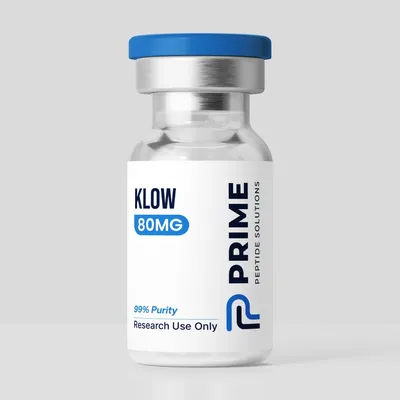
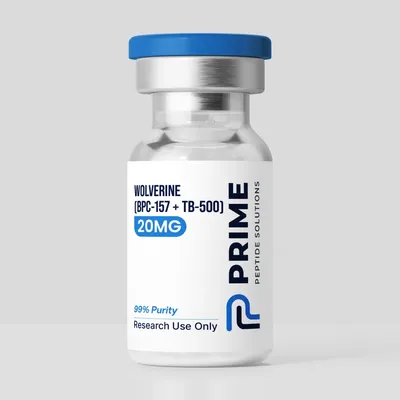
KLOW and Wolverine are two pre-mixed peptide blends in this catalog built on the same core pair, BPC-157 and TB-500. Wolverine (BPC-157 + TB-500) contains only that pair, at a listed total of 20mg. The KLOW blend contains the same pair plus two further compounds, the copper complex GHK-Cu and the tripeptide KPV, at a listed total of 80mg.
The practical difference is pathway scope. Wolverine draws on BPC-157 work on endothelial and fibroblast signaling and on thymosin beta-4, the actin-sequestering parent protein of TB-500. KLOW adds a Cu(II)-binding tripeptide studied for extracellular-matrix and Nrf2 redox signaling, and a fragment of alpha-MSH studied for NF-kB and MAP kinase signaling.
Both products are supplied as lyophilized powder strictly for in-vitro laboratory research. The research-grade material sold here is not approved for human use and is not for human or animal consumption.
| Property | KLOW | Wolverine |
|---|---|---|
| Components | 4: BPC-157, TB-500, GHK-Cu, KPV | 2: BPC-157, TB-500 |
| Shared base | BPC-157 + TB-500 | BPC-157 + TB-500 |
| Added compounds | GHK-Cu (Cu(II) complex) and KPV (alpha-MSH 11-13) | None |
| Listed size | 80mg (total for the blend) | 20mg (total for the blend) |
| Per-component amount | Not listed on the product page; the vial label and batch COA list the composition | Not listed on the product page; the vial label and batch COA list the composition |
| Vial format | One vial, four components pre-mixed | One vial, two components pre-mixed |
| Pathways in the component literature | G-actin sequestration (thymosin beta-4); VEGFR2-Akt-eNOS and FAK-paxillin (BPC-157); Cu(II), extracellular matrix and Nrf2/Keap1 (GHK-Cu); NF-kB and MAPK (KPV) | G-actin sequestration (thymosin beta-4); VEGFR2-Akt-eNOS and FAK-paxillin (BPC-157) |
| Combination studied as a whole | No primary study found; a PubMed search returns 8 records, all published in 2026 and all review or overview articles | One controlled animal comparison (exploratory 2026 rat study) of each peptide alone versus the combination; it reported the combination was not superior to either peptide alone |
| Supplied form in this store | Lyophilized blend, 80mg | Lyophilized powder, 20mg |
About KLOW (BPC-157, TB-500, GHK-Cu, KPV)
KLOW is listed in a single size, 80mg, a total for the whole blend. All four components are pre-mixed in one vial and share one solution; the vial label and batch Certificate of Analysis list the composition, and each batch is third-party tested. Alongside the BPC-157 and TB-500 pair described below, KLOW contains two compounds with separate literatures.
GHK-Cu. GHK is the tripeptide glycyl-L-histidyl-L-lysine (Gly-His-Lys). PubChem lists the free peptide as C14H24N6O4 (340.38 g/mol) and the copper complex as C14H23CuN6O4+ (402.92 g/mol). GHK was discovered in 1973 as an activity in human albumin, is present in human plasma, saliva and urine, and has high affinity for copper ions. X-ray and spectroscopic work describes Cu(II) bound in solution through three nitrogens (the terminal amine, an amidyl nitrogen and the histidine imidazole), with rapid Cu(II) exchange. A 2015 review describes GHK stimulating both synthesis and breakdown of collagen and glycosaminoglycans and modulating metalloproteinases and their inhibitors. In cultured human alveolar epithelial cells under an oxidative challenge, GHK-Cu lowered the lipid-peroxidation marker malondialdehyde and restored glutathione, effects the authors link to Nrf2; the accompanying mouse work reports NF-kB downregulation and Nrf2/Keap1 upregulation. See the GHK-Cu research overview.
KPV. KPV is L-lysyl-L-prolyl-L-valine (Lys-Pro-Val), indexed as alpha-MSH(11-13); PubChem lists C16H30N4O4 and 342.43 g/mol. Alpha-MSH is a tridecapeptide processed from proopiomelanocortin, and a 2007 review reports that alpha-MSH acts on pathways that regulate inflammatory responses, including NF-kB activation and pro-inflammatory cytokine production, and attributes most of these alpha-MSH activities to its C-terminal tripeptide KPV. In cytokine-stimulated human epithelial cell lines and Jurkat T cells, nanomolar KPV inhibited activation of the NF-kB and MAP kinase signaling pathways and reduced pro-inflammatory cytokine secretion; it entered the cells through PepT1, a di/tripeptide transporter. More in the KPV research overview.
What has not been studied. A four-compound PubMed search, (BPC-157 OR BPC 157) AND (GHK OR KPV) AND (thymosin OR TB-500) (re-run 2026-09-28), returned 8 records, all published in 2026 and all review or overview articles; none is a primary cell, animal or chemistry study of the combination. KLOW is more accurately described as four compounds with separately studied pathways, not as a tested combination.
About Wolverine (BPC-157 + TB-500)
Wolverine is listed in a single size, 20mg, a total for the blend. BPC-157 and TB-500 are pre-mixed in one vial and supplied as lyophilized powder; the vial label and batch COA list the composition.
BPC-157. BPC-157 is a 15-residue linear peptide, Gly-Glu-Pro-Pro-Pro-Gly-Lys-Pro-Ala-Asp-Asp-Ala-Gly-Leu-Val (GEPPPGKPADDAGLV); PubChem lists C62H98N16O22 and 1419.5 g/mol. It is described as a partial sequence of body protection compound (BPC), isolated from human gastric juice. In cultured rat fibroblasts it did not directly change proliferation, but it increased transwell migration, cell spreading and F-actin formation, and raised phosphorylation of FAK and paxillin while total protein was unchanged; the authors conclude the effect is likely mediated by the FAK-paxillin pathway. In chick chorioallantoic membrane and endothelial tube-formation assays it increased vessel density. In human vascular endothelial cells it raised VEGFR2 mRNA and protein (but not VEGF-A), promoted VEGFR2 internalization that the endocytosis inhibitor dynasore blocked, and time-dependently activated VEGFR2-Akt-eNOS signaling. See the BPC-157 research overview.
TB-500. TB-500 is commonly described in the literature as a synthetic version of the peptide LKKTETQ with an acetylated N-terminus; residues 17-23 of thymosin beta-4 are described as the protein's actin-binding site. PubChem lists N-acetyl-LKKTETQ as C38H68N10O14 (889.0 g/mol). Thymosin beta-4 itself is a 43-residue mature chain that forms a 1:1 complex with actin monomers (G-actin), and a seven-amino-acid actin-binding motif was essential for its angiogenic activity in endothelial cell migration and chick aortic-arch sprouting assays. Those findings belong to thymosin beta-4 research: a 2024 metabolism study notes that the biological effects of TB-500 "have not been documented," and in rats identified Ac-LK as its primary metabolite.
The pair together. A BPC-157 and TB-500 search on PubMed found one controlled animal study that compares each peptide alone with the combination: an exploratory 2026 rat study with four groups (control, BPC-157, TB-500, combined). It reported that the combination was not superior to either peptide alone; the authors suggest this "may reflect convergence on shared downstream pathways," a hypothesis they say requires further experimental confirmation, and they do not name the pathway. The single peptides are set side by side in the BPC-157 vs TB-500 comparison.
Which Should Researchers Choose?
The choice comes down to how many pathway families a study design needs in one solution:
- Focused two-peptide model: Wolverine fits studies centered on cytoskeletal and endothelial signaling, pairing G-actin sequestration from thymosin beta-4 research with BPC-157's VEGFR2-Akt-eNOS and FAK-paxillin findings in angiogenesis and cell-migration assays.
- Broader four-pathway model: KLOW fits designs that deliberately include the Cu(II)-GHK complex, with its extracellular-matrix and Nrf2/Keap1 redox signaling findings (GHK-Cu), and NF-kB/MAPK cytokine signaling (KPV) alongside that shared pair.
- Copper in the shared solution: KLOW places the Cu(II)-GHK complex in one solution with the other three peptides. No study of this blend has examined copper interactions with its other components, so copper-sensitive assays use Wolverine or copper-matched controls.
- Isolating one component: neither blend separates contributions, since the components share one solution in proportions this page does not list (see the vial label and COA); each of the four is also listed on its own for single-compound reference samples.
- Combination questions: a PubMed search finds one exploratory animal comparison of the BPC-157 + TB-500 pair, which reported the combination was not superior to either peptide alone, and no primary study of the four-compound set, so a KLOW design starts from separately studied pathways.
Frequently Asked Questions
What is the difference between KLOW and Wolverine?
Composition. Both contain BPC-157 and TB-500. KLOW adds GHK-Cu and KPV, for four components and a listed total of 80mg; Wolverine has two components and a listed total of 20mg. Each is supplied as one vial with its components pre-mixed.
Does 80mg versus 20mg mean KLOW holds more of each peptide?
No such conclusion follows. The totals cover different numbers of components, in amounts not listed here (see the vial label and COA), and the components differ widely in molecular weight: BPC-157 is 1419.5 g/mol, GHK-Cu 402.92 g/mol and KPV 342.43 g/mol, roughly a 3.5- to 4.1-fold spread. Milligram totals therefore say nothing about the molar amount of any single component.
Has the four-compound KLOW combination been studied?
Not as a combination. A PubMed search across the four components returned 8 records, all 2026 review or overview articles; none is a primary cell, animal or chemistry study of the blend.
How is each blend reconstituted?
Each blend is reconstituted as one vial on its total mass; the vial label and batch COA list the composition. Bacteriostatic water, a diluent containing a preservative, is sold separately in 3 mL and 10 mL sizes.
Are these approved for human use?
No. KLOW and Wolverine are sold strictly for in-vitro laboratory research. They are not approved for human use, are not for human or animal consumption, and are not medicines. Batch Certificates of Analysis are published on the COA page.
Shop these products
- Ships the same business day
- Free US shipping on $199.99+
- 14-day money-back guarantee on damaged items