
KLOW vs GLOW: Four-Peptide vs Three-Peptide Research Blends
KLOW and GLOW are names for two research peptide blends built on the same three-compound base: the copper complex GHK-Cu, the 15-residue peptide BPC-157, and TB-500, commonly described in the literature as a short synthetic fragment of thymosin beta-4. GLOW is that base on its own. KLOW adds a fourth compound, the tripeptide KPV (Lys-Pro-Val), so KPV is the only component that separates the two names.
This catalog lists KLOW blend but does not sell a GLOW product. This page compares the two compositions, summarizes the published NF-kB and cytokine-signaling literature on KPV, and notes what has and has not been studied.
All peptides in this catalog are supplied as lyophilized powder strictly for in-vitro laboratory research. The research-grade material sold here is not approved for human use and is not for human or animal consumption.
| Property | KLOW | GLOW |
|---|---|---|
| Components | 4: GHK-Cu, BPC-157, TB-500, KPV | 3: GHK-Cu, BPC-157, TB-500 |
| Component that differs | KPV (Lys-Pro-Val, alpha-MSH 11-13) | None |
| Tripeptides in the blend | Two of near-identical size as free peptides: GHK (340.38 g/mol; 402.92 g/mol as the Cu complex) and KPV (342.43 g/mol) | One: GHK (340.38 g/mol as the free peptide; 402.92 g/mol as the Cu complex) |
| Pathways in the component literature | The GLOW set plus KPV's NF-kB reporter, MAP kinase and p65 RelA nuclear-translocation findings (NF-kB is also listed for GHK) | Actin binding at the LKKTETQ segment (TB-500 literature; G-actin sequestration is described for full thymosin beta-4); FAK-paxillin and VEGFR2-Akt-eNOS (BPC-157); Cu(II) binding and NF-kB (GHK) |
| Melanocortin receptors | KPV reported not to bind MC1R in radioligand assays or to raise cAMP | No alpha-MSH fragment present |
| Blend studied as a whole | No primary study found on PubMed (searched September 2026) | No primary study found on PubMed (searched September 2026) |
| In this catalog | KLOW: one pre-mixed vial, 80mg total | Not sold; each component listed on its own |
| Per-component amounts | Composition listed on the vial label and batch COA | No standard split in the literature |
About KLOW (GHK-Cu, BPC-157, TB-500, KPV)
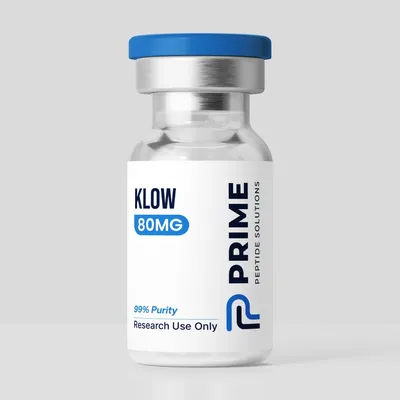
KLOW is one vial with all four compounds pre-mixed, listed in one size: 80mg, the total for the whole blend, not a per-component amount; the vial label and the batch Certificate of Analysis list the composition. The shared components are described under GLOW below; what sets KLOW apart is KPV.
KPV identity. KPV is L-lysyl-L-prolyl-L-valine (Lys-Pro-Val), indexed in PubChem as alpha-MSH(11-13). PubChem lists the free-acid tripeptide as C16H30N4O4 (342.43 g/mol, CAS 67727-97-3). In UniProt, alpha-MSH is the 13-residue peptide SYSMEHFRWGKPV, processed from pro-opiomelanocortin, and KPV is its last three residues. It does not include His-Phe-Arg-Trp (residues 6-9), called "the core melanocortin peptide" in a 2003 study.
The receptor question. In radioligand assays in macrophage-like RAW 264.7 cells, alpha-MSH competed for MC1 receptor binding sites but KPV did not, even at concentrations up to 1 mM, and KPV did not stimulate cAMP. It still inhibited LPS/IFN-gamma-induced NF-kB nuclear translocation (maximal effect between 1 nM and 1 µM). In mouse models of peritoneal leukocyte recruitment, KPV's anti-migratory effect was not blocked by an MC3/MC4 receptor antagonist and was also seen in mice with a nonfunctional MC1 receptor. A 2010 review notes that KPV lacks the motif required for binding any known melanocortin receptor and that its exact signaling mechanism "currently is unknown." One study adds nuance: in hamster ovary cells transfected with the MC1 receptor, alpha-MSH and KPV peptides raised intracellular calcium.
NF-kB and cytokine signaling. In cytokine-stimulated human epithelial cell lines and Jurkat T cells, nanomolar KPV inhibited activation of the NF-kB and MAP kinase pathways and reduced pro-inflammatory cytokine secretion; uptake studies showed transport into the cells by PepT1, a di/tripeptide transporter. In human bronchial epithelial cells, KPV inhibited TNF-alpha-evoked NF-kB reporter signaling and IL-8 secretion, an effect associated with KPV's own nuclear import, stabilization of IkB-alpha and suppressed nuclear translocation of the p65 RelA subunit, with competition assays pointing to the importin-alpha3 binding site on p65. KPV is also listed on its own as KPV; see the KPV research overview.
About GLOW (GHK-Cu, BPC-157, TB-500)
GLOW is not sold in this catalog. By name it is the KLOW base without KPV; no standard component split exists in the literature. Each of its three compounds is listed on its own: GHK-Cu in 50mg and 100mg, BPC-157 in 10mg and TB-500 in 10mg.
GHK-Cu. GHK is glycyl-L-histidyl-L-lysine (Gly-His-Lys). PubChem lists the free peptide as C14H24N6O4 (340.38 g/mol) and the copper complex as C14H23CuN6O4+ (402.92 g/mol). A 2012 review states that GHK "was discovered in 1973 as an activity in human albumin." It is described as a high-affinity Cu(II) chelator found in blood plasma, forming, in solution, a monomeric complex through the terminal amine, an amidyl nitrogen and the histidine imidazole. A 2018 review lists suppression of NF-kB among GHK's reported actions.
BPC-157. BPC-157 is a synthetic 15-residue linear peptide, Gly-Glu-Pro-Pro-Pro-Gly-Lys-Pro-Ala-Asp-Asp-Ala-Gly-Leu-Val; PubChem lists C62H98N16O22 (1419.5 g/mol). The name refers to a partial sequence of body protection compound from human gastric juice. In cultured rat fibroblasts it did not directly change proliferation, but it increased transwell migration, spreading and F-actin formation, with rising FAK and paxillin phosphorylation and unchanged total protein, which the authors attribute to the FAK-paxillin pathway. In human vascular endothelial cells it increased VEGFR2 mRNA and protein (but not VEGF-A) and time-dependently activated VEGFR2-Akt-eNOS signaling.
TB-500. TB-500 is commonly described in the literature as a short synthetic fragment of thymosin beta-4, not the full protein: N-acetyl LKKTETQ, the segment (residues 17-23) described as the protein's actin-binding site. PubChem lists that heptapeptide as C38H68N10O14 (889.0 g/mol); this catalog's TB-500 listing is that acetylated seven-residue fragment (Ac-LKKTETQ). UniProt describes the 43-residue thymosin beta-4 chain as sequestering actin monomers (G-actin), which inhibits actin polymerization; that description applies to the full protein, not to a product called TB-500.
Which Should Researchers Choose?
Because GLOW is not sold here, the practical question is whether a design needs KPV in the same solution as the three shared compounds:
- Shared base only: no three-compound blend is listed here. GHK-Cu, BPC-157 and TB-500 are each listed as single compounds, with the amount per vial stated, and serve as the source for single-compound reference conditions.
- NF-kB and cytokine-signaling readouts: KLOW is the listed blend that combines KPV with the three shared compounds (KPV is also sold on its own), and KPV's literature covers NF-kB reporter activity, p65 RelA nuclear translocation, MAP kinase activation and cytokine secretion in cell models.
- Attributing an NF-kB readout: KPV is not the only component linked to NF-kB, since a review lists NF-kB suppression among GHK's reported actions. Separating the two needs KPV-alone and GHK-Cu-alone control conditions, which a fixed blend cannot provide; the KPV vs BPC-157 comparison covers KPV as a single compound.
- Solution stability: KLOW is one pre-mixed vial, so once it is in solution its four components share one pH and one diluent volume, and GHK-Cu's copper complex sits in the same solution as the other three. General peptide-handling guidance lists residues linked to a shorter solution shelf life: BPC-157 (two Asp) and the N-acetyl LKKTETQ heptapeptide that the literature describes as TB-500 (C-terminal Gln) contain them, while GHK and KPV do not.
Frequently Asked Questions
What is the difference between KLOW and GLOW?
One compound. Both contain GHK-Cu, BPC-157 and TB-500; KLOW adds KPV. KPV and GHK are tripeptides of almost the same size as free peptides (342.43 and 340.38 g/mol), but their sequences differ: GHK's histidine supplies one of the nitrogens in its Cu(II) complex, and KPV contains no histidine.
Does this store sell GLOW?
No. This catalog has no GLOW product. Its three compounds are each listed as single compounds, and KLOW contains all three plus KPV.
Does KPV activate melanocortin receptors?
KPV is reported not to bind MC1R in radioligand assays or to raise cAMP, and is described as acting largely independently of melanocortin receptors. That is not absolute: one study saw calcium responses in MC1R-transfected cells.
Has either blend been studied as a combination?
As of September 2026, no primary study of either full combination was found on PubMed; searches for GHK, BPC-157 and KPV, or for GHK-Cu and KPV, returned none. Searches combining GHK, BPC-157 and TB-500 returned only general narrative and scoping reviews of peptides, not primary studies of a fixed blend. What is known comes from studies of the individual molecules.
How is KLOW listed and stored?
As one product, a single pre-mixed vial with an 80mg blend total; the vial label and batch COA list the composition. Bacteriostatic water (0.9% benzyl alcohol in sterile water) is sold separately in 3 mL and 10 mL. General guidance is to store lyophilized peptides at -20 °C away from bright light and to aliquot solutions rather than freeze and thaw them repeatedly.
Is KLOW approved for human use?
No. KLOW and its components are sold strictly for in-vitro laboratory research; they are not approved for human use, are not for human or animal consumption, and are not medicines. KLOW's batch Certificate of Analysis is published on the COA page.
Shop these products
- Ships the same business day
- Free US shipping on $199.99+
- 14-day money-back guarantee on damaged items