
MOTS-C vs NAD+: Mitochondrial Signaling Peptide vs Redox Coenzyme
MOTS-c and NAD+ both come up in mitochondrial research, but they are different kinds of molecule. MOTS-c is a 16-amino-acid peptide encoded by a short open reading frame in the mitochondrial 12S rRNA gene, first reported in 2015. NAD+ (nicotinamide adenine dinucleotide, oxidized form) is a small-molecule coenzyme, not a peptide, first described in yeast fermentation extracts in 1906.
In cell models, MOTS-c is studied as a signaling molecule that is linked to the folate-AICAR-AMPK pathway and that moves into the nucleus under metabolic stress. NAD+ is studied as the major hydride acceptor in redox reactions and as a substrate consumed by sirtuins, PARPs and CD38. This page compares the two catalog items, MOTS-C and NAD+, on structure, pathways studied in cell and animal models, and handling.
Both are sold strictly for in-vitro laboratory research. The research-grade material sold here is not approved for human use and is not for human or animal consumption.
| Property | MOTS-c | NAD+ |
|---|---|---|
| Compound class | Mitochondrial-derived peptide (MDP) | Dinucleotide coenzyme; not a peptide |
| Structure | 16 residues, MRWQEMGYIF YPRKLR; free N- and C-termini; no Cys | Nicotinamide and adenine nucleotides joined by a pyrophosphate linkage |
| Formula and mass | C101H152N28O22S2; 2174.6 g/mol | C21H27N7O14P2; 663.4 g/mol |
| Origin | sORF in the mitochondrial 12S rRNA gene (MT-RNR1), translated in the cytoplasm | Made from tryptophan, nicotinic acid, or recycled from nicotinamide (NAMPT salvage) |
| First described | 2015 | 1906 |
| Core pathway studied | Folate-AICAR-AMPK; stress-induced nuclear entry and NRF2/ARE genes | Hydride acceptor in redox reactions; substrate for sirtuins, PARPs and CD38 |
| Location | Predominantly extra-nuclear at rest; transient nuclear entry under stress (cell models) | Separate cytoplasmic, mitochondrial and nuclear pools |
| Handling notes | Met and Trp prone to oxidation; Gln, Met and Trp limit shelf life | Highly hygroscopic solid; base-catalyzed degradation at high pH in solution |
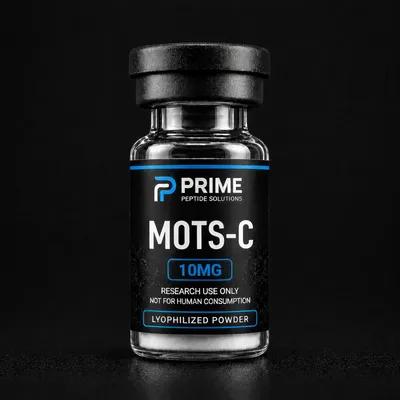
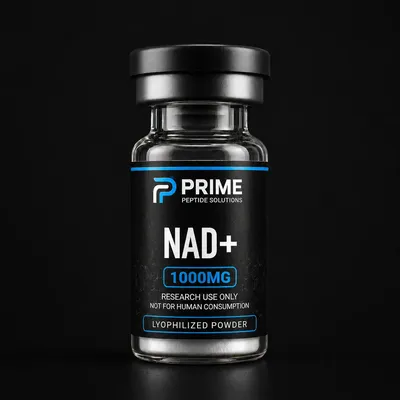
| Listed sizes | 10mg, 20mg, 40mg | 1000mg |
| Nominal molar amount per vial | About 4.6, 9.2 or 18.4 micromol | About 1,507 micromol (1.51 mmol) |
About MOTS-c (a mitochondrial-derived peptide)
Identity. The name stands for mitochondrial open-reading-frame of the twelve S rRNA type-c. The peptide, MRWQEMGYIF YPRKLR, has a free N-terminal amine and a free C-terminal acid (not amidated). PubChem gives C101H152N28O22S2 and 2174.6 g/mol with a computed XLogP of -3.9, so it is hydrophilic. It has no cysteine, so no disulfide bond, but carries two Met, one Trp and one Gln. It belongs to the mitochondrial-derived peptides: a 2020 review counted eight, with MOTS-c in the 12S rRNA gene and humanin and SHLP1-6 in the 16S rRNA gene.
Origin. The 2015 discovery paper found a 51-base-pair sORF in human 12S rRNA. Because the mitochondrial genetic code would give tandem start and stop codons, translation obligatorily occurs in the cytoplasm using the standard code. UniProt lists the peptide as secreted, mitochondrial and nuclear, and notes that how it is produced and secreted remains unclear.
Folate-AICAR-AMPK. In HEK293 cells stably overexpressing MOTS-c, 5-methyl-tetrahydrofolate and methionine fell and homocysteine rose, so the folate-methionine pathway was inhibited. De novo purine synthesis was blocked and endogenous AICAR accumulated to more than 20-fold the control level, a measurement in overexpressing cultured cells. AICAR is a known AMPK activator, and adding MOTS-c to HEK293 cells led to AMPK-alpha phosphorylation at Thr172.
Nuclear translocation. In a 2018 study, glucose restriction, serum deprivation or oxidative stress sent MOTS-c into the nucleus of HEK293 cells as early as 30 minutes, and it had largely left again by 24 hours; HepG2 cells behaved similarly. Entry was AMPK-dependent: compound C or siRNA against AMPK-alpha blocked it, and AICAR alone drove it. MOTS-c has no known nuclear localization sequence; swapping 8-YIFY-11 for alanines prevented entry, while swapping 13-RKLR-16 did not. Three hours after stress, NRF2 co-immunoprecipitated with nuclear MOTS-c and MOTS-c binding to ARE-containing promoter regions of HO-1 and NQO1 rose, returning to baseline by 24 hours. See a MOTS-c PubMed search.
About NAD+ (a redox coenzyme)
Identity. PubChem files NAD+ as "Nadide" (synonyms beta-NAD, coenzyme I, DPN): C21H27N7O14P2, 663.4 g/mol, CAS 53-84-9, computed XLogP -6. It is ribosylnicotinamide 5'-diphosphate coupled to adenosine 5'-phosphate by a pyrophosphate linkage, with no amino acids or peptide bonds, and PubChem describes it as a highly hygroscopic white solid. Harden and Young reported it in cell-free yeast fermentations in 1906.
Redox role. NAD+ is the major hydride acceptor in redox reactions. Accepting a hydride at position 4 of the nicotinamide ring forms NADH, and this regulates dehydrogenases in glycolysis, glutaminolysis and fatty acid oxidation; the electrons then pass to the electron transport chain to form ATP. NAD+ can also be phosphorylated to NADP+, whose reduced form NADPH supplies reducing power for biosynthetic pathways.
Consumed as a substrate. Sirtuins (SIRT1-SIRT7) cleave NAD+ to nicotinamide and ADP-ribose, PARP1-PARP3 use it to ADP-ribosylate proteins, and CD38 hydrolyzes it and, as an ADP-ribosyl cyclase, forms cyclic ADP-ribose. PARP1 has a lower Km and higher Vmax for NAD+ than SIRT1, so it likely outcompetes SIRT1 for the shared nuclear pool.
Pools and turnover. Cytoplasmic, mitochondrial and nuclear pools are regulated independently. NAD+ is made de novo from tryptophan (kynurenine pathway, mainly liver); it is also made from nicotinic acid (Preiss-Handler pathway) or recycled from nicotinamide (salvage pathway, in which NAMPT is rate-limiting). An isotope-tracer study in mice reported that turnover of the cell's own NAD pool differs widely between tissues. See a NAD+ PubMed search.
Which Should Researchers Choose?
One is a signaling peptide studied in cell models for its effects on the folate-AICAR-AMPK pathway; the other is a coenzyme that dehydrogenases use as a hydride acceptor and that sirtuins, PARPs and CD38 consume. The choice follows the laboratory question:
- AMPK and folate-purine metabolism: MOTS-c fits cell studies of the folate-AICAR-AMPK route, AICAR accumulation and AMPK-alpha Thr172 phosphorylation.
- Stress-induced nuclear signaling: its transient nuclear entry, AMPK dependence, YIFY core and NRF2/ARE association were studied in HEK293 cells, with the stress-induced nuclear entry also seen in HepG2 cells.
- Redox and dehydrogenase assays: NAD+ is itself a hydride acceptor. NAD+ absorbs at 260 nm but not 340 nm, while NADH absorbs at both, so the two forms can be told apart.
- NAD+-consuming enzymes: sirtuin, PARP and CD38 work uses NAD+ as the substrate, including PARP1-SIRT1 competition for the nuclear pool.
- Other pairing: SS-31 vs MOTS-c compares MOTS-c with a different partner.
They are compared here as separate reagents for separate experimental questions.
Frequently Asked Questions
Is NAD+ a peptide?
No. NAD+ is a dinucleotide of adenine and nicotinamide with no amino acids or peptide bonds; the catalog lists it as a coenzyme. MOTS-c is a 16-residue peptide.
Does MOTS-c interact with NAD+?
The 2015 discovery paper reports no direct interaction between the two, and MOTS-c contains no NAD+. In that paper, a metabolomics panel of genetically engineered HEK293 cells overexpressing MOTS-c listed NAD+ among the purine-synthesis precursor metabolites that changed. The authors then tested the NAD+-dependent deacetylase SIRT1 and concluded it is partially necessary for some MOTS-c actions on glycolysis in those cells; SIRT1 protein levels were unchanged. These are observations in one engineered cell line, not evidence that either compound acts on the other.
How do the vial contents compare by amount?
On a nominal molar basis (labeled mass divided by the PubChem molecular weight), a 10, 20 or 40 mg MOTS-C vial corresponds to about 4.6, 9.2 or 18.4 micromol, while the 1000 mg NAD+ vial corresponds to about 1.51 mmol.
How do the storage concerns differ?
Peptides containing Met or Trp need care to avoid oxidation, and those with Gln, Met or Trp have limited shelf lives. Lyophilized peptide is stored in a tightly closed container below -15 °C, or at 4 °C short-term (see the peptide storage guide), and the container should reach room temperature in a desiccator before opening. NAD+ is highly hygroscopic, and in solution it undergoes base-catalyzed degradation at high pH, with stability differing between the aqueous buffers tested. For both, keep solutions at 2-8 °C, protected from light and not repeatedly frozen and thawed; long-term solution storage is not recommended (see reconstituted-peptide stability), and no fixed shelf life is given here.
Are these approved for human use?
No. Both are sold strictly for in-vitro laboratory research, are not approved for human use and are not for human or animal consumption. Batch COAs for MOTS-C are published on the COA page. For NAD+, batch Certificates of Analysis are published on the COA page as they become available; check it for a report matching the product and batch (see how to read a COA).
Shop these products
- Ships the same business day
- Free US shipping on $199+
- 14-day money-back guarantee