
Semaglutide vs Tirzepatide
Semaglutide and tirzepatide are two of the most widely studied long-acting incretin receptor agonists in metabolic research, and they often appear together in the same experimental design. Semaglutide is a selective GLP-1 receptor agonist built on the human GLP-1 sequence. Tirzepatide is built on the GIP sequence and acts at both the GIP receptor and the GLP-1 receptor. Comparing them is, at its core, a comparison of single versus dual incretin receptor engagement.
The two molecules share design features that extend their pharmacokinetic half-life, namely Aib substitutions that resist DPP-4 cleavage and a fatty diacid moiety that binds serum albumin. They differ in sequence origin, length, fatty-acid chain (C18 versus C20), receptor profile and signaling bias at the GLP-1 receptor. This page sets out those differences using published molecular and pharmacological data. For a longer discussion of GLP-1 and GIP/GLP-1 receptor agonists, see the full research comparison.
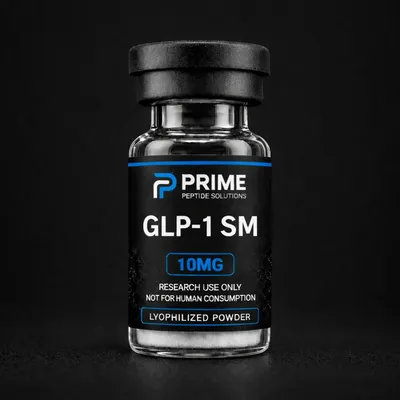
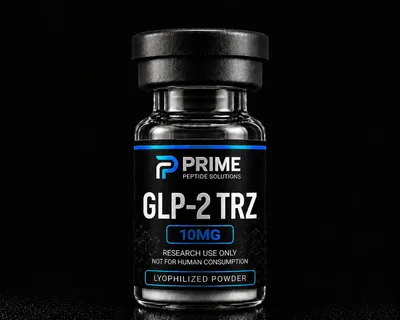
In this catalog semaglutide is listed as GLP-1 SM (semaglutide) and tirzepatide as GLP-2 TZ (tirzepatide). Both are lyophilized research peptides supplied strictly for in-vitro laboratory use and are not for human or animal consumption.
| Property | Semaglutide | Tirzepatide |
|---|---|---|
| Receptor targets | GLP-1 receptor only | GIP receptor and GLP-1 receptor |
| Class | Selective GLP-1 receptor mono-agonist | Dual GIP/GLP-1 receptor agonist, described as "imbalanced" |
| Peptide basis | Human GLP-1(7-37), about 94% sequence identity; Aib at position 8; Lys34Arg substitution | GIP sequence; Aib at positions 2 and 13; C-terminal amide |
| Length | Same length as native GLP-1(7-37) | 39 amino acids, linear |
| Fatty-acid moiety | C18 fatty diacid on Lys26 through a gamma-glutamic acid / OEG linker (albumin binding) | C20 fatty diacid through a linker (albumin binding) |
| Molecular formula | C187H291N45O59 | C225H348N48O68 |
| Molecular weight | About 4113.6 Da | About 4813.5 Da |
| Half-life (pharmacokinetic property) | About 7 days (roughly 165 hours) | About 5 days |
| Supplied form in this store | GLP-1 SM: lyophilized powder, 10mg vial | GLP-2 TZ: lyophilized powder, 10mg and 20mg vials |
About Semaglutide
Semaglutide is a GLP-1 receptor agonist whose peptide backbone is based on human GLP-1(7-37), with about 94% sequence identity to the native hormone. Three modifications define it. An Aib (alpha-aminoisobutyric acid) substitution at position 8 protects the N-terminus from DPP-4 cleavage. A Lys34Arg substitution leaves Lys26 as the only lysine, and Lys26 carries a C18 fatty diacid through a gamma-glutamic acid / OEG linker that binds serum albumin.
Together, DPP-4 resistance and albumin binding give semaglutide an elimination half-life of about 7 days (roughly 165 hours) in published pharmacokinetic data, longer than that of tirzepatide. Its molecular formula is C187H291N45O59, with a molecular weight of about 4113.6 Da. Because it acts at a single receptor, semaglutide is widely used as a GLP-1 receptor reference compound. In cell and animal models it has been used to study glucose-dependent insulin secretion, gastric emptying and appetite-related signaling pathways attributable to GLP-1 receptor activation alone.
Semaglutide has been studied extensively in published literature, including clinical research, which a PubMed search for semaglutide will surface. For more depth, read the semaglutide research overview; 10mg vial preparation is covered in the semaglutide reconstitution guide.
About Tirzepatide
Tirzepatide is a 39-amino-acid linear peptide built on the GIP sequence rather than the GLP-1 sequence, and engineered to activate both the GIP receptor and the GLP-1 receptor. It carries Aib at positions 2 and 13, the first of which confers DPP-4 resistance, along with an amidated C-terminus and a C20 fatty diacid moiety attached through a linker for albumin binding. Its molecular formula is C225H348N48O68 (about 4813.5 Da), and its reported half-life is about 5 days.
Tirzepatide is described as an "imbalanced" agonist: its GIP receptor affinity is comparable to native GIP, while its GLP-1 receptor affinity is weaker than native GLP-1. At the GLP-1 receptor it favors cAMP signaling over beta-arrestin recruitment, a biased agonism profile that is often examined alongside GLP-1 receptor mono-agonists in signaling assays. In cell and animal models it has been used to study incretin signaling, glucose-dependent insulin secretion and the interplay between GIP and GLP-1 receptor pathways.
Tirzepatide has been studied extensively in published literature, including clinical research; see a PubMed search for tirzepatide. The tirzepatide research overview covers its pharmacology in more depth, and the tirzepatide reconstitution guide covers 10mg and 20mg vial preparation.
Which Should Researchers Choose?
- GLP-1 receptor mechanism in isolation: semaglutide acts at one receptor, so observed effects can be attributed to GLP-1 receptor activation without a GIP receptor component.
- GIP and GLP-1 receptor interplay: tirzepatide is the relevant compound when the hypothesis concerns how the two incretin receptors combine.
- Single versus dual agonism: running both side by side, with semaglutide as the mono-agonist reference, is a common way to isolate the contribution of GIP receptor activity.
- GLP-1 receptor signaling bias: cAMP accumulation and beta-arrestin recruitment assays can contrast tirzepatide's cAMP-favoring profile with a mono-agonist reference.
- Albumin binding and half-life: the C18 and C20 fatty diacid designs make the pair useful for structural and pharmacokinetic comparisons of lipidated peptides.
To bring in the triple agonist, see tirzepatide vs retatrutide and semaglutide vs retatrutide, or see all three receptor profiles in the three-way comparison.
Frequently Asked Questions
What is the main difference between semaglutide and tirzepatide?
Receptor profile. Semaglutide is a selective GLP-1 receptor agonist built on the GLP-1 sequence. Tirzepatide is a dual GIP and GLP-1 receptor agonist built on the GIP sequence. That difference in receptor coverage is the key pharmacological distinction in the research literature.
Why is tirzepatide called an "imbalanced" agonist?
Because its activity is not equal at its two targets. Its GIP receptor affinity is comparable to native GIP, while its GLP-1 receptor affinity is weaker than native GLP-1. At the GLP-1 receptor it also favors cAMP signaling over beta-arrestin recruitment, which is described as biased agonism.
Which has the longer half-life?
Semaglutide. Published pharmacokinetic data give semaglutide an elimination half-life of about 7 days (roughly 165 hours) and tirzepatide about 5 days. In both molecules the extended half-life comes mainly from albumin binding by the fatty diacid moiety (C18 in semaglutide, C20 in tirzepatide), together with resistance to DPP-4 cleavage.
How are the lyophilized vials stored and reconstituted?
Both compounds are handled the same way. Lyophilized vials are stored cold at 2-8 °C, or at -20 °C for long-term storage, and protected from light. They are reconstituted with bacteriostatic water (0.9% benzyl alcohol in sterile water). The reconstituted solution is kept refrigerated at 2-8 °C, is not shaken, and is not frozen and thawed repeatedly. The reconstitution guides linked above cover each vial size.
Are these approved for human use?
No. The research-grade semaglutide and tirzepatide sold here are not approved for human use and are not for human or animal consumption. They are supplied strictly for in-vitro laboratory research, they are not medicines, and they are not equivalent to any approved pharmaceutical product.
How are these listed in the catalog?
Semaglutide is listed as GLP-1 SM in a 10mg vial, and tirzepatide as GLP-2 TZ in 10mg and 20mg vials. Bacteriostatic water is sold separately in 3 mL and 10 mL vials. Every batch is verified by HPLC and mass spectrometry, and its Certificate of Analysis is published on the COA page.
Shop these products
- Ships the same business day
- Free US shipping on $199+
- 14-day money-back guarantee