GHK-Cu vs KPV: Copper-Binding Tripeptide vs Alpha-MSH Fragment
GHK-Cu and KPV are both tripeptides, but they come from unrelated sources. GHK is glycyl-L-histidyl-L-lysine (Gly-His-Lys), studied as its copper(II) complex. KPV is L-lysyl-L-prolyl-L-valine (Lys-Pro-Val), the C-terminal tripeptide of alpha-MSH. As free peptides they are almost the same size (340.38 and 342.43 g/mol by PubChem); the bound copper is what makes GHK-Cu heavier.
GHK and its copper complex are studied for copper coordination chemistry, extracellular-matrix signaling and (as GHK) fibroblast gene expression. KPV is studied for NF-kB, MAP kinase and cytokine signaling in cell and animal models, and appears to act largely independently of melanocortin receptors. Their clearest shared ground is NF-kB data in the same macrophage cell line (RAW 264.7), where they were tested in different forms: GHK as its copper complex, KPV as a metal-free peptide.
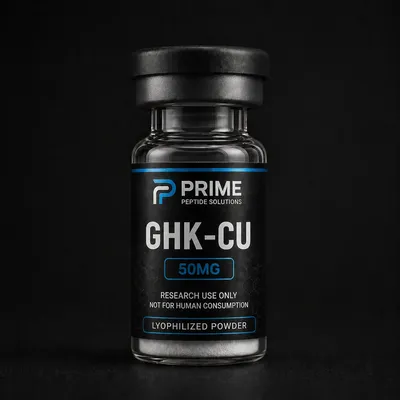
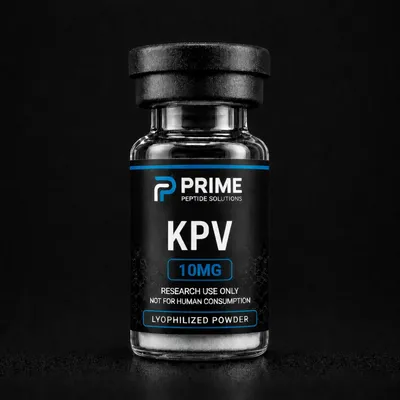
In this catalog the compounds are listed as GHK-Cu and KPV. Both are supplied as lyophilized powder strictly for in-vitro laboratory research. The research-grade material sold here is not approved for human use and is not for human or animal consumption.
| Property | GHK-Cu | KPV |
|---|---|---|
| Sequence | Gly-His-Lys (glycyl-L-histidyl-L-lysine) bound to Cu(II) | Lys-Pro-Val (L-lysyl-L-prolyl-L-valine) |
| Origin | Discovered in 1973 as an activity in human albumin; found in plasma, saliva and urine | C-terminal tripeptide (residues 11-13) of alpha-MSH, which is itself processed from the POMC precursor |
| Molecular formula (PubChem) | Peptide C14H24N6O4; 1:1 copper complex C14H23CuN6O4+ | C16H30N4O4 |
| Molecular weight | 340.38 g/mol free peptide; about 403 g/mol for the 1:1 copper complex (salt forms differ) | 342.43 g/mol (PubChem free-acid record) |
| Metal center | Cu(II) via the terminal amine, an amidyl nitrogen and the histidine imidazole | None (a metal-free peptide) |
| Main pathways studied | Matrix synthesis and turnover (GHK, 2015 review); TGF-beta-like gene-expression patterns and integrin beta-1 expression (reported as GHK, cultured fibroblasts); NF-kB p65 and p38 MAPK (GHK-Cu, macrophages) | NF-kB and MAP kinase signaling; pro-inflammatory cytokine secretion |
| Melanocortin receptors | Not a POMC or alpha-MSH fragment | No cAMP rise; appears to act largely independently of them |
| Solution appearance | Blue (Cu(II) d-d band near 600 nm) | Expected to be colorless (no visible chromophore) |
| Supplied form in this store | Lyophilized powder, 50mg and 100mg vials | Lyophilized powder, 10mg vial |
About GHK-Cu
GHK is the tripeptide glycyl-L-histidyl-L-lysine. A 2012 review states that it was discovered in 1973 as an activity in human albumin and that it has high affinity for copper ions, easily forming the complex GHK-Cu. It is present in human plasma, saliva and urine, and a 2015 review proposes that it functions as a complex with copper 2+. PubChem lists the free peptide as C14H24N6O4 (340.38 g/mol) and the 1:1 copper complex as C14H23CuN6O4+, about 403 g/mol (a computed value; salt forms differ between preparations).
Copper coordination. X-ray, EPR, X-ray absorption and NMR work (Hureau et al., 2011) describes GHK as a high-affinity Cu(II) chelator. In solution, Cu(II)-GHK is a monomer bound through three nitrogens: the terminal amine, a deprotonated backbone amide nitrogen and the histidine imidazole. Cu(II) exchanges quickly between GHK molecules, and the complex is inert under moderate redox potentials but can be reduced to Cu(I), releasing the copper ion. Speciation depends on pH: potentiometric work found several Cu(II)-GHK species across pH 3.5-10.6, and the lysine side-chain amine takes part in copper binding only at alkaline pH.
Pathways studied. A 2015 review describes GHK stimulating both synthesis and breakdown of collagen and glycosaminoglycans and modulating metalloproteinases and their inhibitors. In cultured human lung fibroblasts, GHK at 10 nM recapitulated TGF-beta-induced gene-expression patterns, led to organization of the actin cytoskeleton and raised integrin beta-1 expression (Campbell et al., 2012). In LPS-stimulated RAW 264.7 macrophages, GHK-Cu lowered reactive oxygen species production, and lowered TNF-alpha and IL-6 production through suppression of NF-kB p65 and p38 MAPK signaling (Park et al., 2016). In a rat pharmacokinetic study, GHK was rapidly degraded to the dipeptide His-Lys.
Read the GHK-Cu research overview or run a PubMed search for GHK-Cu.
About KPV
KPV is L-lysyl-L-prolyl-L-valine (Lys-Pro-Val). It is the last three residues of alpha-melanocyte-stimulating hormone (alpha-MSH), a 13-residue peptide (SYSMEHFRWGKPV) processed from the pro-opiomelanocortin (POMC) precursor. PubChem records KPV as the free acid, C16H30N4O4 (342.43 g/mol), while native alpha-MSH ends in a valine amide. An early mouse-model report (Hiltz and Lipton, 1989) described effects of the tripeptide on inflammatory responses, and a 2007 review attributes most of alpha-MSH's anti-inflammatory activities to this C-terminal tripeptide.
Pathways studied. In human epithelial cell lines (Caco2-BBE and HT29-Cl.19A) and Jurkat T cells stimulated with pro-inflammatory cytokines, nanomolar KPV inhibited activation of the NF-kB and MAP kinase pathways and reduced pro-inflammatory cytokine secretion (Dalmasso et al., 2008). In these cell lines KPV was taken up through PepT1, a di- and tripeptide transporter. In LPS/IFN-gamma-stimulated RAW 264.7 macrophages, alpha-MSH(11-13) inhibited nitric oxide production and NF-kB nuclear translocation (Mandrika et al., 2001).
Melanocortin receptors. Alpha-MSH is a ligand for the MC1, MC3, MC4 and MC5 receptors, but KPV lacks the His-Phe-Arg-Trp core melanocortin sequence (alpha-MSH residues 6-9). In those macrophages it did not compete for MC1 receptor binding sites even at 1 mM and did not raise cAMP (Mandrika et al., 2001), and in mice its effect on leukocyte accumulation was not blocked by an MC3/MC4 receptor antagonist (Getting et al., 2003). The question is not fully settled, since one review reports MC1 receptor binding. The published picture is that KPV does not produce the cAMP signal typical of melanocortin-receptor activation.
For the primary literature, run a PubMed search for KPV.
Which Should Researchers Choose?
The two tripeptides answer different laboratory questions, so the choice follows the hypothesis:
- Copper coordination and redox chemistry: GHK-Cu, whose Cu(II) binding, pH-dependent speciation and reduction to Cu(I) are well characterized for spectroscopic and copper-competition studies.
- Extracellular-matrix and fibroblast gene expression: GHK-Cu, noting that the fibroblast TGF-beta-like and integrin gene-expression data were reported for GHK without a stated copper complex, and that the matrix synthesis and turnover statements come from a review of GHK.
- NF-kB, MAP kinase and cytokine signaling: KPV, a metal-free tripeptide reported to inhibit NF-kB and MAP kinase activation in three cytokine-stimulated cell lines (Dalmasso et al., 2008).
- Melanocortin-receptor versus cAMP-independent signaling: KPV, run alongside full-length alpha-MSH, for designs that separate MC1 receptor/cAMP signaling from cAMP-independent inhibition of NF-kB translocation.
- Peptide transporter uptake: KPV, whose PepT1-mediated entry has been characterized in epithelial and T-cell lines.
- A shared macrophage readout: both have NF-kB data in RAW 264.7 cells, which allows a side-by-side design, provided copper is accounted for separately: GHK-Cu brings Cu(II) into the medium and KPV does not.
For each tripeptide against a longer peptide, see GHK-Cu vs BPC-157 and KPV vs BPC-157.
Frequently Asked Questions
Are GHK-Cu and KPV related peptides?
No. Both are tripeptides with one lysine (C-terminal in GHK, N-terminal in KPV), but they come from different sources. KPV is a fragment of alpha-MSH, while the Gly-His-Lys sequence does not occur anywhere in the POMC precursor, so GHK is not an alpha-MSH fragment.
Why is a GHK-Cu solution blue while KPV is expected to be colorless?
The color comes from the copper center. Cu(II)-GHK has a visible d-d absorption band near 600 nm, in the orange part of the spectrum, so the solution appears blue. KPV has no visible chromophore, so its solution is expected to be colorless. Color intensity changes with the medium even when the complex is intact, so color is only a rough sign that Cu(II) is bound, not a test of identity or purity.
Does pH matter when working with GHK-Cu?
For the copper complex, yes. pH controls peptide deprotonation and which donor atoms are available. A 2026 review notes that phosphate, citrate, chelators, amino-acid buffers and proteins compete with GHK for copper, and that reducing agents shift the Cu(II)/Cu(I) balance, so when checking a buffer or culture medium, copper-binding and redox readouts say more than appearance or peptide recovery alone. KPV carries no metal.
How do the vial sizes compare?
GHK-Cu is listed in 50mg and 100mg vials and KPV in a 10mg vial, each as lyophilized powder in a sealed vial, with bacteriostatic water sold separately (3 mL and 10 mL vials). Nominally, using PubChem's 402.92 g/mol for the 1:1 copper complex and 342.43 g/mol for KPV, 50 mg of GHK-Cu is about 124 micromol and 10 mg of KPV about 29.2 micromol; salt forms change the real molar content.
Are these approved for human use?
No. The research-grade GHK-Cu and KPV sold here are not approved for human use and are not for human or animal consumption, and they are not equivalent to any approved medicine. A GHK-Cu batch Certificate of Analysis (HPLC purity with mass-spec confirmation) is published on the COA page. For KPV, batch Certificates of Analysis are published on the COA page as they become available; check it for a report matching the product and batch. For what each section of a report shows, see how to read a COA.
Shop these products
- Ships the same business day
- Free US shipping on $199+
- 14-day money-back guarantee