NAD+ vs NMN (and NR): The Coenzyme and Its Salvage-Pathway Precursors
NAD+ and NMN are often searched together but sit at different points of the same pathway. NAD+ (nicotinamide adenine dinucleotide, oxidized form) is the coenzyme itself: a dinucleotide that carries electrons in redox reactions, alternating between NAD+ and NADH, and donates ADP-ribose moieties. NMN (nicotinamide mononucleotide) is its immediate precursor in the salvage pathway, and NR (nicotinamide riboside) sits one reaction earlier. None of the three is a peptide.
Structurally they form a ladder: NR carries no phosphate, NMN carries one, and NAD+ carries two, joined as a pyrophosphate bridge to an adenosine half. This page compares their structure, interconverting enzymes, cell-surface handling in human and mouse cell models, and behavior in solution. Of the three, the catalog lists only NAD+; NMN and NR are discussed as pathway intermediates and are not sold here.
The research-grade NAD+ sold here is for in-vitro laboratory research only. It is not approved for human use and is not for human or animal consumption.
| Property | NAD+ | NMN (and NR) |
|---|---|---|
| Compound class | Dinucleotide coenzyme (oxidized form); not a peptide | NMN: mononucleotide. NR: nucleoside. Salvage-pathway precursors; not peptides |
| Formula and mass | C21H27N7O14P2; 663.4 g/mol | NMN: C11H15N2O8P, 334.22 g/mol. NR cation: C11H15N2O5+, 255.25 g/mol (chloride salt 290.70 g/mol) |
| Phosphate groups | Two, forming the pyrophosphate bridge between the NMN half and the AMP half | NMN: one (5'-phosphate). NR: none |
| Computed XLogP | -6 | NMN: -3.5. NR: -1.8 |
| Made by | NMNAT1-3: NMN + ATP to NAD+ + diphosphate | NMN: NAMPT (from nicotinamide + PRPP) or NRK1/NRK2 (from NR + ATP) |
| At the cell surface (cell models) | Hydrolyzed by CD38; CD73 can convert it toward NR | NMN: CD73 removes the phosphate (gives NR); CD38 gives nicotinamide. NR can enter via ENT1, ENT2 and ENT4 (HEK293 overexpression) |
| Inside the cell | Nuclear, Golgi and mitochondrial synthesis; SLC25A51 imports intact NAD+ into mitochondria | NMN: substrate of NMNAT1-3. NR: phosphorylated to NMN by NRK1/NRK2 |
| Solution stability | Base-catalyzed degradation at high pH; buffer-dependent | NMN: faster breakdown at high temperature or strong acid/alkali. NR: base-catalyzed hydrolysis to nicotinamide |
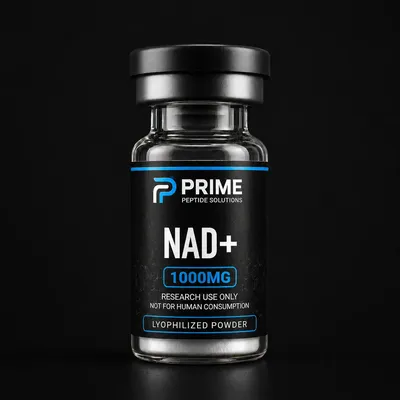
| In this catalog | 1000mg vial | Not sold; discussed as pathway intermediates |
About NAD+ (the coenzyme)
Identity. PubChem files NAD+ under CID 5892 (synonyms beta-NAD, coenzyme I and diphosphopyridine nucleotide, abbreviated DPN): C21H27N7O14P2, 663.4 g/mol, CAS 53-84-9, computed XLogP -6, described as a highly hygroscopic white solid. It is ribosylnicotinamide 5'-diphosphate coupled to adenosine 5'-phosphate by a pyrophosphate linkage; in other words, an NMN half joined to an AMP half. The formulas agree: NMN (334.22) plus AMP (347.22) minus water (18.02) gives 663.42 g/mol, about twice NMN's mass and 2.6 times the NR cation's.
The final reaction. NMNAT joins NMN to the AMP half of ATP, forming NAD+ and diphosphate. NMNAT1 also catalyzes the reverse, pyrophosphorolytic cleavage of NAD+; Kornberg described the reversible enzymatic synthesis of DPN with inorganic pyrophosphate in 1948. A 2005 study placed the three isoforms in separate compartments (NMNAT1 nuclear, NMNAT2 at the Golgi, NMNAT3 mitochondrial) and argued against a single general cellular NAD pool.
Mitochondrial supply. A 2011 study in human cells proposed that mitochondria were supplied with NMN made in the cytosol, converted by NMNAT3 in the matrix. Studies published in 2020 added a second route: mammalian mitochondria can take up intact NAD+ through SLC25A51 (MCART1), an inner-membrane carrier (not a plasma-membrane route) whose loss decreased mitochondrial but not whole-cell NAD+. See a SLC25A51 PubMed search.
NAD+-consuming enzymes. Sirtuins, PARPs and the NADases CD38, CD157 and SARM1 all release nicotinamide, which the salvage pathway recycles. CD38, at the cell surface and inner nuclear membrane, hydrolyzes NAD+ to ADP-ribose and nicotinamide, and as a cyclase forms cyclic ADP-ribose, a second messenger; NAD hydrolysis is described as CD38's major enzymatic activity.
About NMN and NR (the salvage-pathway precursors)
Identity. NMN (PubChem CID 14180; also nicotinamide ribonucleotide) is C11H15N2O8P, 334.22 g/mol, CAS 1094-61-7, computed XLogP -3.5: a nucleotide in which nicotinamide is in beta-N-glycosidic linkage with C-1 of D-ribose, carrying a 5'-phosphate. NR (CID 439924) is the corresponding nucleoside, with no phosphate; as a cation (C11H15N2O5+, 255.25 g/mol, XLogP -1.8) it is handled as a salt, and the chloride is 290.70 g/mol. NMN's formula exceeds NR's by one PO3 unit, about 79 g/mol.
Two routes that meet at NMN. NAMPT, described as rate-limiting in mammalian NAD biosynthesis, condenses nicotinamide with PRPP to give NMN. The kinases NRK1 and NRK2 phosphorylate NR with ATP to give NMN, the last intermediate before NMNAT. The eukaryotic NR kinase route was described in 2004, when NR was identified as an unanticipated NAD+ precursor in yeast, and NR kinases from yeast and humans were identified and found to be highly specific for phosphorylating NR.
At the plasma membrane. In human cells studied in 2011, only nicotinamide, nicotinic acid and the corresponding nucleosides readily entered; nucleotides such as NAD and NMN were degraded outside the cell first. CD73, a 5'-nucleotidase, removes NMN's phosphate to give NR, the chemical opposite of the NRK reaction inside; CD38 cleaves NMN to nicotinamide. In human cell lines, CD73 enabled and CD38 impaired the conversion of extracellular NMN to NR for NAD+ synthesis. In primary hepatocytes from NRK1-knockout mice, NR and NMN no longer raised NAD+ levels, while nicotinamide still did. In HEK293 overexpression experiments, NR entered through ENT1, ENT2 and ENT4. A sodium-dependent NMN transporter, Slc12a8, was proposed in 2019 and contested in published correspondence the same year; it remains debated. See a NRK and NMN PubMed search.
Which Should Researchers Choose?
They are not interchangeable reagents. Each fits a different question about the same pathway:
- NAD+-dependent enzymes and redox assays: NAD+ is the substrate for sirtuin, PARP and CD38 work and the coenzyme that alternates with NADH in redox reactions. NAD+ absorbs at 260 nm but not 340 nm, while NADH absorbs at both, so the two forms can be told apart.
- Salvage-pathway enzymology: NMN is the product of NAMPT and NRK1/NRK2 and the substrate of NMNAT1-3; NR is the NRK substrate.
- Ectoenzymes and uptake: cell studies silenced or overexpressed CD38 and CD73 to follow NMN-to-NR conversion, supplied NAD+, NMN or NR to human cell lines under NAMPT inhibition, and used isotope-labeled NMN as a tracer.
- Mitochondrial NAD+ transport: intact NAD+ is the molecule in SLC25A51 import studies with isolated mitochondria.
- Medium design: serum changes what cells see. NR and NMN were both stable in serum-free MEM at 37 °C up to 6 h, but NR, not NMN, degraded when the medium held 10% fetal bovine serum.
- Related pages: the storage guide, HPLC and mass spectrometry explained, how to read a COA and MOTS-C vs 5-Amino-1MQ.
Of the three compounds, only NAD+ is in the catalog; NMN and NR are not sold here.
Frequently Asked Questions
Are NAD+, NMN or NR peptides?
No. NAD+ is a dinucleotide, NMN a nucleotide and NR a nucleoside, each built on a nicotinamide-ribose unit; NMN adds one phosphate, and NAD+ adds a pyrophosphate-linked adenosine half. None contains amino acids or peptide bonds.
Did cells take up NAD+ and NMN intact?
Not in the cell studies summarized here. In human cells in 2011, NAD+ and NMN were degraded outside the cell before uptake. The 2016 tracer work used NMN only: in HepG2 cells given 18O-labeled NMN, labeled NR appeared rapidly in the medium, which the authors called kinetically inconsistent with transport of intact NMN, and in primary mouse hepatocytes double-labeled NMN was not observed inside the cells over 6 h. A proposed sodium-dependent NMN transporter, Slc12a8 (mouse, 2019), remains debated. In human cell lines whose NAMPT was pharmacologically inhibited, extracellular NAD+, NMN or NR could each serve as an alternative source for intracellular NAD+ synthesis in that assay. Inside cells, mitochondria do import intact NAD+ through SLC25A51. None of this ranks one compound above another.
How do they behave in solution?
NAD+ undergoes base-catalyzed degradation at high pH; of three buffers tested, NAD+ was most stable in Tris and least stable in HEPES. NMN breaks down faster at high temperature and in strong acid or alkali, and was more stable cool and near neutral. NR chloride hydrolyzes to nicotinamide and ribose, faster at pH 7.4 than at pH 5.0 in the buffers tested. For reconstituted NAD+, keep solutions at 2-8 °C, protected from light and not repeatedly frozen and thawed; no fixed shelf life is given here. See the solution storage guide.
How much NAD+ is in the vial, in molar terms?
At 663.4 g/mol (the salt form is not stated), 1000 mg is about 1.51 mmol of NAD+. The molar concentration is that amount divided by the final buffer volume; buffer choice affects stability, as described above. This is arithmetic, not a solubility claim.
Is the NAD+ sold here approved for human use?
No. It is sold strictly for in-vitro laboratory research, is not approved for human use and is not for human or animal consumption. Batch Certificates of Analysis are published on the COA page as they become available; check it for a report matching the product and batch.
Shop NAD+
- Ships the same business day
- Free US shipping on $199+
- 14-day money-back guarantee