

One of the most common questions in research peptide work is: how long does a peptide remain viable after reconstitution? The answer is more nuanced than a single number — stability depends on the peptide structure, storage temperature, solvent, and how the vial is handled throughout its working life.
This guide covers practical storage and stability considerations for research peptides, from the day you receive a lyophilized vial through the working life of your reconstituted solution. The goal is to help researchers maintain experimental integrity by minimizing degradation between synthesis and use.
This article is provided for educational purposes for laboratory researchers. All compounds discussed are sold strictly for in-vitro research and are not for human consumption.
Why Peptide Stability Matters for Research
Peptides are inherently less stable than small-molecule research compounds. Their stability depends on a chain of amino acid bonds that can be disrupted by several mechanisms:
- Hydrolysis — water molecules cleaving peptide bonds, especially at extreme pH
- Oxidation — affecting methionine, cysteine, and tryptophan residues particularly
- Deamidation — asparagine and glutamine residues converting to other amino acid forms
- Aggregation — peptide chains clumping together into inactive larger structures
- Adsorption — peptides binding to container walls, reducing solution concentration
- Microbial contamination — bacterial or fungal growth in reconstituted solutions
For research integrity, degradation matters because a peptide that's only 60% intact behaves differently in experiments than fresh peptide at 99% purity. Stability problems can create irreproducible results, confounded data, and wasted research time.
Lyophilized (Powder) Form Storage
Why lyophilized form is the most stable
Lyophilization (freeze-drying) removes water from a peptide solution, leaving behind a stable solid powder. In this form, the peptide is protected from most degradation pathways — hydrolysis can't occur without water, oxidation is much slower in dry conditions, and microbial growth is impossible without moisture.
Recommended storage conditions for lyophilized peptides
- Refrigerated at 2-8°C: Suitable for short-term storage (weeks to a few months). Acceptable for peptides you'll use soon
- Frozen at -20°C: Recommended for long-term storage. Most research peptides remain stable for 1-3 years at -20°C when kept properly
- Frozen at -80°C: Used for maximum stability for very long-term storage of valuable or sensitive samples
Critical handling considerations
- Allow vials to warm to room temperature before opening. Opening a cold vial in warm humid air causes condensation INSIDE the vial — water on the peptide accelerates degradation. Let the vial sit at room temperature for 20-30 minutes before opening
- Keep desiccant in storage containers if your refrigerator/freezer is humidity-prone
- Minimize freeze-thaw of the lyophilized form. Each cycle can cause physical changes to the powder. If you frequently access a vial, store it refrigerated rather than frozen
- Check vial seals before storage
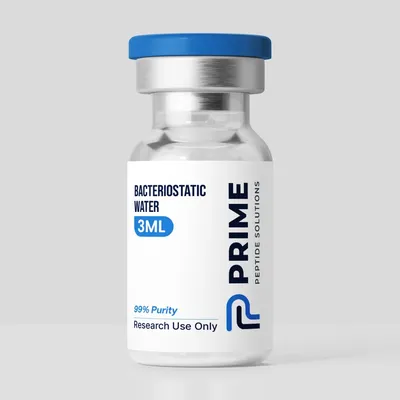
Prime Peptide Solutions offers bacteriostatic water at >99% purity with batch-specific Certificates of Analysis.
Shop Bacteriostatic Water
- Ships the same business day
- Free US shipping on $199+