
Why units matter in peptide research
Research peptides are described and measured using a few different units, and understanding how they relate is essential for accurate, repeatable work. A vial might be labeled in milligrams, a target amount discussed in micrograms, and some compounds referenced in international units. This guide explains what each unit means and how reconstitution ties them together into a syringe measurement.
This article is a practical handling reference for laboratory researchers and does not constitute dosing guidance for human use. All peptides sold by Prime Peptide Solutions are for in-vitro research only and not for human consumption.
Background: The Units
Milligram (mg)
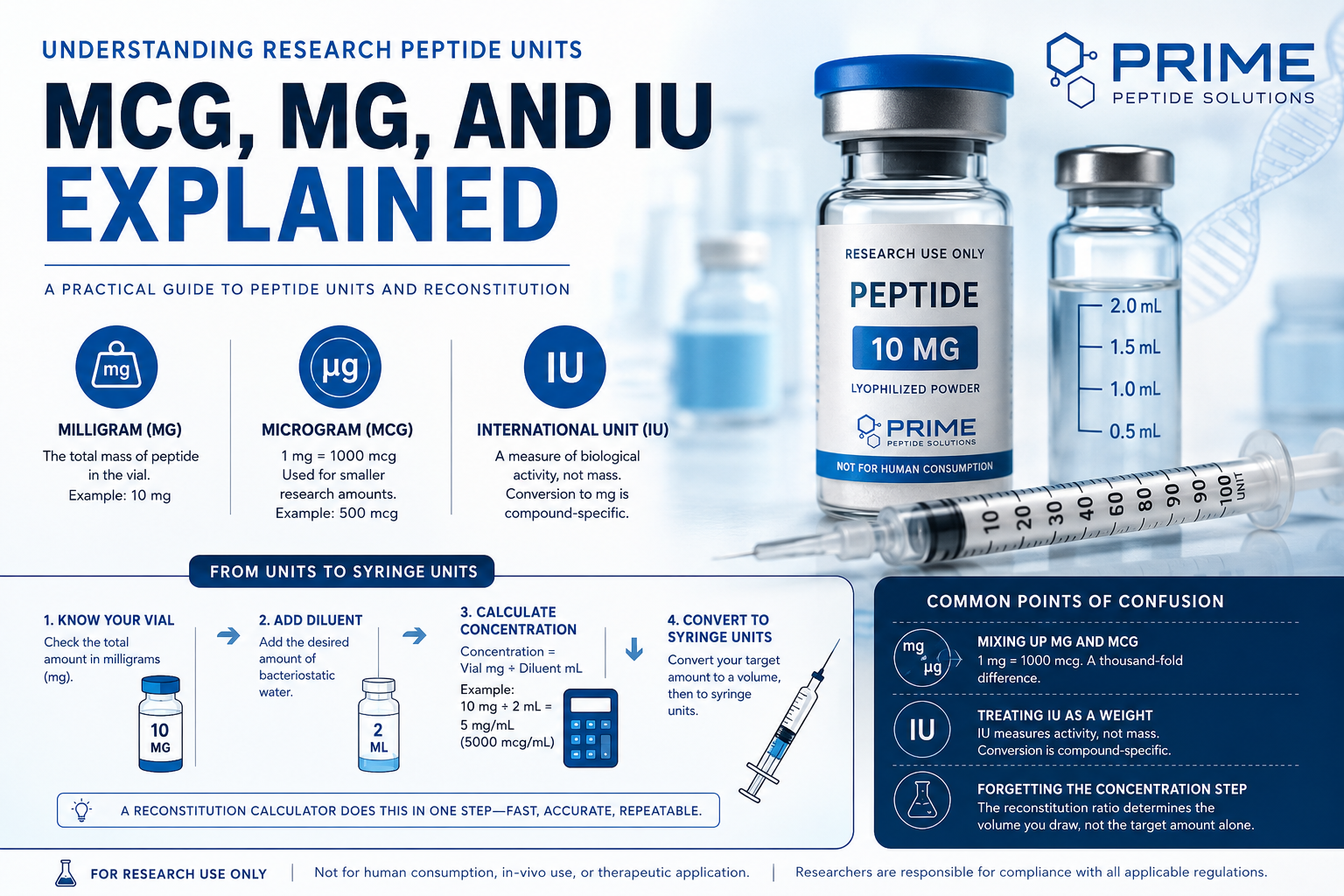
The milligram is the unit most peptide vials are labeled with, describing the total mass of lyophilized peptide in the vial. A vial might contain 5 mg or 10 mg of peptide, for example. This is the starting figure for any reconstitution calculation.
Microgram (mcg or g)
A microgram is one-thousandth of a milligram: 1 mg = 1000 mcg. Because research amounts are often small relative to the total vial contents, target amounts are frequently expressed in micrograms. Keeping the mg-to-mcg relationship clear is one of the most common sources of arithmetic error, so it is worth stating explicitly.
International Unit (IU)
An international unit is not a measure of mass but of biological activity, defined separately for each substance. For a few compounds referenced in research, quantities are discussed in IU rather than milligrams. Because the IU-to-mg relationship is specific to each substance, an IU figure cannot be converted to milligrams with a universal formula; the conversion depends on the particular compound.
How the Units Relate
Milligrams to micrograms
This is the conversion researchers use most. Since 1 mg equals 1000 mcg, a 5 mg vial contains 5000 mcg of peptide. Working in a consistent unit, usually micrograms for the target and milligrams for the vial total, keeps calculations clean.
International units
Where a compound is referenced in IU, the conversion to mass is compound-specific and should be taken from that compound's own documentation rather than assumed. IU is a measure of activity, not weight.
Reconstitution: Turning Units into a Measurement
The practical question in handling is how a target amount translates into a volume drawn on a syringe. That depends on the reconstitution ratio: how much diluent is added to the vial. For example, adding 2 mL of bacteriostatic water to a 10 mg vial produces a concentration of 5 mg per mL, or 5000 mcg per mL. A target amount can then be converted into a volume, and that volume into units on the syringe.
Because this involves several steps, a reconstitution calculator is the most reliable approach: enter the vial's milligram amount, the diluent volume, and the target amount, and it returns the volume and the number of syringe units to draw. This removes the most common source of measurement error.
Common Points of Confusion
Mixing up mg and mcg
The thousand-fold difference between a milligram and a microgram is the most frequent arithmetic mistake. Always confirm which unit a figure is expressed in before calculating.
Treating IU as a weight
IU measures activity, not mass, and its relationship to milligrams differs by compound. An IU figure should never be converted to mass with a generic formula.
Forgetting the concentration step
A target amount alone does not tell you how much to draw; the reconstitution ratio (and therefore the concentration) is what converts an amount into a volume and a syringe reading.
Frequently Asked Research Questions
How many micrograms are in a milligram?
1 milligram equals 1000 micrograms.
What is an international unit (IU)?
A measure of biological activity defined separately for each substance. It is not a unit of mass, and its conversion to milligrams is compound-specific.
How do I convert a target amount into syringe units?
Determine the concentration from your reconstitution ratio (vial mg divided by diluent mL), then convert the target amount into a volume, then into units. A reconstitution calculator does this in one step.
Why are peptide amounts often given in micrograms?
Because research amounts are frequently small relative to the total milligrams in a vial, so micrograms give a more readable figure.
Does the reconstitution ratio change the amount of peptide?
No. The amount of peptide in the vial is fixed. The ratio changes the concentration, which changes the volume you draw to reach a given amount, but not the total peptide present.
Conclusion
Milligrams, micrograms, and international units each describe research peptides in a different way: milligrams and micrograms measure mass (related by a factor of 1000), while IU measures compound-specific activity. The reconstitution ratio is what ties an amount to a syringe measurement. Keeping the units straight, and using a reconstitution calculator to handle the conversion, is the foundation of accurate and repeatable peptide research handling.
Disclaimer: This article is provided for educational and research purposes only. Information contained herein is a summary of publicly available scientific literature and does not constitute medical advice. All research peptides and all peptide compounds sold by Prime Peptide Solutions are intended strictly for laboratory research and are not for human consumption, in-vivo human use, or therapeutic application. Researchers are responsible for compliance with all applicable regulations governing peptide use in their jurisdiction.
References & Further Reading
- Related: Peptide Reconstitution Guide
- Related: Choosing Syringes and Needle Gauge
- Tool: Peptide Reconstitution Calculator
- For batch-specific COAs, see our published Certificates of Analysis
Research Peptides from Prime Peptide Solutions
We supply third-party tested research peptides in lyophilized form, with Certificates of Analysis available for every batch on our COA page. You can browse the full catalog on our products page.
Sold strictly for in-vitro laboratory research. Not for human or animal consumption.