

What is AOD-9604?
AOD-9604 (Anti-Obesity Drug 9604) is a synthetic peptide corresponding to the C-terminal fragment of human growth hormone, specifically the amino acid region 176-191. Because of this it is often referred to in research literature as HGH Fragment 176-191. It represents the portion of the growth hormone molecule associated in studies with fat metabolism, without the full-length hormone's effects on growth or blood sugar pathways.
The rationale behind AOD-9604 in research is to isolate the metabolic activity attributed to growth hormone's C-terminus while separating it from the broader systemic effects of the intact hormone. This makes it a compound of interest in preclinical studies of lipid metabolism.
This article is intended as a scientific overview for laboratory researchers. All compounds discussed are sold strictly for in-vitro research and are not for human consumption.
Discovery and Background
AOD-9604 emerged from research into which regions of the growth hormone molecule are responsible for its reported effects on fat metabolism. Investigators identified the C-terminal fragment as the region associated with lipolytic activity in laboratory models, and synthesized it as a standalone peptide with a modification to improve stability.
Because it is a fragment rather than the whole hormone, research literature characterizes it as lacking the growth-promoting and glucose-related activity of full-length growth hormone — a distinction that is central to how the compound is studied.
Mechanism of Action
AOD-9604's proposed mechanism centers on lipolysis — the breakdown of stored fat — and the inhibition of lipogenesis, the formation of new fat. In preclinical research it is examined for its effect on fat metabolism pathways that are associated with the C-terminal region of growth hormone.
Notably, research literature reports that AOD-9604's activity in these models does not appear to depend on the growth hormone receptor in the same way full-length growth hormone does, which is one of the more actively investigated questions surrounding the compound. Studies also examine whether it affects markers of glucose handling, with research generally characterizing it as separate from the insulin-related pathways engaged by the intact hormone.
Research Applications
AOD-9604 is examined in preclinical and in-vitro research contexts including studies of adipose tissue metabolism and lipolytic signaling, comparative research against full-length growth hormone and other metabolic fragments, investigation of receptor-independent metabolic pathways, and peptide stability and analytical characterization using HPLC and mass spectrometry methods.
Because AOD-9604 is a fragment with a specific proposed mechanism, it is frequently referenced in metabolic research alongside other compounds studied for effects on fat metabolism rather than in isolation.
Comparison to Other Metabolic Research Peptides
Within metabolic peptide research, AOD-9604 is often distinguished from the incretin-based compounds (which act on GLP-1 and related pathways) because its proposed mechanism is tied to growth hormone's lipolytic fragment rather than appetite or insulin signaling. For a look at the incretin class, see our comparison of Semaglutide and Tirzepatide and our overview of Tesamorelin, a related growth-hormone-axis compound.
Laboratory Handling and Storage
AOD-9604 is supplied in lyophilized (freeze-dried) form. Standard handling considerations for peptides of this class apply. Store the lyophilized powder sealed, dry, and protected from light; -20°C is generally recommended for long-term storage. Reconstitute with bacteriostatic water using appropriate dilution calculations for the intended experimental concentration — see our reconstitution guide for detailed ratios. Once reconstituted, store at 2-8°C and minimize freeze-thaw cycles. Verify purity and identity documentation before use; see our overview of how peptide purity is verified.
Research-Grade AOD-9604
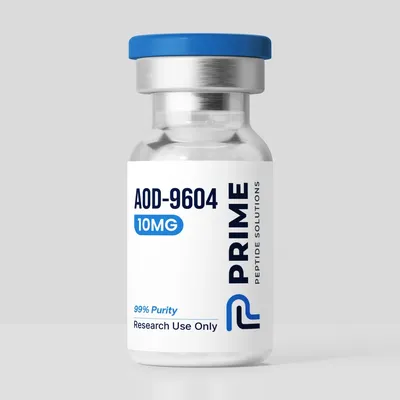
In our catalog, AOD-9604 is available as AOD-9604, supplied as a lyophilized powder and third-party tested for purity. Certificates of Analysis are available for every batch on our COA page.
Sold strictly for in-vitro laboratory research. Not for human or animal consumption. This material has not been evaluated by the FDA.
Shop AOD-9604
- Ships the same business day
- Free US shipping on $149.99+
- 7-day money-back guarantee on damaged items