
What is Tesamorelin?
Tesamorelin is a synthetic 44-amino acid analog of human growth hormone-releasing hormone (GHRH), modified at the N-terminus with a hexenoyl-trans-3 acid group. This single modification dramatically improves resistance to enzymatic degradation by dipeptidyl peptidase-4 (DPP-4) compared with native GHRH (1-44), while preserving full receptor activity at the GHRH receptor on pituitary somatotrophs.
Tesamorelin holds a unique position in the GHRH analog literature: it has the most extensive clinical and preclinical characterization of any peptide in this class, making it a frequent reference compound in growth hormone axis research.
This article is intended as a scientific overview for laboratory researchers. All compounds discussed are sold strictly for in-vitro research and are not for human consumption.
Discovery and Development
Tesamorelin was developed by Theratechnologies, a Canadian biopharmaceutical company, and emerged from research focused on creating a GHRH analog with sufficient half-life and stability for therapeutic and research applications. Native GHRH has a circulating half-life of only a few minutes, severely limiting its utility for sustained research investigation.
The hexenoyl-trans-3 modification was identified through structure-activity work on GHRH stabilization. Tesamorelin received FDA approval in 2010 for a specific indication (HIV-associated lipodystrophy), making it one of the few GHRH-based compounds with formal clinical approval.
Mechanism of Action
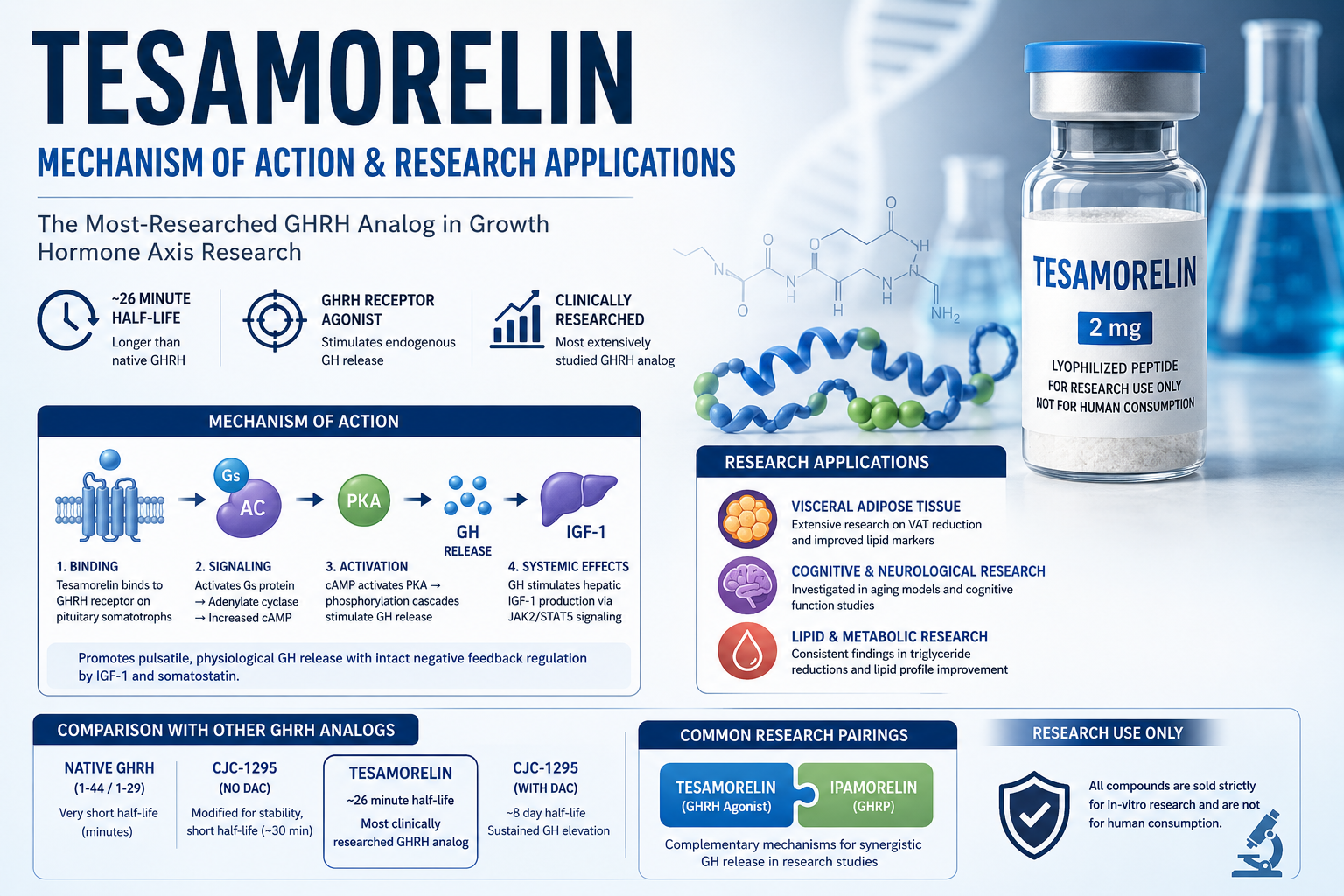
Tesamorelin acts as an agonist at the growth hormone-releasing hormone receptor (GHRH-R), a G-protein coupled receptor expressed predominantly on somatotroph cells of the anterior pituitary. Receptor activation triggers the following sequence in published preclinical models:
- Binding to GHRH-R activates adenylate cyclase via Gs protein coupling.
- Intracellular cAMP rises, activating protein kinase A (PKA).
- PKA phosphorylation cascades stimulate growth hormone (GH) synthesis and release.
- Released GH circulates and stimulates hepatic IGF-1 production via JAK2/STAT5 signaling.
Importantly, this mechanism produces endogenous growth hormone release rather than introducing exogenous GH. Research literature notes this preserves the pulsatile nature of GH secretion and intact negative feedback regulation by IGF-1 and somatostatin.
Pharmacokinetics
Tesamorelin has a reported circulating half-life of approximately 26 minutes in research models — significantly longer than native GHRH but considerably shorter than the DAC-modified GHRH analogs. Peak GH release is typically observed within 30 minutes of subcutaneous administration in published research.
Research Applications
Visceral Adipose Tissue Research
The most extensively published research application of Tesamorelin involves visceral adipose tissue (VAT). Multiple controlled studies have characterized reductions in VAT volume measured by imaging following Tesamorelin protocols, with research literature describing concurrent improvements in lipid markers including triglycerides.
The mechanism by which GHRH-stimulated GH affects VAT specifically — rather than subcutaneous adipose — is an active area of investigation. Hypotheses in research literature focus on differential expression of GH receptors and lipolytic enzymes between fat depots.
Cognitive Research
A growing body of research has investigated Tesamorelin in cognitive and neurological contexts. Published preclinical work has examined effects on cognitive markers in aging models, with research focused on the GH/IGF-1 axis as it relates to cerebral function.
Lipid and Metabolic Research
Beyond visceral adiposity, research literature characterizes effects on circulating lipid profiles in animal and clinical research models. Triglyceride reductions are a consistent finding across multiple published protocols.
Comparison with Other GHRH Analogs
Tesamorelin sits within a broader class of GHRH-receptor agonists used in research, which includes:
- Native GHRH (Sermorelin / GRF 1-29) — Shortest half-life, limited utility for sustained research.
- CJC-1295 (No DAC) / Modified GRF (1-29) — Four amino acid substitutions for enzymatic stability; similar short half-life to Tesamorelin.
- CJC-1295 (with DAC) — DAC modification extends half-life to roughly 8 days, producing sustained rather than pulsatile GH elevation.
In research design, Tesamorelin is often selected when investigators want the most-characterized GHRH analog with documented clinical research history.
Common Research Pairings
Tesamorelin is sometimes investigated in combination with growth hormone secretagogues (GHRPs) such as Ipamorelin in research protocols studying synergistic activation of GH release. The rationale in research literature is that GHRH agonists and ghrelin-receptor agonists act on distinct receptors with complementary intracellular cascades.
Safety and Adverse Effect Profile in Research Literature
Tesamorelin has the most documented safety profile of the GHRH analogs in clinical research. Published research has characterized adverse effects including injection site reactions, transient arthralgias, fluid retention, and effects associated with increased IGF-1 levels.
As with all GH-axis active compounds, research has noted considerations around individuals with active malignancy or proliferative retinopathy in clinical literature, given the role of IGF-1 in cellular proliferation pathways.
Storage and Handling in Laboratory Settings
Lyophilized Tesamorelin is reported in research literature as stable at controlled refrigerated temperatures (2-8 degrees C) for extended periods when sealed. Following reconstitution with bacteriostatic water, research-grade product is typically maintained at 2-8 degrees C with stability data supporting 14-28 days depending on storage conditions and bacteriostatic water concentration.
As with all lyophilized peptides, exposure to moisture, light, and elevated temperatures should be minimized to preserve research integrity. Refer to your supplier's published Certificate of Analysis for batch-specific stability data.
Conclusion
Tesamorelin represents one of the most thoroughly characterized peptides in growth hormone axis research. Its hexenoyl-modified structure, well-documented mechanism via GHRH receptor agonism, and substantial body of research literature on visceral adipose tissue and lipid markers make it a frequent reference compound in metabolic and GH-axis research design.
For laboratory researchers selecting between GHRH analogs, Tesamorelin offers the advantage of the most extensive published research base — a meaningful factor when designing studies that build on existing literature.
Prime Peptide Solutions offers Tesamorelin at >99% purity with batch-specific Certificates of Analysis.