
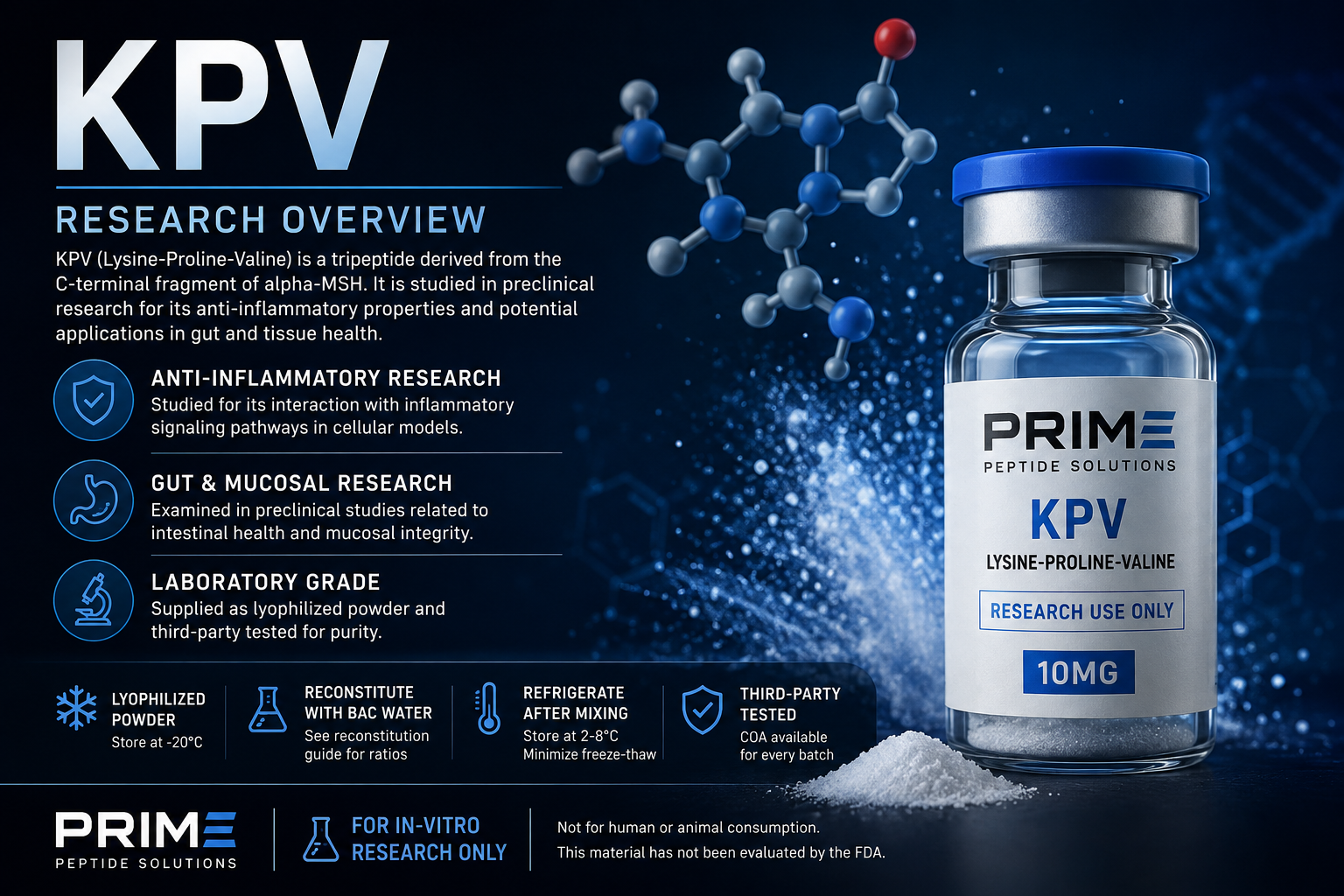
What is KPV?
KPV is a tripeptide composed of the amino acids Lysine-Proline-Valine, corresponding to the C-terminal fragment of the hormone alpha-melanocyte-stimulating hormone (alpha-MSH). Research literature investigates it for anti-inflammatory activity that is associated with this fragment of the parent hormone.
Because it is a short fragment rather than the full hormone, KPV is studied for the specific anti-inflammatory properties attributed to the C-terminal region while lacking the pigmentation activity of full-length alpha-MSH.
This article is intended as a scientific overview for laboratory researchers. All compounds discussed are sold strictly for in-vitro research and are not for human consumption.
Discovery and Background
KPV emerged from research into which portions of alpha-MSH are responsible for its reported anti-inflammatory effects. The C-terminal tripeptide was identified as retaining anti-inflammatory activity in laboratory models, and is studied as a standalone compound.
Mechanism of Action
KPV's proposed mechanism centers on modulating inflammatory signaling pathways. Research literature examines its association with reduced activity of pro-inflammatory signaling in cellular models, and investigates its behavior in gastrointestinal research contexts, where it is studied for effects on intestinal inflammation. It is often discussed in research alongside gut-and-healing peptides.
Research Applications
KPV is examined in preclinical and in-vitro research including inflammatory signaling studies, gastrointestinal and mucosal research, and analytical characterization. It is frequently studied alongside other gut-and-tissue peptides such as BPC-157.
Laboratory Handling and Storage
KPV is supplied in lyophilized (freeze-dried) form. Store the lyophilized powder sealed, dry, and protected from light; -20°C is generally recommended for long-term storage. Reconstitute with bacteriostatic water using appropriate dilution calculations for the intended experimental concentration — see our reconstitution guide for detailed ratios. Once reconstituted, store at 2-8°C and minimize freeze-thaw cycles, which contribute to peptide degradation. Verify purity and identity documentation before use; see our overview of how peptide purity is verified.
Research-Grade KPV
In our catalog, KPV is available as KPV, supplied as a lyophilized powder and third-party tested for purity. Certificates of Analysis are available for every batch on our COA page.
Sold strictly for in-vitro laboratory research. Not for human or animal consumption. This material has not been evaluated by the FDA.