
What Is KLOW?
KLOW is the catalog name for a research blend of four peptides: GHK-Cu, BPC-157, TB-500 and KPV. Each has its own literature in cell and animal models, and each is studied through a different pathway.
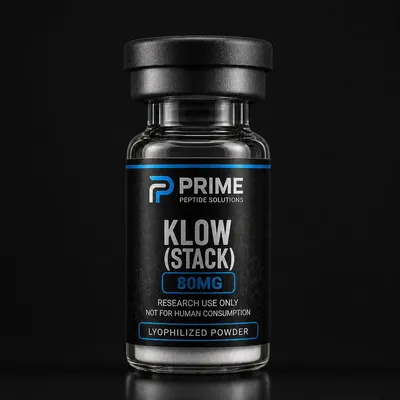
At Prime Peptide Solutions, KLOW is supplied as one lyophilized vial with all four peptides pre-mixed, listed at 80 mg total. The per-component amounts are given on the vial label and the batch Certificate of Analysis.
This article is a scientific overview for laboratory researchers. The research-grade KLOW blend supplied by Prime Peptide Solutions is sold strictly for in-vitro laboratory research. It is not approved for human use and is not for human or animal consumption.
The Four Components at a Glance
GHK-Cu: the copper-binding tripeptide
GHK is glycyl-L-histidyl-L-lysine (Gly-His-Lys). PubChem lists the free peptide (CID 73587) with the molecular formula C14H24N6O4 and a molecular weight of 340.38 g/mol, and indexes the copper complex under CID 71587328 with the formula C14H23CuN6O4+ and a molecular weight of 402.92 g/mol. A 2012 review states that GHK was discovered in 1973 as an activity in human albumin and that it has high affinity for copper ions, readily forming the GHK-Cu complex.
Crystallographic and spectroscopic work describes the complex as dimeric in the solid state but monomeric in solution, with the copper held by three nitrogen ligands: the terminal amine, an amidyl nitrogen and the histidine imidazole nitrogen. A 2015 review reports that GHK modulates the synthesis and breakdown of collagen and glycosaminoglycans and the activity of metalloproteinases and their inhibitors, and a 2018 review lists suppression of NF-kB among the actions it attributes to GHK. The GHK-Cu research overview covers the molecule in more depth.
BPC-157: VEGFR2 and nitric-oxide signaling
BPC-157 is a 15-residue linear peptide with the sequence Gly-Glu-Pro-Pro-Pro-Gly-Lys-Pro-Ala-Asp-Asp-Ala-Gly-Leu-Val (H-GEPPPGKPADDAGLV-OH). PubChem (CID 9941957) lists the molecular formula C62H98N16O22 and a molecular weight of 1419.5 g/mol. The sequence contains no histidine or cysteine.
In cultured human vascular endothelial cells, BPC-157 increased VEGFR2 mRNA and protein without changing VEGF-A, promoted VEGFR2 internalization and time-dependently activated the VEGFR2-Akt-eNOS pathway. The endocytosis inhibitor dynasore blocked both. The same study reported more endothelial tube formation in vitro. A later study in isolated rat aorta found endothelium-dependent, nitric-oxide-mediated vasodilation and proposed a Src-caveolin-1-eNOS pathway. In cultured rat fibroblasts, BPC-157 increased migration along with FAK and paxillin phosphorylation. See the BPC-157 research overview.
TB-500: the actin-binding motif of thymosin beta-4
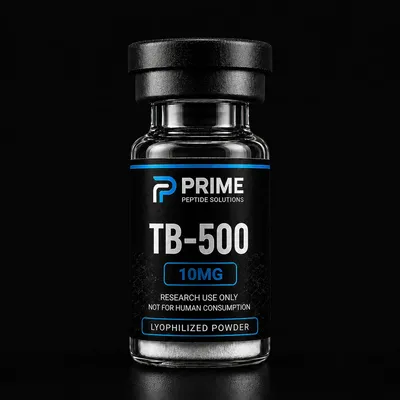
Thymosin beta-4 is a 43-residue protein of about 5 kDa that binds and sequesters actin monomers (G-actin) and so inhibits actin polymerization; work on human platelets showed a 1:1 complex with actin monomers. In the literature, TB-500 is not the full protein: it is commonly described as N-acetyl-LKKTETQ, a synthetic, N-terminally acetylated version of the LKKTETQ segment (residues 17-23 in the mature 43-residue numbering), described as the site responsible for actin binding and cell migration. PubChem (CID 62707662) lists this peptide with the formula C38H68N10O14 and a molecular weight of 889.0 g/mol.
In human umbilical vein endothelial cell migration assays and chick aortic-arch sprouting assays, thymosin beta-4 and a peptide carrying its seven-amino-acid actin-binding motif showed near-identical activity at about 50 nM, while peptides lacking any part of the motif were inactive.
KPV: the C-terminal tripeptide of alpha-MSH
KPV is L-lysyl-L-prolyl-L-valine (Lys-Pro-Val), also indexed as alpha-MSH(11-13). PubChem (CID 125672) lists the molecular formula C16H30N4O4 and a molecular weight of 342.43 g/mol. Alpha-MSH is a 13-residue peptide derived from proopiomelanocortin. A 2007 review describes its effects on pathways including NF-kB activation and pro-inflammatory cytokine production, and states that most of these actions of alpha-MSH can be attributed to its C-terminal tripeptide, KPV.
In human epithelial cell lines (Caco2-BBE and HT29-Cl.19A) and Jurkat T cells stimulated with pro-inflammatory cytokines, nanomolar KPV inhibited activation of the NF-kB and MAP kinase pathways and reduced pro-inflammatory cytokine secretion. Uptake studies showed that KPV enters these cells through PepT1, a di- and tripeptide transporter.
How the Four Literatures Relate
We found no primary study of this four-peptide combination. A PubMed search for BPC-157, thymosin, GHK and KPV together returns no records, and the papers that mention several of them are narrative reviews that cover each peptide individually. The grouping brings four separately studied pathways into one research material; it is not evidence of any combined effect. Side by side, the four literatures cover distinct areas:
- Copper and extracellular-matrix signaling (GHK-Cu): a high-affinity Cu(II) complex linked in reviews to collagen and glycosaminoglycan turnover.
- Endothelial receptor signaling (BPC-157): VEGFR2-Akt-eNOS and nitric-oxide signaling.
- Cytoskeletal dynamics (TB-500): the actin-binding motif of thymosin beta-4 (a G-actin-sequestering protein) and cell migration.
- Inflammatory signaling (KPV): NF-kB and MAP kinase pathways in epithelial and T-cell lines.
The threads meet at the level of assays: BPC-157 and the thymosin beta-4 motif have both been examined in endothelial cell assays, and NF-kB appears in both the KPV cell studies and a GHK review. These overlaps show where the literatures touch, not that the peptides act together.
One Pre-Mixed Vial: What a Shared Solution Means
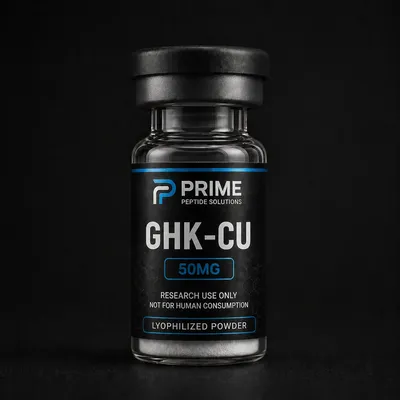
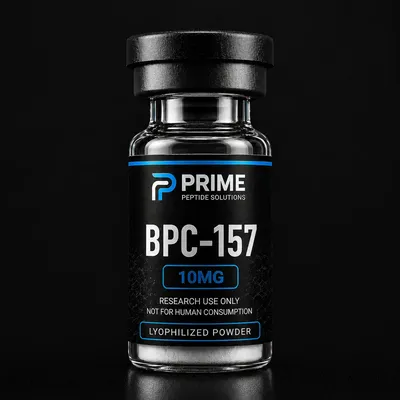
Because KLOW is a single vial, all four peptides share one lyophilized cake and, after reconstitution, one solution: one pH, one diluent volume and one storage history. The GHK-Cu copper complex is therefore present in the same solution as BPC-157, TB-500 and KPV. Work that needs independent control of one component uses single-compound vials, which the catalog also lists: GHK-Cu in 50mg and 100mg sizes, and BPC-157, TB-500 and KPV in 10mg vials.
Copper coordination in solution
Structural work on GHK-Cu gives general chemistry relevant to a shared solution. In the solid state, the fourth equatorial position on the copper is filled by a labile carboxylate oxygen, and the authors probed that position by forming ternary complexes of GHK-Cu with glycine or histidine. Copper exchange with GHK-Cu is fast, and the complex is inert under moderate redox potentials, although it can be reduced to Cu(I) at around -0.62 V (versus AgCl/Ag), with release of the copper ion. Solution studies also report that GHK forms copper complexes of different stoichiometries, and suggest that the lysine side-chain amine joins copper binding only at alkaline pH, since it is protonated at physiological pH. The pH of a shared solution therefore bears on which copper species are present.
Metal ions and peptide chemistry
A 1990 review of metal-catalyzed protein oxidation describes how, in the presence of oxygen, Cu(II) or Fe(III) and a suitable electron donor, such systems modify one or a few amino acid residues at metal-binding sites, with relatively little peptide-bond cleavage. This is general protein chemistry, not tested on these peptides or on KLOW, and not evidence that the blend changes in the vial. Each lot's purity and composition are recorded on its batch Certificate of Analysis.
Handling and Reconstituting the KLOW Vial
Reconstitute as one vial
KLOW is reconstituted as a single vial with bacteriostatic water (0.9% benzyl alcohol in sterile water), which is sold separately in 3 mL and 10 mL vials. The figure to calculate is the total concentration: 80 mg divided by the volume of diluent added. For example, 80 mg in 2 mL gives 40 mg/mL of total peptide, and 80 mg in 4 mL gives 20 mg/mL.
That is the concentration of the whole blend. For experimental work that needs one component's concentration, divide that component's labeled mass by the same diluent volume. Do not assume the components are present in equal amounts; the vial label and batch COA give each one's mass. The single-compound calculator presets model vials holding only one compound.
Labeling and storage
Label the reconstituted vial with the date, the diluent volume and the total concentration, and record the batch number so the vial can be matched to its COA. The product page lists storage at 2-8 °C refrigerated, or -20 °C for long-term storage. After reconstitution, keep the solution refrigerated and protected from light, swirl rather than shake it, and avoid repeated freezing and thawing. See the guide to reconstituted peptide stability.
Frequently Asked Research Questions
What is KLOW?
KLOW is a research blend of four peptides, GHK-Cu, BPC-157, TB-500 and KPV, supplied here as one pre-mixed lyophilized vial listed at 80 mg total.
Does the name KLOW stand for anything?
We have not found a published source that defines the name. It is used as a product name for this four-peptide combination.
Is KLOW one vial or four?
One. All four peptides are pre-mixed in a single lyophilized vial, so they share one solution after reconstitution.
How much of each peptide is in the vial?
The vial label and the batch Certificate of Analysis list the composition. The 80 mg figure is the total for all four peptides, not a per-component amount.
Is TB-500 the same as thymosin beta-4?
Not as the term is used in the literature. Thymosin beta-4 is a 43-residue protein of about 5 kDa; TB-500 is commonly described in the literature as its acetylated actin-binding segment, N-acetyl-LKKTETQ (889.0 g/mol).
Does the copper in GHK-Cu affect the other peptides?
We found no study of this blend, so whether the copper complex interacts with the other peptides in a shared solution is not known. Structural work on GHK-Cu describes a labile fourth coordination position in the solid-state structure and fast copper exchange. The batch COA reports the lyophilized lot at the time of testing, not the reconstituted solution.
Is KLOW approved for human use?
No. The research-grade KLOW blend sold by Prime Peptide Solutions is not approved for human use and is not for human or animal consumption. It is supplied only as a reference material for in-vitro laboratory research.
Conclusion
KLOW combines four peptides with separate literatures: GHK-Cu (copper and extracellular-matrix signaling), BPC-157 (VEGFR2-eNOS signaling), TB-500 (the actin-binding segment of thymosin beta-4) and KPV (NF-kB signaling). We found no published study of the four together. As one pre-mixed 80 mg vial, the blend shares a single solution, so laboratories work from the total concentration, read component amounts from the label and COA, and keep GHK-Cu's copper chemistry in mind when choosing buffers.
Disclaimer: This article is provided for educational and research purposes only. It summarizes publicly available scientific literature and does not constitute medical advice. KLOW and all peptide compounds sold by Prime Peptide Solutions are intended strictly for laboratory research, are not approved for human use, and are not for human or animal consumption. Researchers are responsible for compliance with all applicable regulations in their jurisdiction.
Shop these products
- Ships the same business day
- Free US shipping on $199+
- 14-day money-back guarantee
References & Further Reading
- PubMed: GHK-Cu copper complex structure and chemistry
- PubMed: BPC-157 and VEGFR2-eNOS signaling
- PubMed: Thymosin beta-4 and G-actin sequestration
- PubMed: KPV tripeptide and NF-kB signaling
- PubMed: Metal-catalyzed oxidation of proteins
Research-Grade KLOW
In our catalog, the blend is listed as KLOW (Stack), supplied as one lyophilized vial with all four peptides pre-mixed, 80 mg total. The batch Certificate of Analysis lists the composition and purity, and the KLOW batch COA is published on our COA page.
Sold strictly for in-vitro laboratory research. Not for human or animal consumption.