

Why Does Bacteriostatic Water Contain Benzyl Alcohol?
Bacteriostatic water contains benzyl alcohol as an antimicrobial preservative: it holds back the growth of bacteria that get in when the vial is opened, so one vial can be entered more than once. The usual strength is 0.9% benzyl alcohol, which is 9 mg per mL, or about 83 mM. The Hospira label describes sterile water "containing 0.9% (9 mg/mL) or 1.1% (11 mg/mL) of benzyl alcohol added as a bacteriostatic preservative".
It is not an inert passenger, though. Below: what it does to bacteria, proteins, peptides and cells, how it breaks down, and what a lab report tests. For bacteriostatic vs sterile water and SWFI, see the BAC water explainer.
This article is a scientific overview for laboratory researchers. The research-grade Bacteriostatic Water supplied by Prime Peptide Solutions is sold strictly for in-vitro laboratory research. It is not approved for human use and is not for human or animal consumption.
Benzyl Alcohol in Bacteriostatic Water at a Glance
PropertyValueSourceCompoundBenzyl alcohol (phenylmethanol), C7H8O, 108.14 g/molPubChem CID 244Strength0.9% w/v = 9 mg/mL; Hospira also lists 1.1% (11 mg/mL)Hospira labelMolar concentration0.9% is 83.2 mM; 1.1% is about 101.7 mM (calculated)Stroppel et al., 2023Water solubility42.9 mg/mL at 25 °C, so 0.9% is about a fifth of saturationPubChemMost activeBelow pH 5; little activity above pH 8Stroppel et al., 2023Label pH5.7 (4.5 to 7.0)Hospira labelUV absorptionStrongest maximum at 258.5 nm (measured in alcohol)PubChemIn airSlowly oxidized to benzaldehyde and benzoic acidPubChemLabel warningNOT FOR USE IN NEONATESHospira label
What Does 0.9% Benzyl Alcohol Mean in mg/mL and mM?
The percentage is weight per volume: 0.9 g per 100 mL, which the label states as 9 mg/mL. At a molar mass of 108.14 g/mol (PubChem) that is 83.2 mM, the figure used in the preservative literature (Stroppel et al., 2023). Hospira's 1.1% version is about 101.7 mM, so check the strength on the vial in hand.
That is about a fifth of its 42.9 mg/mL solubility at 25 °C, and far more than the peptide: a 3,000 g/mol peptide at 1 mg/mL is about 0.33 mM, so benzyl alcohol outnumbers it roughly 250 to 1. At that ratio even weak interactions can matter.
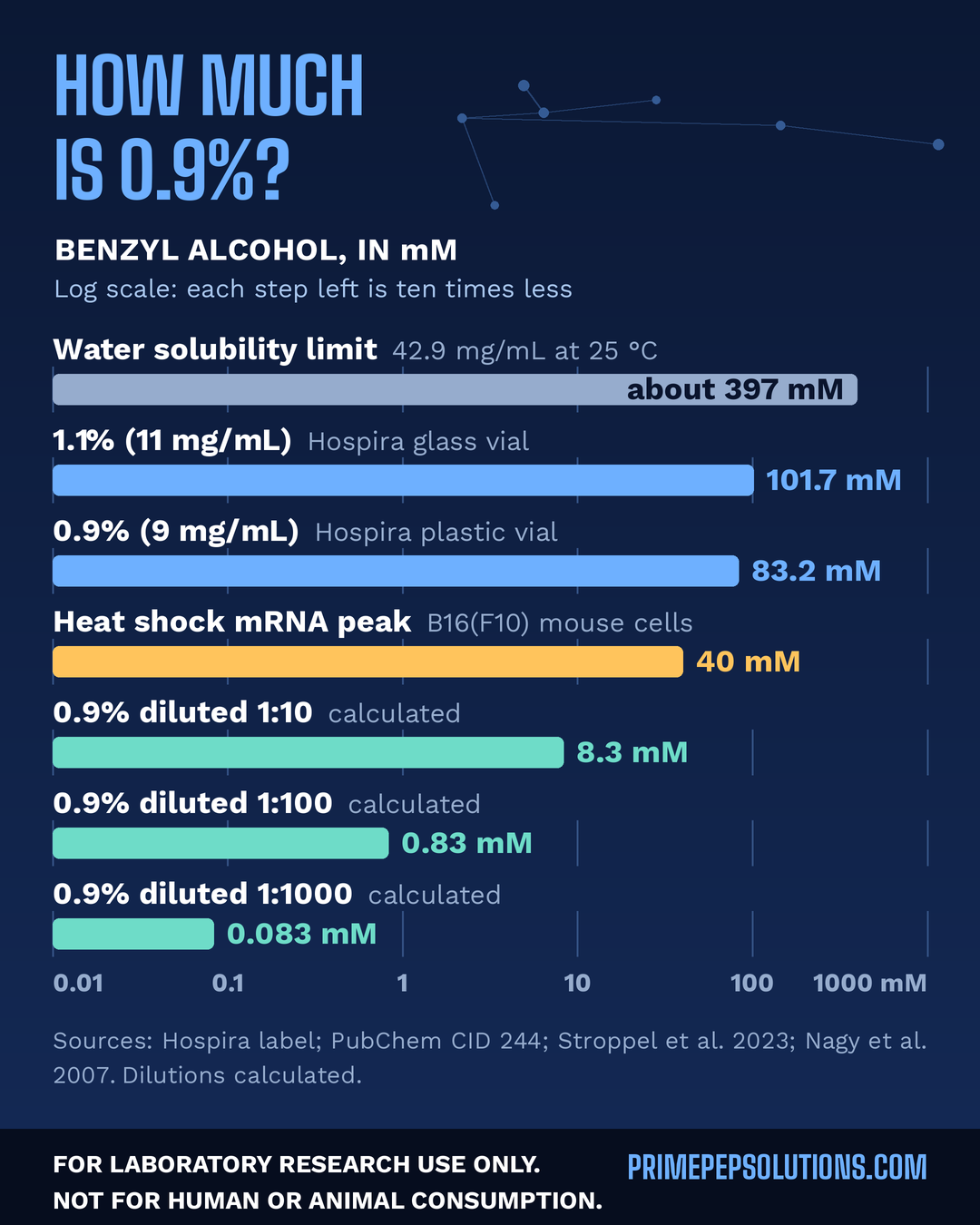 Benzyl alcohol concentrations on a log scale; dilutions are calculated.
How Does Benzyl Alcohol Stop Bacterial Growth?
It acts on membranes. Benzyl alcohol is membrane-active, raising membrane fluidity and interfering with bacterial membrane functions such as efflux pumps (Stroppel et al., 2023). In a comparison of phenolic compounds and aromatic alcohols, all altered bacterial membranes, especially in Gram-negative bacteria, and all had lethal effects, benzyl alcohol included; the authors linked their action to lipophilicity (Lucchini et al., 1990). "Bacteriostatic" names its job in the vial, not the limit of what the molecule can do.
- pH matters. Benzyl alcohol is most effective below pH 5 and has little antimicrobial effect above pH 8 (Stroppel et al., 2023). The Hospira label gives pH 5.7 (4.5 to 7.0).
- The peptide matters. With a model peptide, higher peptide concentrations lowered the antimicrobial efficacy of benzyl alcohol, phenol and m-cresol in the European Pharmacopoeia test; the authors proposed that the preservatives adsorb onto peptide oligomers (Heljo et al., 2015). A concentrated peptide solution can weaken its own preservative.
- Technique still matters. The label still says: "Use aseptic technique for single or multiple entry and withdrawal from all containers." A preservative slows what gets in; it does not undo a contaminated transfer.
Is Benzyl Alcohol Bad for Peptides?
Not as a rule, but it is not inert. Most evidence of harm comes from larger folded proteins, where 0.9% benzyl alcohol favored partially unfolded, aggregation-prone states, most strongly at 37 °C and near neutral pH. In the fewer peptide studies it often interacted less than m-cresol or phenol, but the pattern changed from one sequence to the next. Phenol and benzyl alcohol are the two most common preservatives in licensed peptide and protein products (Meyer et al., 2007).
What the protein studies found
- Weak binding, partial unfolding. With interleukin-1 receptor antagonist (rhIL-1ra), benzyl alcohol bound weakly through hydrophobic interactions, slightly perturbed tertiary but not secondary structure, and accelerated aggregation at 37 °C; sucrose partly protected the protein (Zhang et al., 2004). A review of that work reports almost 60% monomer loss in two days at 37 °C with 0.9% benzyl alcohol, against about 10% without it (Stroppel et al., 2023).
- Freeze-dried protein. Dissolving lyophilized rhIL-1ra in 0.9% benzyl alcohol caused more aggregation than dissolving it in water, depending on how much structure survived freeze-drying; during later room-temperature storage, benzyl alcohol did not accelerate aggregation (Roy et al., 2005).
- Temperature and pH. Benzyl alcohol did not enhance rhIL-1ra aggregation at 25 °C but greatly accelerated it at 37 °C (Roy et al., 2006). With granulocyte colony-stimulating factor it accelerated aggregation at pH 7.0, much more at 37 °C, and caused none at pH 3.5 (Thirumangalathu et al., 2006).
- Concentration. With interferon-gamma, the loss of tertiary structure, which came with the formation of aggregates, was faster at higher benzyl alcohol concentration (Lam et al., 1997), and with interferon alpha-2a the apparent aggregation temperature fell linearly as benzyl alcohol rose (Bis et al., 2015).
- Ranking. Aggregation of cytochrome c followed m-cresol > phenol > benzyl alcohol > phenoxyethanol > chlorobutanol (Hutchings et al., 2013), and interferon alpha-2a followed the same order for the four preservatives tested (Bis and Mallela, 2014).
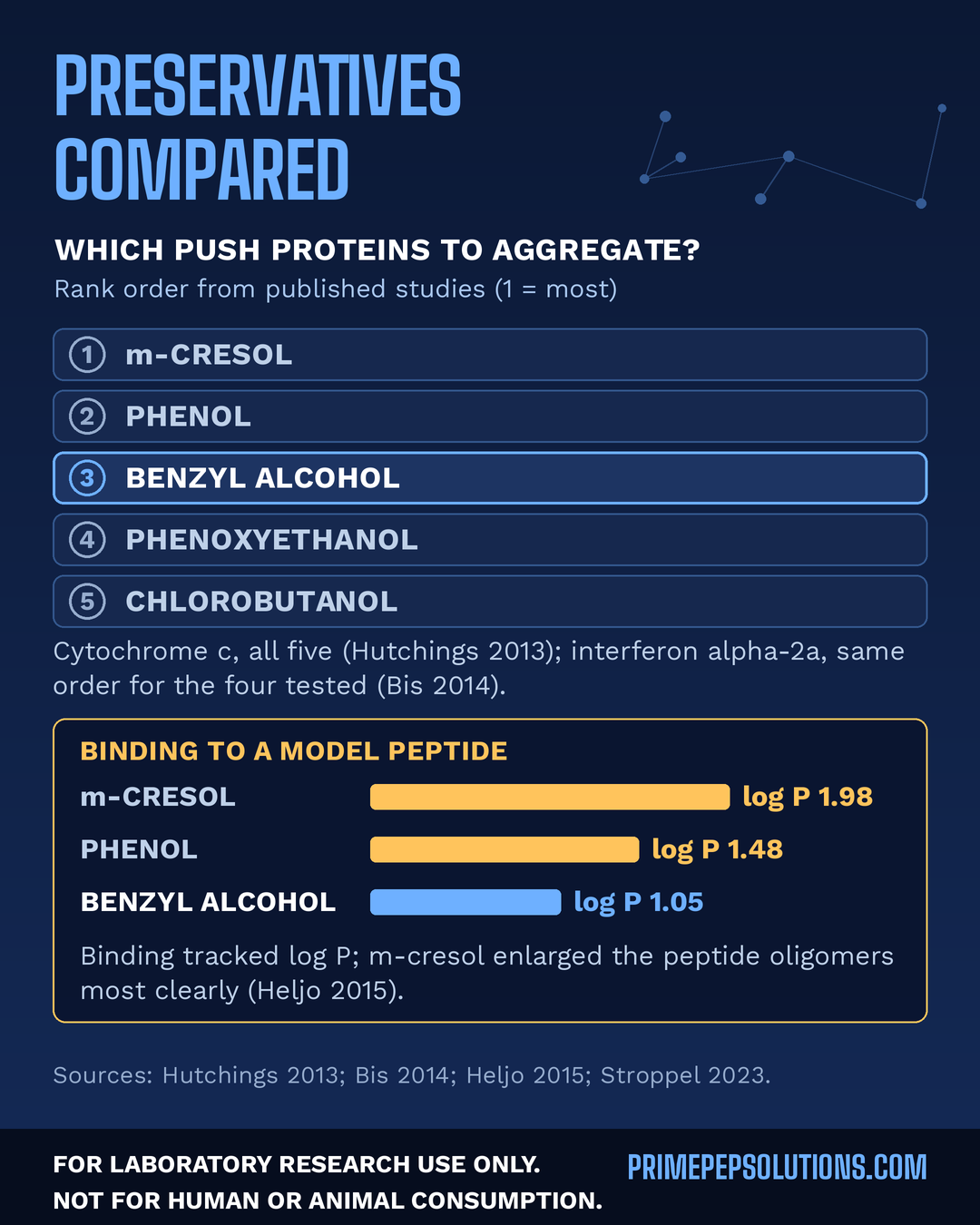 Benzyl alcohol sits mid-table for protein aggregation and bound a model peptide least of the three aromatic preservatives.
What the peptide studies found
With a model peptide, m-cresol clearly enlarged reversible oligomers while phenol and benzyl alcohol had smaller effects (Heljo et al., 2015); binding ran m-cresol > phenol > benzyl alcohol, in line with log P values of 1.98, 1.48 and 1.05 (Stroppel et al., 2023). With a linear, palmitoylated 31-residue peptide, benzyl alcohol caused no conformational change and no measurable binding enthalpy, and it improved solubility under salt stress, while m-cresol and phenol interacted with the peptide. Those trends did not hold for two similar lipidated peptides, underlining that each sequence behaves differently (D'Addio et al., 2021).
What this means for a laboratory stock solution
- Check each compound. The Hospira label warns that some products may be incompatible with a vehicle containing benzyl alcohol, and peptide data cover only a handful of sequences.
- Avoid warm storage. The rhIL-1ra authors suggested storage at reduced temperature, such as room temperature or 4 °C, to minimize the risk of preservative-induced aggregation (Roy et al., 2005); see the peptide storage guide.
- Inspect it. Haze or particles can signal aggregation. The cloudy solution guide covers what to check, and the peptide degradation guide the chemistry.
- Go preservative-free when the method needs it, for example structural work, sensitive cell assays and UV measurements.
Can Benzyl Alcohol Affect Cell Assays and UV Readings?
Yes. Benzyl alcohol has a well-known fluidizing effect on artificial and cellular membranes (Maula et al., 2009). In mouse B16(F10) cells it switched on heat shock genes, with hsp70 and hsp25 mRNA peaking at 40 mM (Nagy et al., 2007), and in K562 cells it lowered the temperature threshold of the heat shock response (Balogh et al., 2005). Undiluted 0.9% is about 83 mM, twice that figure; diluted 1:100 into medium it is about 0.83 mM. Run a vehicle control with the same final benzyl alcohol concentration as the test wells, or prepare stocks for sensitive assays in a preservative-free diluent.
Benzyl alcohol also absorbs UV light, most strongly at about 258.5 nm (PubChem), and UV readings from 220 to 350 nm have been used to measure it (Stroppel et al., 2023). In UV quantitation or HPLC-UV of a stock made in bacteriostatic water, blank against the same diluent.
The label's opening warning, "NOT FOR USE IN NEONATES", points the same way: the label cites the potential toxicity of benzyl alcohol in newborns. Reports from 1982 linked neonatal deaths to fluids preserved with benzyl alcohol, the "gasping syndrome" (CDC, 1982; Gershanik et al., 1982; reviewed by Stroppel et al.).
Does Benzyl Alcohol Break Down or Escape From a Vial?
Slowly. On exposure to air it is oxidized to benzaldehyde and benzoic acid (PubChem). It is also slowly adsorbed by natural rubber, neoprene and butyl rubber closures, and permeates some plastics: losses from low-density polyethylene reached almost 80% after 90 days at 40 °C, against under 10% from polypropylene (Stroppel et al., 2023). Keep vials closed, store them as labeled (20 to 25 °C on the Hospira label) and use them within their printed date.
What Does a Bacteriostatic Water Lab Report Test?
The batch PRIME1026 lab report for our bacteriostatic water (10 mL vial, BT Labs, tested October 26, 2026) lists:
- Appearance: clear liquid.
- Identity by FTIR: "FTIR sample spectrum confirms the presence of benzyl alcohol in water."
- HPLC purity: 99.7%, with an HPLC potency assay; its 220 nm trace shows a single peak.
- pH: three readings, 6.98 to 7.02.
Its testing-purpose line matters just as much: the analysis "does not provide information on particulate matter, microbial contamination or presence of endotoxins." A chemistry report confirms what is in the vial and how pure it is; it is not a sterility or endotoxin test. Batch reports are listed on the lab reports page, and the COA verification guide explains how to confirm one with the lab.
Frequently Asked Research Questions
Why does bacteriostatic water have benzyl alcohol in it?
Benzyl alcohol is the preservative. At 0.9% (9 mg/mL) it holds back bacterial growth so a vial can be entered more than once. Plain sterile water has none.
Is 0.9% benzyl alcohol the same as 9 mg/mL?
Yes: 0.9 g per 100 mL, or about 83 mM. Hospira also lists a 1.1% (11 mg/mL) version.
Is benzyl alcohol bad for peptides?
Not as a rule. Its strongest effects were on larger folded proteins at 37 °C and near neutral pH; in peptide studies it often interacted less than m-cresol or phenol, but this varied by sequence.
Does benzyl alcohol interfere with cell assays?
It can. It fluidizes membranes, and in one mouse cell line heat shock gene expression peaked at 40 mM, so dilute well and run a vehicle control at the same final benzyl alcohol concentration.
Does a bacteriostatic water COA prove the water is sterile?
No. The PRIME1026 report confirms benzyl alcohol by FTIR and gives HPLC purity and pH; it states that it does not cover particulates, microbial contamination or endotoxins.
Conclusion
The 0.9% in bacteriostatic water is 9 mg/mL of benzyl alcohol, about 83 mM, there to hold back bacterial growth across repeated entries. It also acts on proteins, membranes and UV readings, and compatibility is compound-specific: inspect the solution, keep it cool and control for it.
Disclaimer: This article is provided for educational and research purposes only. It summarizes publicly available scientific literature and does not constitute medical advice. Bacteriostatic Water and all peptide compounds sold by Prime Peptide Solutions are intended strictly for laboratory research, are not approved for human use, and are not for human or animal consumption. Researchers are responsible for compliance with all applicable regulations in their jurisdiction.
Shop Bacteriostatic Water
- Ships the same business day
- Free US shipping on $149.99+
References & Further Reading
- Hospira bacteriostatic water label (LAB-0977-2.0, revised 11/2019). Pfizer labeling
- PubChem Benzyl alcohol. CID 244
- Stroppel et al., 2023 Pharmaceutics: preservative review. PubMed 36839885
- Meyer et al., 2007 J Pharm Sci: preservatives in parenteral products. PubMed 17722087
- Lucchini et al., 1990 Res Microbiol: aromatic alcohols. PubMed 1697976
- Heljo et al., 2015 Pharm Res: peptide-preservative interactions. PubMed 25893328
- D'Addio et al., 2021 J Pharm Sci: palmitoylated peptides. PubMed 32980392
- Zhang et al., 2004 J Pharm Sci: rhIL-1ra aggregation mechanism. PubMed 15514986
- Roy et al., 2005 J Pharm Sci: lyophilized rhIL-1ra. PubMed 15614819
- Roy et al., 2006 Biochemistry: temperature dependence. PubMed 16548517
- Thirumangalathu et al., 2006 J Pharm Sci: rhGCSF. PubMed 16729274
- Lam et al., 1997 Pharm Res: interferon-gamma. PubMed 9210188
- Bis et al., 2015 J Pharm Sci: interferon alpha-2a. PubMed 25100180
- Hutchings et al., 2013 J Pharm Sci: five preservatives ranked. PubMed 23169345
- Bis and Mallela, 2014 Int J Pharm: aggregation order. PubMed 24974985
- Maula et al., 2009 Biochim Biophys Acta: bilayer fluidization. PubMed 19766094
- Nagy et al., 2007 PNAS: heat shock in B16(F10) cells. PubMed 17470815
- Balogh et al., 2005 FEBS J: heat shock in K562 cells. PubMed 16302971
- CDC, 1982 MMWR: neonatal deaths and benzyl alcohol. PubMed 6810084
- Gershanik et al., 1982 N Engl J Med: the gasping syndrome. PubMed 7133084
- Lab report: BAC water lab report, PRIME1026
- Related: How to read a peptide COA
Bacteriostatic Water from Prime Peptide Solutions
Our bacteriostatic water comes in 3 mL and 10 mL vials for laboratory work, and batch lab reports (COAs) are listed on our COAs page as they become available. Lyophilized research peptides are in the product catalog.
Sold strictly for in-vitro laboratory research. Not for human or animal consumption.