
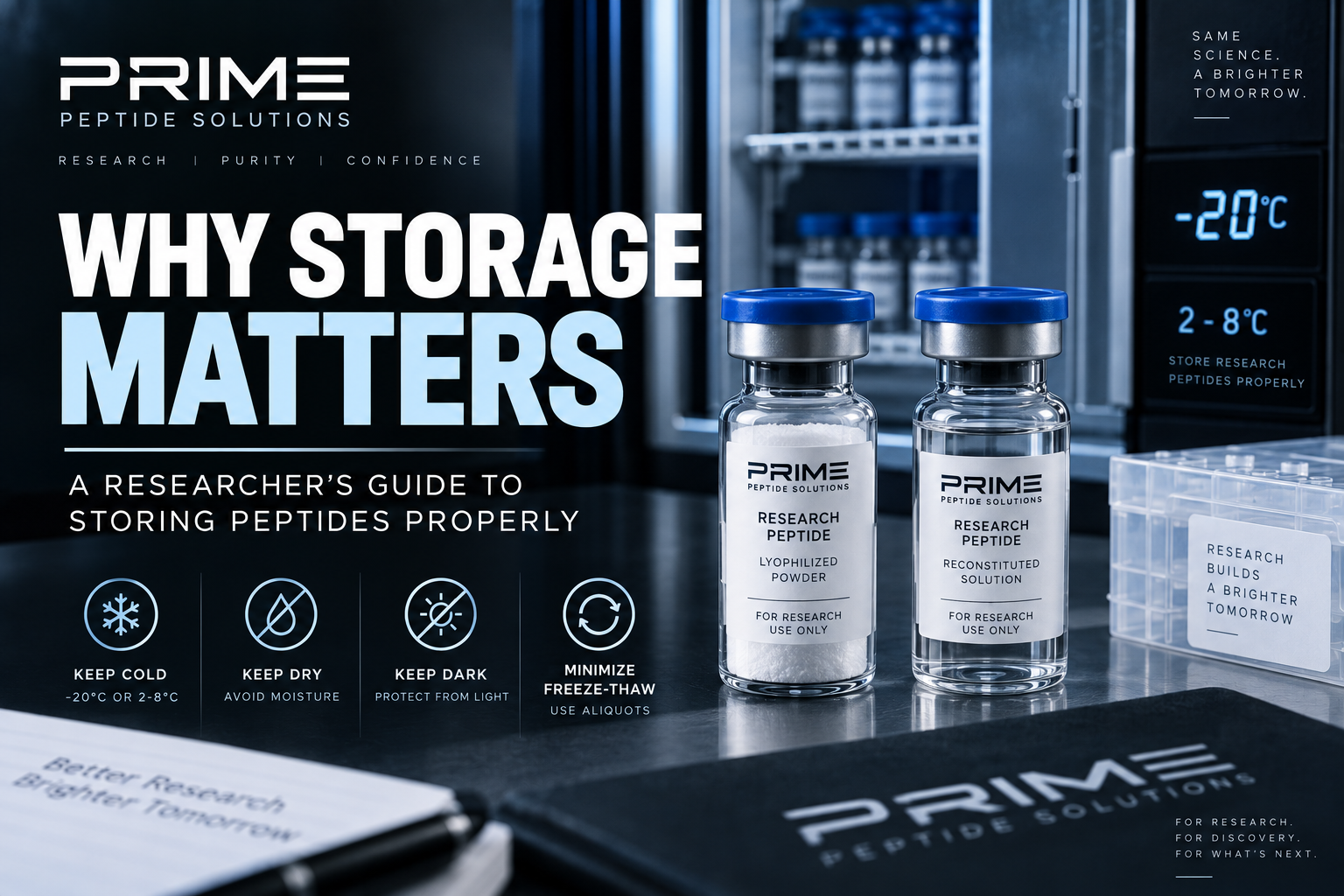
Why Storage Matters
Peptides are sensitive molecules, and proper storage is one of the most important factors in preserving their integrity for research. Improper storage — heat, light, moisture, or repeated freeze-thaw cycles — can contribute to degradation that affects experimental reliability. This guide covers the general principles for storing research peptides in both their lyophilized and reconstituted forms.
This article is intended as a scientific overview for laboratory researchers. All compounds discussed are sold strictly for in-vitro research and are not for human consumption.
Storing Lyophilized (Freeze-Dried) Peptides
In lyophilized form, peptides are at their most stable. General laboratory practice is to keep the sealed vial dry, sealed, and protected from light. For long-term storage, -20°C or colder is commonly recommended. Short-term storage at 2-8°C is often acceptable, but the colder and drier the environment, the better for long-term stability. Moisture is a primary enemy — allowing a cold vial to reach room temperature before opening helps prevent condensation inside.
Storing Reconstituted Peptides
Once reconstituted with bacteriostatic water, peptides are less stable than in dry form. Reconstituted peptide is generally stored at 2-8°C (refrigerated) and used within a shorter window. The bacteriostatic component of the water helps limit microbial growth, but the peptide itself is now in solution and more susceptible to degradation over time. See our guide on reconstituted peptide shelf life for more detail.
The Freeze-Thaw Problem
Repeated freezing and thawing is one of the most damaging things for reconstituted peptides. Each cycle stresses the molecule and can accelerate degradation. A common laboratory practice is aliquoting — dividing reconstituted peptide into smaller single-use portions before freezing — so that each portion is thawed only once.
Light and Temperature Summary
The general principles: keep peptides cold, dry, and dark. Lyophilized at -20°C for long-term; reconstituted at 2-8°C for short-term; protect from light throughout; and minimize freeze-thaw cycles. For reconstitution methodology, see our reconstitution guide, and for verifying peptide integrity, see how peptide purity is verified.
Research-Grade Peptides from Prime Peptide Solutions
We supply lyophilized research peptides with Certificates of Analysis available for every batch on our COA page. Browse the full catalog on our products page.
Sold strictly for in-vitro laboratory research. Not for human or animal consumption. This material has not been evaluated by the FDA.