
Retatrutide vs Survodutide: Triple vs Dual Glucagon-Receptor Co-Agonists
Retatrutide and survodutide are single peptides that combine glucagon receptor (GCGR) and GLP-1 receptor (GLP-1R) agonism. Retatrutide adds a third target, the GIP receptor (GIPR). Published receptor-pharmacology data describe three targets for retatrutide (GCGR, GIPR and GLP-1R) and two for survodutide (GLP-1R and GCGR), so GIPR is the one receptor retatrutide engages that survodutide does not.
The two also start from different native hormones: retatrutide was developed from a GIP backbone, survodutide from the human glucagon sequence. This page compares receptor profiles, backbone design, half-life extension chemistry, and what cell and animal models show about the glucagon-receptor arm the two share. Both appear in published literature, including clinical research; this page covers only receptor pharmacology, structure and preclinical pathways.
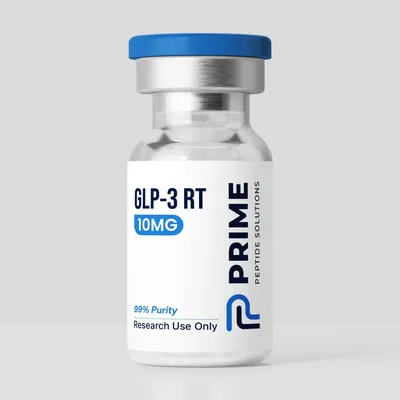
Retatrutide is listed in this catalog as GLP-3 RT (retatrutide). Survodutide is not sold here and is included as a reference compound. The research-grade material sold here is not approved for human use and is not for human or animal consumption.
| Property | Retatrutide | Survodutide |
|---|---|---|
| Agonist class | Triple: GIPR, GLP-1R, GCGR | Dual: GLP-1R, GCGR |
| Design template | GIP backbone; N-terminal tyrosine, as in native GIP | Human glucagon sequence; N-terminal histidine, as in native glucagon |
| Peptide class | Modified peptide, 39 residues | Modified peptide; oxyntomodulin analog |
| Receptor balance in vitro | Balanced at GCGR and GLP-1R, more GIPR activity; more potent than native GIP at GIPR, less potent than native glucagon and GLP-1 at theirs | Balanced GCGR/GLP-1R agonism by design; GLP-1R potency relative to native GLP-1 varies by assay (lower in the standard recombinant-cell assay, similar under low-plasma conditions) |
| Non-coded residues | Aib and alpha-methyl-L-leucine | 1-aminocyclobutane-1-carboxylic acid at the DPP-4 cleavage site |
| Half-life extension | C20 fatty diacid on a lysine via AEEA spacer and gamma-glutamate linker; reversible albumin binding | Long-chain fatty diacid on a glycine-serine linker; albumin binding |
| C-terminus | Amidated | Amidated |
| Glucagon-arm pathways studied in animal models | GCGR contribution to energy-expenditure pathways studied in mice; findings model-dependent | Hepatic GCGR engagement tracked by liver Nnmt, plasma FGF-21 and amino acids in mice |
| In this catalog | GLP-3 RT, 10mg and 20mg vials | Not sold |
About Retatrutide
Structure. Retatrutide is a 39-amino-acid peptide developed from a GIP backbone. Its molecular formula is C221H342N46O68 and its molecular weight is about 4731.4 Da. It contains the non-coded amino acids Aib (alpha-aminoisobutyric acid) and alpha-methyl-L-leucine, and its C-terminus is amidated. A modified lysine carries an AEEA spacer, a gamma-glutamate linker and a C20 fatty diacid that binds serum albumin reversibly and noncovalently.
Receptor profile. In vitro, retatrutide shows balanced GCGR and GLP-1R activity with more GIPR activity. Compared with the native hormones it is more potent at the GIP receptor and less potent at the glucagon and GLP-1 receptors. In mouse models, energy expenditure was linked to the glucagon-receptor component (a model-dependent finding), and appetite-related signalling pathways to GIPR and GLP-1R activity. The triple-agonist concept came from rodent studies of an earlier, different triagonist peptide, in which GIP action buffered the glucose-raising effect of the built-in glucagon activity.
Structural biology. Cryo-EM structures show retatrutide bound to GLP-1R, GIPR and GCGR, each in complex with the Gs protein, as a single continuous helix. The N-terminal segment enters the transmembrane core; the C-terminal segment contacts the extracellular domain, the tip of TM1 and extracellular loop 1 (ECL1). In GLP-1R and GCGR, ECL1 is a short rigid helix, while the GIPR ECL1 is an unwound, flexible loop, and mutations in and next to it strongly reduced retatrutide-induced cAMP signalling.
Hepatic findings. A separate preclinical study examined hepatic lipid-metabolism pathways in mouse and hamster models. More in the retatrutide research overview and a retatrutide PubMed search.
About Survodutide
Structure. Survodutide was designed from the human glucagon sequence, with modifications that balance agonism at the glucagon and GLP-1 receptors. Its sequence begins HXQGTFTSDYSKYLD, matching native glucagon except that X, the non-coded amino acid 1-aminocyclobutane-1-carboxylic acid, replaces the residue next to the N-terminal histidine. That is where dipeptidyl peptidase-4 (DPP-4) cleaves, and together with an amidated C-terminus it improves proteolytic stability. A glycine-serine linker carries a long-chain fatty diacid that mediates albumin binding and extends the terminal half-life.
Oxyntomodulin link. Survodutide is classed as an oxyntomodulin analog, although it was built on the glucagon sequence. Oxyntomodulin, an endogenous proglucagon-derived peptide (the full glucagon sequence plus a short C-terminal extension), activates both the GLP-1 and glucagon receptors and is the natural precedent for this co-agonism.
Cell studies. Survodutide stimulated cAMP in cells expressing recombinant human GCGR and GLP-1R, and activated the endogenous glucagon receptor in primary hepatocytes from mouse, rat, cynomolgus monkey and human; inhibition of glycogen synthesis in rat hepatocytes confirmed GCGR activity. In the standard recombinant-cell assay it was less potent than native GLP-1 and glucagon. In low-plasma conditions its GLP-1R potency was similar to native GLP-1, while it stayed less potent than glucagon at the GCGR.
Animal models. In mice, energy-expenditure pathways (by indirect calorimetry) and appetite-related signalling pathways were studied. GLP-1R knockout mice supported the dual-agonist profile, and cAMP-response-element reporter mice showed GCGR engagement in the liver and GLP-1R engagement in the pancreas. Hepatic GCGR engagement was tracked through higher liver Nnmt mRNA, higher plasma FGF-21 and lower plasma amino acids such as glutamine and serine. The Nnmt and amino-acid changes, and a set of liver transcript changes, did not appear with a semaglutide (GLP-1R-only) comparator. In liver-specific GCGR knockout mice given a related analog, the GCGR-dependent energy-expenditure and plasma amino-acid readouts were blunted or absent.
Brain access. In the mouse brain, labeled survodutide reached the circumventricular organs and adjacent nuclei without evidence of uniformly crossing the blood-brain barrier. GCGR was barely detectable in the area postrema and arcuate nucleus, where GLP1R is expressed. Survodutide activated neurons in nuclei linked to appetite-related signalling, while a GCGR-only agonist did not activate these regions, which the authors read as consistent with the GLP-1R arm driving this central signalling. See a survodutide PubMed search.
Which Should Researchers Choose?
The choice depends on whether GIP-receptor signalling belongs in the research question:
- GIPR contribution: retatrutide is the relevant compound. GIP receptors are described as expressed mainly in pancreatic beta cells and secondarily in adipose and nervous tissue; retatrutide places GIPR, GLP-1R and GCGR agonism on one molecule.
- GLP-1R/GCGR pair without GIP: survodutide (not sold here) isolates the two-receptor combination; its published data include recombinant-cell and primary-hepatocyte GCGR activity.
- Receptor structure and activation: retatrutide has cryo-EM structures at all three receptors, including the flexible GIPR ECL1 contacts, which suits structure-function and mutagenesis work.
- Glucagon-receptor signalling in cells: both engage GCGR in vitro. Survodutide's GCGR arm is described in primary hepatocytes (endogenous receptor activation in four species and inhibition of glycogen synthesis in rat hepatocytes); for retatrutide, in-vitro data describe balanced GCGR and GLP-1R activity alongside more GIPR activity.
- Reference comparators: in receptor-selectivity assays, a GLP-1R-only comparator such as GLP-1 SM (semaglutide) helps separate glucagon-receptor effects. Related pages: tirzepatide vs retatrutide and the three-way GLP comparison.
Frequently Asked Questions
What is the main difference between retatrutide and survodutide?
Receptor count and backbone. Retatrutide is a triple GIPR, GLP-1R and GCGR agonist built on a GIP backbone; survodutide is a dual GLP-1R and GCGR agonist built on the glucagon sequence.
Is survodutide a triple agonist?
No. It is a dual agonist whose listed targets are GLP-1R and GCGR only, with no GIP receptor, and it is classed as an oxyntomodulin analog; retatrutide, built on a GIP backbone, is not in that group.
How is retatrutide handled in the lab?
It is supplied as lyophilized powder, stored cold (2-8 °C, or -20 °C long-term) away from light and warmed to room temperature before opening. Its sequence contains moisture-absorbing Asp, Glu and Lys, so vials stay tightly capped, ideally in a desiccator. Reconstituted solution is kept at 2-8 °C, not shaken and not repeatedly frozen and thawed. See the retatrutide reconstitution guide for lab preparation.
Is survodutide sold here, and are these approved for human use?
Survodutide is not sold in this catalog. Retatrutide is listed as GLP-3 RT in 10mg and 20mg vials, strictly for in-vitro laboratory research. The research-grade material is not approved for human use and is not for human or animal consumption. Batch Certificates of Analysis are on the COA page.
Shop these products
- Ships the same business day
- Free US shipping on $199.99+
- 14-day money-back guarantee on damaged items