

What Are Amylin Analogues?
Amylin, also called islet amyloid polypeptide (IAPP), is a 37-amino-acid peptide hormone of the pancreatic beta cell (Hay et al., 2015), co-secreted with insulin (da Silva et al., 2016). Amylin analogues are synthetic peptides built on its sequence. They exist largely because the native human peptide is hard to work with: its aggregation and solubility properties have held back structure-function studies (Bower and Hay, 2016), and its high propensity to form amyloid fibrils makes analogue design a challenge (Kruse et al., 2021).
This hub covers the class: native human and rat amylin, pramlintide (a proline-substituted analogue) and cagrilintide (a lipidated analogue), with their receptors, identity data and solution chemistry. Calcitonin-based dual agonists appear where they help explain receptor selectivity.
This article is a scientific overview for laboratory researchers. The research-grade cagrilintide supplied by Prime Peptide Solutions is sold strictly for in-vitro laboratory research. It is not approved for human use and is not for human or animal consumption.
Discovery: A Peptide Isolated from Amyloid
Two groups reported the peptide in 1987. One purified a 37-amino-acid peptide with a calculated mass of 3905 Da as a major protein component of amyloid-rich pancreatic extracts and found it 46% identical to rat and human calcitonin gene-related peptide (CGRP) (Cooper et al., 1987). The other purified it from human and cat amyloid deposits, reported a 37-residue human sequence with more than 40% identity to human CGRP, and detected it by immunostaining in islet B cells (Westermark et al., 1987). The CGRP likeness places amylin in the calcitonin peptide family, alongside calcitonin, the two CGRPs and adrenomedullin (Poyner et al., 2002).
The Receptor Map
Receptors for this family are built from one of two G protein-coupled receptors, the calcitonin receptor (CTR) or the calcitonin receptor-like receptor (CLR), alone or with one of three receptor activity-modifying proteins (RAMPs) (Hay et al., 2018):
- CTR: the calcitonin receptor on its own, cloned in 1991 and coupled to cyclic AMP (cAMP) (Lin et al., 1991).
- AMY1, AMY2 and AMY3: CTR with RAMP1, RAMP2 or RAMP3; these are the amylin receptors.
- CGRP receptor: CLR with RAMP1.
- AM1 and AM2: CLR with RAMP2 or RAMP3; these are the adrenomedullin receptors.
RAMPs were first described as the partners that decide whether CLR acts as a CGRP or an adrenomedullin receptor (McLatchie et al., 1998). A year later, RAMP1 or RAMP3 co-expressed with the human calcitonin receptor in COS-7 cells produced specific amylin binding with two distinct phenotypes, mirrored in cAMP responses (Christopoulos et al., 1999). The map has complications: species-dependent CTR splice variants, probable co-expression of CTR alongside its RAMP complexes, and an AMY1(a) receptor activated equally well by amylin and CGRP (Hay et al., 2018). Amylin is reported to act principally in the circumventricular organs of the central nervous system (Hay et al., 2015).
Amylin-type and calcitonin-type binding
In cryo-EM structures, amylin-bound complexes were similar across AMY1, AMY2 and AMY3, constrained by the RAMP and an ordered mid-peptide "bypass motif", while calcitonin-bound amylin receptor complexes overlapped with calcitonin-bound CTR complexes (Cao et al., 2022). Peptides that activate both CTR and the amylin receptors have been built on a salmon calcitonin backbone (32 amino acids) or an amylin backbone (37 amino acids) (Cao et al., 2025).
Native Amylin, Pramlintide and Cagrilintide Side by Side
All amylin-based peptides discussed here share a Cys2-Cys7 disulfide and an amidated C-terminus (Cao et al., 2025). One-letter sequences, with the changes from human amylin:
- Human amylin:
KCNTATCATQ(UniProt P10997, residues 34-70 of the precursor).RLANFLVHSS NNFGAILSST NVGSNTY-NH2 - Rat amylin:
KCNTATCATQ; six differences from human, including prolines at 25, 28 and 29 (UniProt P12969).RLANFLVRSS NNLGPVLPPT NVGSNTY-NH2 - Pramlintide:
KCNTATCATQ; human amylin with Pro25, Pro28 and Pro29 (da Silva et al., 2016).RLANFLVHSS NNFGPILPPT NVGSNTY-NH2 - Cagrilintide:
KCNTATCATQ; the pramlintide backbone plus Glu14, Arg17 and Pro37, with a C20 diacid on a gamma-Glu linker at the N-terminus (Cao et al., 2025).RLAEFLRHSS NNFGPILPPT NVGSNTP-NH2
Molecule at a Glance
- Human amylin (INN amlintide): C165H261N51O55S2; 3903.3 g/mol; CAS 122384-88-7; PubChem CID 16132430
- Pramlintide: C171H267N51O53S2; 3949 g/mol; CAS 151126-32-8; PubChem CID 70691388
- Cagrilintide: C194H312N54O59S2; 4409 g/mol; CAS 1415456-99-3; PubChem CID 171397054
- N-terminus: free amine in amylin and pramlintide; acylated in cagrilintide
- C-terminus: tyrosinamide in amylin and pramlintide; prolinamide in cagrilintide
Formulas and molecular weights are PubChem's computed values for the neutral peptides; salt forms have higher formula masses. The 3905 Da calculated in 1987 sits within 2 Da of PubChem's figure for human amylin.
Findings by Study Model
Synthetic peptides in solution
- The amyloidogenic core. Synthetic peptides for positions 20-29 of human and cat amylin formed amyloid-like fibrils in vitro; the matching segments from three rodent species did not. Ala-Ile-Leu-Ser-Ser (25-29) was strongly amyloidogenic, and a proline-for-serine substitution at 28, as in several rodents, almost completely inhibited fibril formation (Westermark et al., 1990).
- Pramlintide is not fibril-proof. Designed to address the solubility and amyloid characteristics of human amylin, it still assembled into multimers and formed amyloid fibrils in vitro in a pH-dependent process within a few hours (da Silva et al., 2016).
- pH and concentration. Pramlintide had little defined structure in dilute solution, was stable in its pH 4 formulation, and tended to aggregate at high concentration at pH 6 to 7.5 (Nonoyama et al., 2008).
- Zinc. Zn(II) binds the Lys1 amine and the His18 imidazole and bends pramlintide; the initially soluble complex formed fibrillar, oligomeric aggregates after a lag of about 20 hours (Łoboda and Rowińska-Żyrek, 2017; Dudek et al., 2022).
- Cagrilintide's design. N14E and V17R were added to counteract fibril formation by stabilizing the N-terminal helix through a salt bridge (Cao et al., 2025).
Receptor-expressing cells
- Selectivity: pramlintide was amylin-receptor-selective, salmon calcitonin nonselective, and cagrilintide (AM833) nonselective, with a profile unlike the others across 25 endpoints (Fletcher et al., 2021).
- Calcitonin-based dual agonists: KBP-336 was more potent than cagrilintide and biased toward CTR (Larsen et al., 2022); salmon calcitonin and AM1784 behaved alike at CTR and AMY1 but differently at AMY2 and AMY3 in subtype-specific Gs-recruitment assays (Keov et al., 2024).
Purified receptor complexes
Beyond the amylin and calcitonin structures above (Cao et al., 2022), cagrilintide has been solved with AMY1, AMY2, AMY3 and CTR (Cao et al., 2025) and, by a second group, with AMY1 and CTR (Gu et al., 2026).
Animal and human studies
In the 1990 work, the non-fibril-forming segments came from three rodent species that do not develop amylin-derived islet amyloid, while the cat, which does, gave a fibril-forming peptide (Westermark et al., 1990). Whole-animal studies of amylin analogues are outside the scope of this page. Of the analogues here, cagrilintide has been evaluated in phase 1 and phase 2 clinical trials (Cao et al., 2025); the clinical literature is outside the scope of this page.
Key Studies
- Cooper et al., 1987, Proc Natl Acad Sci U S A (PMID 3317417): isolation of the 37-residue peptide and its CGRP homology.
- Christopoulos et al., 1999, Mol Pharmacol (PMID 10385705): RAMP1 and RAMP3 create amylin receptors from the calcitonin receptor.
- Westermark et al., 1990, Proc Natl Acad Sci U S A (PMID 2195544): positions 20-29 and the proline effect on fibril formation.
- Fletcher et al., 2021, J Pharmacol Exp Ther (PMID 33727283): selectivity of cagrilintide, pramlintide and five other agonists.
- Cao et al., 2022, Science (PMID 35324283): structural basis of amylin receptor phenotype.
- Cao et al., 2025, Nat Commun (PMID 40204768): cagrilintide bound to all four target receptors.
Handling Amylin-Based Peptides in the Lab
Keep lyophilized amylin-based peptides sealed, cold, dry and dark, and let a cold vial reach room temperature before opening. In solution, the chemistry above applies. Pramlintide in a pH 4.0 formulation stressed at 40 °C degraded mainly by deamidation, with cyclic imides and backbone hydrolysis making up the rest (Hekman et al., 1999). Under forced degradation, pramlintide acetate degraded extensively under hydrolytic, oxidative and thermal stress but only minimally under light, and reversed-phase and strong-cation-exchange HPLC separated the products for LC-MS identification (Yuan et al., 2018). Because zinc can trigger pramlintide fibril formation after a lag, metal-ion content is worth recording in aggregation work. See our guides to peptide storage, lyophilization, HPLC and mass spectrometry and peptide modifications, which covers C-terminal amides.
Frequently Asked Research Questions
Are amylin and IAPP the same thing?
Yes. Both names refer to the same 37-residue peptide; IAPP reflects its discovery in islet amyloid, and PubChem lists amlintide as its INN.
Why does rat amylin not form fibrils like human amylin?
Its sequence differs at six positions, including prolines at 25, 28 and 29. In synthetic-peptide tests of the 20-29 region, the rodent segments did not form fibrils, and a single proline-for-serine change at 28 almost completely inhibited fibril formation by the human segment.
How is pramlintide related to cagrilintide?
Pramlintide is the backbone peptide used to make cagrilintide, which adds Glu14, Arg17, a C-terminal prolinamide and an N-terminal C20 diacid on a gamma-Glu linker.
Are amylin analogues GLP-1 receptor agonists?
Not the ones covered here. Native amylin, pramlintide and cagrilintide act at the calcitonin receptor and its RAMP complexes, and none of the sources reviewed here reports GLP-1 receptor activity for them. The GLP-1 receptor is a separate but related receptor: when it was cloned, its sequence resembled the receptors for secretin, calcitonin and parathyroid hormone (Thorens, 1992). For cagrilintide beside a GIP, GLP-1 and glucagon receptor agonist, see retatrutide vs cagrilintide.
Which amylin analogue is sold here?
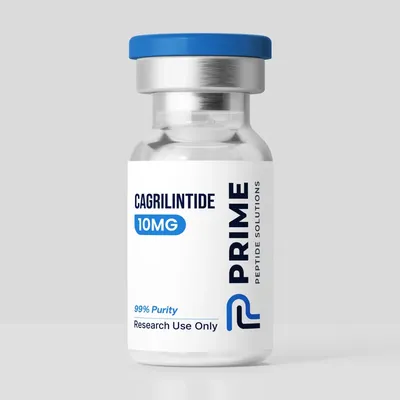
Only cagrilintide, as a 10mg vial of lyophilized powder for in-vitro research. Native amylin, rat amylin and pramlintide are not stocked. Batch lab reports are listed by product and batch on our lab reports page as they become available; check it for a cagrilintide report.
Conclusion
Amylin analogues show how an awkward peptide gets fixed. Human amylin aggregates through its 20-29 region; pramlintide carries the three prolines found in rat amylin yet can still form fibrils under some conditions; cagrilintide adds a helix-stabilizing salt bridge, a C-terminal prolinamide and a lipid. All of them act through the calcitonin receptor and its three RAMP complexes, with selectivity that differs from peptide to peptide.
Disclaimer: This article is provided for educational and research purposes only. It summarizes publicly available scientific literature and does not constitute medical advice. Cagrilintide and all peptide compounds sold by Prime Peptide Solutions are intended strictly for laboratory research, are not approved for human use, and are not for human or animal consumption. Researchers are responsible for compliance with all applicable regulations in their jurisdiction.
Shop Cagrilintide
- Ships the same business day
- Free US shipping on $199.99+
- 14-day money-back guarantee on damaged items
References & Further Reading
- Hay DL et al., 2015. Pharmacol Rev. PMID 26071095.
- Hay DL et al., 2018. Br J Pharmacol. PMID 29059473.
- Poyner DR et al., 2002. Pharmacol Rev. PMID 12037140.
- Bower and Hay, 2016. Br J Pharmacol. PMID 27061187.
- PubChem: human amylin, pramlintide and cagrilintide compound records
Research-Grade Cagrilintide
In our catalog, research-grade cagrilintide is listed as Cagrilintide, a lyophilized powder in one size, a 10mg vial. Batch lab reports are listed by product and batch on our lab reports page as they become available. To verify a supplier's report, see how to verify a peptide COA.
Sold strictly for in-vitro laboratory research. Not for human or animal consumption.