

What Are Peptide Modifications?
Many research peptides are not plain strings of the twenty standard amino acids. Their labels carry small chemical changes: an acetyl cap, a C-terminal amide, a DAC group, a D-amino acid, or an LR3 extension. Each name signals a specific change to the chain, usually made to slow enzymatic breakdown, change how the molecule binds, or raise its stability. This page explains the modifications that appear on peptides in our catalog, with the chemistry behind each and a note on why it is there.
It is a reference companion to the individual compound pages and to our primer on peptide structure, so it keeps to the chemistry of the modifications rather than the biology of any one peptide.
This article is a scientific overview for laboratory researchers. All research-grade peptides discussed are supplied by Prime Peptide Solutions strictly for in-vitro laboratory research. They are not approved for human use and are not for human or animal consumption.
Why Modify a Peptide at All?
A plain peptide is vulnerable at both ends and at certain residues: exopeptidases cut inward from a free N-terminus (aminopeptidases) or C-terminus (carboxypeptidases), endopeptidases cut internal bonds, and some side chains react on their own in water. A review of half-life strategies describes modification of the N- and C-terminus, replacement of L-amino acids with D-amino acids, and attachment of polyethylene glycol (PEGylation), and summarizes the main proteolytic enzymes of human blood, liver and kidney and their cleavage specificity (Werle and Bernkop-Schnürch, 2006). The modifications below are specific examples.
N-Terminal Acetylation
Acetylation puts an acetyl group (CH3CO-) on the N-terminal amino group, removing the positive charge there and changing the chemistry of that end. A 2018 review notes the change is irreversible and affects a protein's folding, binding and lifespan (Ree et al., 2018).
As a deliberate research modification, acetylation blocks aminopeptidase attack at the N-terminus. In a study in fresh human plasma in vitro, a nine-residue immunogenic peptide had a calculated half-life of 22 seconds; C-terminal amidation and/or N-terminal acetylation (capping) markedly prolonged its stability, and the capped peptides were still recognized by the T cells used to detect them (Brinckerhoff et al., 1999).
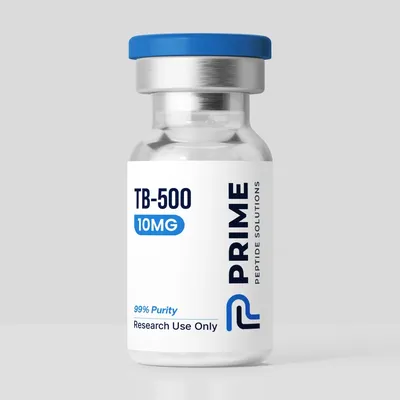
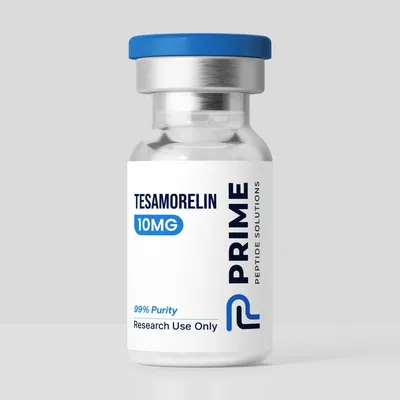
Where it appears here. TB-500 is the acetylated form of the thymosin beta-4 fragment LKKTETQ: the key ingredient is the peptide LKKTETQ with artificial acetylation of the N-terminus, as described in an analytical study of the compound (Ho et al., 2012). LKKTETQ corresponds to residues 17-23 of thymosin beta-4, described as the protein's actin-binding active site (Ho et al., 2012; Sosne et al., 2010). Tesamorelin carries a related N-terminal acyl group, a trans-3-hexenoyl moiety on Tyr1, which made the peptide resistant to DPP-IV inactivation (Ferdinandi et al., 2007).
C-Terminal Amidation
Amidation replaces the C-terminal -COOH with -CONH2, removing the negative charge at that end. In the body, amidated hormones are built from glycine-extended precursors, and a single bifunctional enzyme, peptidylglycine alpha-amidating monooxygenase (PAM), cleaves the glycine to leave the amide (Prigge et al., 2000). In structure-activity data for 45 bioactive peptides, the C-terminal amide was required for the full biological activity of most amidated peptide hormones (Merkler, 1994).
For a synthetic peptide, the C-terminal amide is one of the capping changes that protected that same nine-residue peptide from peptidase breakdown in plasma, mirroring acetylation at the N-terminus (Brinckerhoff et al., 1999).
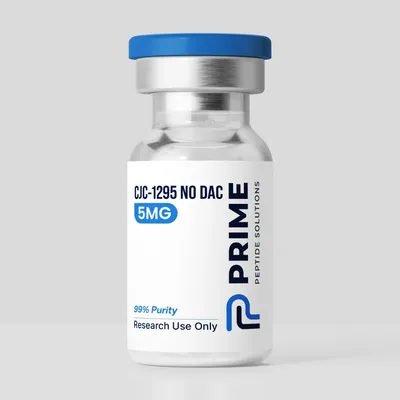
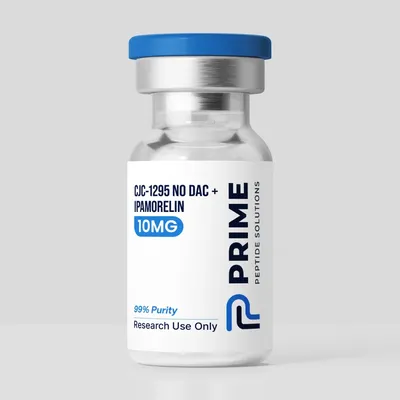
Where it appears here. The GHRH analogs end in a C-terminal amide, matching native GHRH, GRH(1-44)-NH2 (Frohman et al., 1986); this is true of CJC-1295 no DAC (Mod GRF 1-29) and the CJC-1295 portion of the CJC-1295 no DAC + Ipamorelin blend. Ipamorelin (Aib-His-D-2Nal-D-Phe-Lys-NH2), SS-31 (D-Arg-Dmt-Lys-Phe-NH2) and Tesamorelin, an analog of hGRF(1-44)-NH2, are also C-terminally amidated.
D-Amino Acid Substitution
Natural peptides are built from L-amino acids. Swapping in the mirror-image D form at a cleavage site stops the enzyme that recognizes the L geometry. A study that placed D-amino acids in the flanks of an epitope peptide found high resistance to proteolysis in serum and in a lysosomal preparation, while antibody recognition was kept (Tugyi et al., 2005).
Where it appears here. The clearest example is position 2 of Mod GRF 1-29 (CJC-1295 no DAC). Dipeptidyl peptidase IV (DPP-IV) inactivates native GHRH by cutting the Ala2-Asp3 bond (Kubiak et al., 1993); replacing L-Ala with D-Ala at position 2 lowers metabolic clearance, shown directly in a human study of D-Ala2-GHRH(1-29)-NH2 (Soule et al., 1994). Ipamorelin carries two D residues, D-2Nal and D-Phe, in its five-residue chain, and SS-31 begins with D-arginine.
Other Residue Substitutions: The "Mod" in Mod GRF
Not every substitution involves handedness. CJC-1295 no DAC, also called Mod GRF 1-29, carries four changes to GRF(1-29): D-Ala2, Gln8, Ala15 and Leu27. A 1994 study laid out the logic: native GRF rearranges at Asn8 through an aminosuccinimide intermediate and oxidizes at Met27 in water, both lowering activity, so residue 8 is changed to slow isomerization and residue 27 to stop oxidation; Ala15 had separately been shown to raise receptor binding affinity (Campbell et al., 1994). In rat pituitary cells, the Ala15 form was 5 times more potent than the Gly15 form (Coy et al., 1991). Each of those four changes is a worked example of why a residue gets swapped: to defeat a protease, to remove a reactive side chain, or to tune receptor binding.
DAC: Drug Affinity Complex
DAC, short for drug affinity complex (the term used, for example, in a 2021 analytical study of CJC-1295 with DAC; Memdouh et al., 2021), is a larger addition rather than a residue swap. It is a maleimidopropionamide group placed on a lysine added to the peptide, designed to bind covalently to the free thiol of serum albumin in the bloodstream, which tethers the small peptide to a long-lived carrier protein. In the paper that introduced CJC-1295, it is described as a tetrasubstituted hGRF(1-29) with this group at the C terminus, and in rats it remained in plasma beyond 72 hours, found on the albumin band (Jetté et al., 2005). In that respect it resembles PEGylation, which a review of half-life strategies lists among the ways to prolong plasma half-life: both attach a small peptide to something much larger (Werle and Bernkop-Schnürch, 2006).
Where it appears here. Nowhere, by design. Our catalog carries the no-DAC form of CJC-1295 only, so "no DAC" on the label is the absence of this group. The two forms are compared in the CJC-1295 with vs without DAC comparison.
LR3: Long R3
LR3 is an extension plus a point change, seen on IGF-1 LR3. "L" is the 13-residue N-terminal extension and "R3" is arginine replacing glutamic acid at position 3 of IGF-I. The original 1992 papers describe these "Long" analogues as the first 11 residues of methionyl porcine growth hormone plus Val-Asn, joined to an IGF-I sequence, with Long [Arg3]-IGF-I carrying arginine at position 3 (Francis et al., 1992). Unlike the capping modifications, LR3 is not mainly about protease resistance: it weakens binding to IGF-binding proteins, about 1,000-fold against IGFBP-3 and others, which is what raises the analog's potency in cell culture (Ballard et al., 1993).
Modifications at a Glance
- N-terminal acetylation: acetyl cap on the N-terminus; blocks aminopeptidases and removes the N-terminal charge. Example: TB-500.
- C-terminal amidation: -COOH becomes -CONH2; protects that end and is often needed for activity. Examples: CJC-1295 no DAC, Ipamorelin, Tesamorelin, SS-31.
- D-amino acid: mirror-image residue at a cut site; resists site-specific proteases such as DPP-IV. Examples: D-Ala2 in CJC-1295 no DAC; Ipamorelin; SS-31.
- Residue substitution: one standard residue for another; removes reactive residues or tunes binding. Example: Mod GRF 1-29 (Gln8, Ala15, Leu27).
- DAC: albumin-binding group on an added lysine; extends duration through albumin. Not stocked (we carry the no-DAC form only).
- LR3: N-terminal extension plus Arg3; weakens IGF-binding-protein binding. Example: IGF-1 LR3.
Key Studies
- Werle and Bernkop-Schnurch, 2006, Amino Acids (PMID 16622600): survey of half-life strategies and of the main proteases in blood, liver and kidney.
- Brinckerhoff et al., 1999 (PMID 10495424): N-terminal acetylation and/or C-terminal amidation prolonged a peptide's stability in human plasma in vitro.
- Prigge et al., 2000, Cell Mol Life Sci (PMID 11028916): how C-terminal amides are made from glycine-extended precursors by PAM.
- Jetté et al., 2005, Endocrinology (PMID 15817669): the DAC group and albumin binding on a GRF(1-29) analog.
- Francis et al., 1992, J Mol Endocrinol (PMID 1378742): the Long [Arg3] IGF-I analogues.
How Modifications Show Up on a COA
Most of these modifications change the exact mass, so a mass spectrometry check on a Certificate of Analysis is the surest identity test. An acetyl cap adds about 42 Da, an amide changes the C-terminus by roughly 1 Da against the free acid, a D-for-L swap leaves the mass unchanged (so it is confirmed another way), and DAC or LR3 shift the mass substantially. Our guides to HPLC and mass spectrometry and reading a peptide COA explain each field, and the lyophilized material is handled as described in our storage and lyophilization guides.
Frequently Asked Research Questions
What does an acetylated N-terminus do?
It caps the N-terminal amino group with an acetyl group, removing that end's positive charge and blocking aminopeptidases that would otherwise cut inward from the free N-terminus. TB-500 is an N-acetylated fragment.
Why are so many peptides amidated at the C-terminus?
Two reasons: in many natural hormones the C-terminal amide is required for full activity, and for a synthetic peptide the amide caps that end, which helped protect a test peptide from breakdown in plasma.
What is a D-amino acid for?
Proteases recognize the natural L geometry, so a mirror-image D residue placed at a cut site stops that enzyme. D-Ala at position 2 of CJC-1295 no DAC (Mod GRF 1-29) is used to resist DPP-IV cleavage.
What does DAC mean, and does PPS sell it?
DAC (drug affinity complex) is an albumin-binding group that greatly extends a peptide's duration. PPS stocks only the no-DAC form of CJC-1295, so "no DAC" marks its absence.
Is LR3 just another cap?
No. LR3 is an N-terminal extension plus arginine at position 3 of IGF-I. Its main effect is to weaken binding to IGF-binding proteins, not to resist proteases.
Conclusion
The modifications on a research-peptide label are shorthand for specific chemistry: acetylation caps the N-terminus, amidation caps the C-terminus, D-amino acids and residue swaps defeat site-specific proteases or tune binding, DAC tethers a peptide to albumin, and LR3 extends IGF-I and weakens its binding-protein interaction. Each is a deliberate answer to a known weakness of plain peptides, and all of them except a D-for-L swap change the exact mass, so a mass spectrometry check on a COA is the main way to confirm the intended modification is present.
Disclaimer: This article is provided for educational and research purposes only. It summarizes publicly available scientific literature and does not constitute medical advice. All peptide compounds sold by Prime Peptide Solutions are intended strictly for laboratory research, are not approved for human use, and are not for human or animal consumption. Researchers are responsible for compliance with all applicable regulations in their jurisdiction.
Shop these products
- Ships the same business day
- Free US shipping on $199.99+
- 14-day money-back guarantee on damaged items
References & Further Reading
- Werle M and Bernkop-Schnürch A, 2006. Amino Acids. PMID 16622600.
- Brinckerhoff LH et al., 1999. PMID 10495424.
- Prigge ST et al., 2000. Cell Mol Life Sci. PMID 11028916.
- Merkler DJ, 1994. Enzyme Microb Technol. PMID 7764886.
- Kubiak TM et al., 1993. J Med Chem. PMID 8464043.
- Soule S et al., 1994. J Clin Endocrinol Metab. PMID 7962295.
- Campbell RM et al., 1994. Peptides. PMID 7937325.
- Jetté L et al., 2005. Endocrinology. PMID 15817669.
- Francis GL et al., 1992. J Mol Endocrinol. PMID 1378742.
- Ballard FJ et al., 1993. Growth Regul. PMID 7683526.
Research-Grade Peptides Referenced Here
The modifications above appear on several peptides in our catalog: CJC-1295 no DAC, IGF-1 LR3, TB-500 and SS-31, each supplied as a lyophilized powder. Published lab reports (COAs) are listed on our COAs page.
Sold strictly for in-vitro laboratory research. Not for human or animal consumption.