

What Is Net Peptide Content?
Net peptide content (also called peptide content, NPC or the peptide mass fraction) is the share of a weighed peptide powder that is the peptide itself. The rest is mostly counter-ions, such as trifluoroacetate (TFA) or acetate, held by charged groups on the chain, plus residual water. HPLC purity is a different number: the share of the detected, peptide-related material that elutes as the target sequence. A purified peptide can have very few related impurities and still be under 80% peptide by mass, as the reference studies below show.
This guide explains both numbers, where counter-ions come from, how each is measured, and which fields the Prime Peptide Solutions lab reports show. For a tour of a whole COA, see how to read a peptide COA; for checking that a report is genuine, see how to verify a peptide COA.
This article is a scientific overview for laboratory researchers. The research-grade peptides supplied by Prime Peptide Solutions are sold strictly for in-vitro laboratory research. They are not approved for human use and are not for human or animal consumption.
Three Numbers That Are Often Confused
Numbers at a Glance
- HPLC purity: the target peak area as a percentage of all detected peaks, usually by UV absorbance near 214 nm.
- Net peptide content: peptide mass as a percentage of total powder mass.
- Molecular weight: the mass of one molecule of the free peptide, as PubChem lists it; a salt form weighs more per molecule.
- Counter-ion and water content: the mass percentages of trifluoroacetate, acetate or chloride and of residual moisture, each measured by its own method.
- Identity: a mass spectrometry check that the main component has the expected mass; it does not measure quantity.
Counter-Ions at a Glance
- Trifluoroacetic acid (TFA): C2HF3O2, 114.02 g/mol, CAS 76-05-1, PubChem CID 6422; present as trifluoroacetate
- Acetic acid: C2H4O2, 60.05 g/mol, CAS 64-19-7, PubChem CID 176; present as acetate
- Hydrochloric acid: HCl, 36.46 g/mol, CAS 7647-01-0, PubChem CID 313; present as chloride
Where Counter-Ions Come From
Most synthetic peptides are assembled by solid-phase synthesis, cut from the resin with TFA and purified by reversed-phase HPLC in TFA-containing solvents. Because of these conditions, cationic peptides are mainly obtained as trifluoroacetate salts (Roux et al., 2008; Cornish et al., 1999). The anions pair with positively charged groups: the free N-terminal amine and the side chains of lysine, arginine and histidine, so more basic groups mean more possible non-peptide mass. A review of synthesis-related impurities lists trifluoroacetate among the counter-ions that can remain in a finished peptide (D'Hondt et al., 2014).
TFA, Acetate and Hydrochloride Salts
The 2008 study gives pKa values of about 0 for TFA, 4.5 for acetic acid and -7 for hydrochloric acid. It describes the classic exchange as repeated freeze-drying with excess hydrochloric acid, noting that working below pH 1 can degrade peptides, and compares reversed-phase HPLC, an ion-exchange resin and a deprotonation and reprotonation route on the octapeptide lanreotide (Roux et al., 2008). With the peptide indolicidin, hydrochloric acid above about 10 mM in unbuffered solution could modify the structure and reduce thermal stability, while 2 to 10 mM removed essentially all TFA (Andrushchenko et al., 2007). Freeze-drying from either hydrochloric or acetic acid lowered trifluoroacetate to satisfactory levels in a later comparison (Mrozik et al., 2012).
Why the salt form can matter
- Infrared spectroscopy: trifluoroacetate has a strong band at 1673 cm-1 that overlaps or hides the amide I band used to estimate secondary structure (Andrushchenko et al., 2007).
- Cell culture: TFA at 10-8 to 10-7 M lowered cell numbers in fetal rat osteoblast cultures, and TFA salts of three peptides consistently gave less proliferation than their hydrochloride salts (Cornish et al., 1999).
- Antimicrobial assays: acetate, hydrochloride and trifluoroacetate salts of five antimicrobial peptides differed in activity and cytotoxicity, with no pattern consistent across peptides (Sikora et al., 2018).
How Each Number Is Measured
HPLC purity. Reversed-phase HPLC separates the target from related sequences, and a UV detector near 214 nm records each peak. The peptide bond absorbs there (923 M-1 cm-1), while tryptophan absorbs about 30 times more and phenylalanine, tyrosine and histidine about six times more (Kuipers and Gruppen, 2007). An area percentage is a ratio of UV absorbance among peptide-related peaks; it does not account for water or counter-ions.
Net peptide content. Reference laboratories use amino acid analysis after hydrolysis (for example by isotope-dilution LC-MS/MS), quantitative NMR of the intact peptide, or mass balance, which subtracts every measured impurity, including related peptides, water and counter-ion, from the total (Melanson et al., 2018; Chen et al., 2026). Trifluoroacetate can be measured by 19F quantitative NMR (Melanson et al., 2018), and ion chromatography performed well for acetate, trifluoroacetate and chloride (Mrozik et al., 2012).
Two worked examples
- Angiotensin II reference material: TFA made up nearly 25% of the mass; three methods agreed closely, and the final assigned purity was 691 ± 9 mg/g, about 69% by mass (Melanson et al., 2018).
- Sublancin: mass balance gave 78.60% after subtracting 5.46% water, 15.48% trifluoroacetate, 0.4% structurally related impurities and 0.056% inorganic impurities; the certified value was 78.1% (Chen et al., 2026). Related impurities, which HPLC purity reflects, were a small slice.
An illustrative calculation
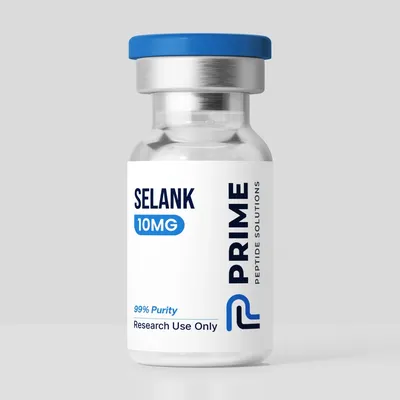
Selank has a free-peptide molecular weight of 751.9 g/mol and three basic sites near neutral pH (the N-terminal amine, lysine and arginine). With one counter-ion per site, the peptide would be about 68.7% of a tris-trifluoroacetate salt (1094.0 g/mol), 80.7% of a tris-acetate (932.1 g/mol) and 87.3% of a trihydrochloride (861.3 g/mol), before any water. Real ratios depend on pH and processing, which is why they are measured; this is arithmetic, not a statement about any batch.
What the Prime Peptide Solutions Lab Reports Show
The published reports, issued by Kovera Labs, carry a test table with a reference value and a measured value for three rows:
- Purity: reference greater than 98%, given to three decimals, with a chromatogram labeled RP-HPLC, C18 column, diode-array detection at 214 nm.
- Net Content: a mass in milligrams set against an approximate reference equal to the labeled quantity.
- Identity Confirmation (LC-MS): the compound identified against the one expected.
The sample section lists product, batch, form, labeled quantity and vial colors; single-compound reports add a formula and CAS number. Blend reports give blend averages for purity and net content, a blend identification and a table of labeled and measured component amounts. The Net Content row is a mass compared with the labeled quantity, not a net peptide content percentage, and the reports do not state its method, the salt form, a counter-ion content or a water content.
- GHK-Cu 50mg, BATCH-0425: purity 99.311%, net content 53.92 mg (reference about 50 mg)
- Tesamorelin 10mg, BATCH-0422: 99.384%, 11.52 mg (about 10 mg)
- MOTS-C 20mg, BATCH-0423: 99.659%, 21.44 mg (about 20 mg)
- KLOW 80mg, BATCH-0502: blend average 99.849%, 87.24 mg (about 80 mg)
- Wolverine (BPC-157 + TB-500) 20mg, BATCH-0501: blend average 99.509%, 22.63 mg (about 20 mg)
- CJC-1295 no DAC + Ipamorelin 10mg, BATCH-0426: blend average 99.248%, 11.08 mg (about 10 mg)
All published reports are grouped on the lab reports by product page.
Reading the Numbers Together
- Purity speaks to related-sequence impurities, not to how much peptide a vial holds.
- Net content (a mass) or net peptide content (a percentage) speaks to quantity, not sequence.
- Identity confirms the expected mass but does not quantify.
- PubChem molecular weights describe the free peptide, as in our research peptide reference table, and a CAS number can refer to either a salt or the free peptide.
For the methods, see how HPLC and mass spec verify purity and what COA purity numbers mean.
Handling and Storage of Lyophilized Material
Purified peptide powders carry some water (5.46% of the sublancin mass), and moisture picked up after opening adds mass that is not peptide. Keep vials sealed, cold, dry and away from light, let a cold vial reach room temperature in a desiccator before opening, and reseal it promptly. See the peptide storage guide and the lyophilization explainer.
Key Studies
- Roux et al., 2008 (J Pept Sci): TFA salts from cleavage and purification; three exchange approaches compared. PubMed 18035848
- Andrushchenko et al., 2007 (J Pept Sci): the 1673 cm-1 trifluoroacetate band; hydrochloric acid range for TFA removal. PubMed 17031869
- Mrozik et al., 2012 (J Pept Sci): measuring acetate, trifluoroacetate and chloride in synthetic peptides. PubMed 22252914
- Cornish et al., 1999 (Am J Physiol): TFA and cell proliferation in osteoblast cultures; TFA versus hydrochloride salts. PubMed 10567002
- Sikora et al., 2018 (Amino Acids): three salt forms of five antimicrobial peptides compared. PubMed 29307075
- Melanson et al., 2018 (Anal Bioanal Chem): angiotensin II reference material; TFA near 25% by mass. PubMed 30143839
- Chen et al., 2026 (J Chromatogr B): sublancin mass balance: water, trifluoroacetate and impurities. PubMed 41916078
- Kuipers and Gruppen, 2007 (J Agric Food Chem): UV absorption of the peptide bond and amino acids at 214 nm. PubMed 17539659
- D'Hondt et al., 2014 (J Pharm Biomed Anal): review of synthesis-related peptide impurities, including counter-ions. PubMed 25044089
Frequently Asked Research Questions
What is the difference between net peptide content and HPLC purity?
HPLC purity compares the target peak with related peptide peaks. Net peptide content compares peptide mass with total powder mass, which also includes counter-ions and water.
Why are so many synthetic peptides TFA salts?
Trifluoroacetic acid is used for resin cleavage and as an HPLC solvent additive, so cationic peptides come out as trifluoroacetate salts unless the counter-ion is exchanged.
Is an acetate salt the same peptide as a TFA salt?
The chain is the same and the counter-ion differs. That changes the mass per molecule and the peptide fraction, and some cell and antimicrobial assays have read the salt forms differently.
What does Net Content mean on the Prime Peptide Solutions lab reports?
A measured mass in milligrams listed against the labeled quantity, such as 21.44 mg against about 20 mg on the MOTS-C report. It is not a percentage.
Do the published reports list TFA, acetate or water content?
No. They list purity, net content and LC-MS identity, plus sample details.
Conclusion
HPLC purity measures related-sequence impurities; net peptide content measures how much of the powder is peptide. Counter-ions from TFA cleavage and purification, plus residual water, explain most of the gap between the two. The published Prime Peptide Solutions reports give purity, a net content in milligrams and LC-MS identity, but not a salt form, counter-ion content or water content.
Disclaimer: This article is provided for educational and research purposes only. It summarizes publicly available scientific literature and does not constitute medical advice. All peptide compounds sold by Prime Peptide Solutions are intended strictly for laboratory research, are not approved for human use, and are not for human or animal consumption. Researchers are responsible for compliance with all applicable regulations in their jurisdiction.
Shop Selank
- Ships the same business day
- Free US shipping on $199.99+
- 14-day money-back guarantee on damaged items
References & Further Reading
- PubMed: Peptide trifluoroacetate counter-ion literature
- PubChem: Trifluoroacetic acid (CID 6422)
- Related: How to read a peptide COA
Lab Reports at Prime Peptide Solutions
Published batch reports are listed on the lab reports page and the COAs page.
Sold strictly for in-vitro laboratory research. Not for human or animal consumption.