

Endotoxin testing measures bacterial lipopolysaccharide (LPS) in a sample, usually reported as EU per mg of peptide, using the LAL assays of USP <85> or recombinant Factor C (USP <86>). Sterility testing (USP <71>) looks for living microbes instead. HPLC purity measures neither, so a 99% peptide can still carry endotoxin.
This guide explains what each test detects, the pharmacopeial chapter behind it, what can distort a result, how to ask a lab for these tests, and what the lab reports for Prime Peptide Solutions products include today. It is written for researchers running cell-based and other in-vitro work, where endotoxin is a known source of misleading readouts.
This article is a scientific overview for laboratory researchers. Peptides sold by Prime Peptide Solutions are for in-vitro laboratory research only, are not FDA-approved for any use in people, and are not for human or animal consumption.
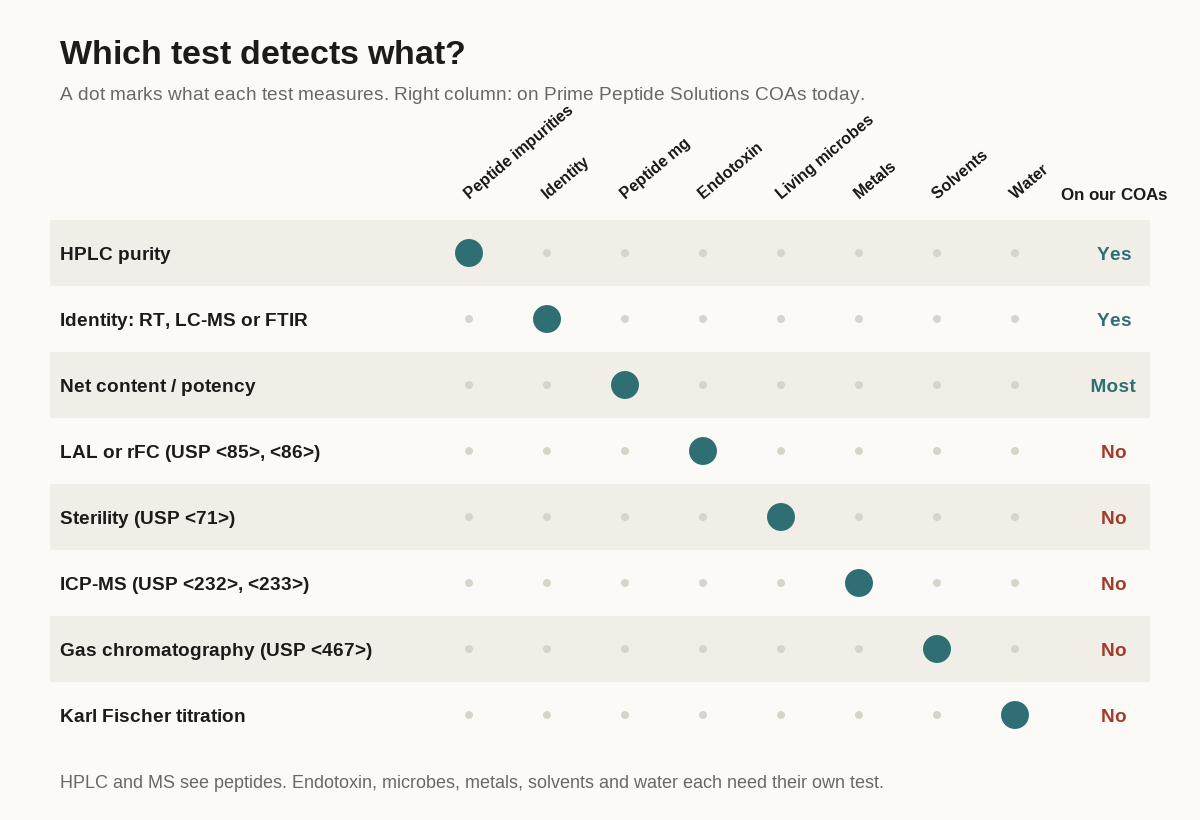
Which Test Detects What? (At a Glance)
| Test | What it detects | Standard or method | Reported as | Seen by HPLC/MS? | On our COAs today? |
|---|---|---|---|---|---|
| HPLC purity | The target peptide as a share of peptide-related peaks | Reverse-phase HPLC with UV detection | % of peak area | It is the HPLC result | Yes, on every report |
| Identity | Whether the main peak is the labeled peptide | Retention time vs a reference, LC-MS, or FTIR | Confirmed / not confirmed | Yes | Yes: retention time (ILS Labs), LC-MS (Kovera Labs) or FTIR (BT Labs) |
| Net peptide content | How many mg of peptide the vial holds | HPLC quantitation against a standard | mg per vial | Yes | Yes, on most reports |
| LAL gel-clot | Endotoxin above the lysate's sensitivity | USP <85> | Pass / fail at a stated limit | No | No |
| LAL kinetic turbidimetric or chromogenic | Endotoxin, quantitatively | USP <85> | EU/mg or EU/mL | No | No |
| Recombinant Factor C (rFC) | Endotoxin, without the glucan pathway | USP <86>, official since May 2025 | EU/mg or EU/mL | No | No |
| Sterility | Living microorganisms that grow in culture media | USP <71> | No growth / growth | No | No |
| Bioburden | How many microorganisms are present | USP <61> | CFU per g or per mL | No | No |
| Elemental impurities | Metals such as Pb, Cd, As and Hg | USP <232> and <233>, by ICP-MS or ICP-OES | µg per g | No | No |
| Residual solvents | Solvents left from synthesis and purification | USP <467>, by gas chromatography | ppm | No | No |
| Water content | Moisture in the powder | Karl Fischer titration | % w/w | No | No |
What Is Endotoxin?
Endotoxin is lipopolysaccharide from the outer membrane of Gram-negative bacteria. LPS has three parts: a hydrophobic lipid A anchor, a core oligosaccharide and a variable O-antigen polysaccharide; lipid A carries the endotoxic activity, and in animal cells it is recognized by Toll-like receptor 4 (TLR4), which signals through the adaptor MyD88 [1]. The genetic proof came from two LPS-unresponsive mouse strains: C3H/HeJ carries a missense mutation in Tlr4 and C57BL/10ScCr a null mutation [2]. The crystal structure later showed LPS bound in a hydrophobic pocket of the co-receptor MD-2, five of its six lipid chains buried inside, with two TLR4-MD-2-LPS complexes forming an m-shaped multimer [3].
Two bench facts follow. LPS is amphiphilic, so it aggregates and sticks to surfaces and to many peptides and proteins, which makes it hard to remove once present [4]. And it is a molecule, not an organism: filtering or autoclaving can leave a solution free of living bacteria but still full of the LPS they shed.
Do Research Peptides Have Endotoxins?
They can, and without a test result nobody knows how much. Peptides made by solid-phase synthesis are not expressed in bacteria, so they do not start with the LPS load of a protein made in E. coli. LPS can still enter through water, buffers and salts, chromatography media, glassware and the filling and freeze-drying steps, and a review of removal methods (adsorption, two-phase partitioning, ultrafiltration, chromatography) describes efficient, cost-effective removal as challenging [4]. We found no peer-reviewed survey of endotoxin levels in research-grade synthetic peptides, so a figure for a given vial has to come from a test of that lot.
Why it matters in vitro: endotoxin in a test compound can produce a TLR4-driven readout that looks like a property of the compound. A review of recombinant proteins made in bacteria raised concerns that some of the effects reported for them may be due to LPS contamination [5]. One study found that most suppliers of recombinant proteins guarantee below 1 EU, measured contamination in that range and sometimes above it, and showed that CD1c+ dendritic cells responded to amounts of LPS equivalent to the contamination in some commercial proteins [6]. Monocyte, macrophage and dendritic-cell assays are the most exposed.
How Does the LAL Test Work?
The LAL test grew from Bang's 1956 finding that Gram-negative bacteria make the blood of the horseshoe crab Limulus polyphemus clot [7]; in 1964 Levin and Bang showed that endotoxin itself triggers the clotting [8]. The amebocyte lysate contains a cascade of serine protease zymogens: endotoxin activates Factor C, Factor C activates Factor B, Factor B activates the proclotting enzyme, and the clotting enzyme turns coagulogen into a coagulin gel. A second, (1,3)-β-D-glucan pathway through Factor G also ends in a gel [9]. USP <85> standardizes the three LAL formats:
| Method | Readout | Result |
|---|---|---|
| LAL gel-clot | A firm gel that holds when the tube is inverted | Pass or fail at the lysate's labeled sensitivity |
| LAL kinetic turbidimetric | Rising turbidity as the clot forms, read over time | Quantitative, from a standard curve of reference endotoxin |
| LAL kinetic or endpoint chromogenic | The clotting enzyme releases a yellow chromophore (p-nitroaniline) | Quantitative, from a standard curve |
| rFC (fluorescent) | Activated recombinant Factor C cleaves a fluorogenic substrate | Quantitative, from a standard curve |
The glucan pathway is the classic false-positive source. All LAL reagents in one study were at least 1,000-fold more sensitive to endotoxin than to LAL-reactive glucans, but glucans also amplified the response to endotoxin, in a concentration-dependent way [10]. Cellulose-based filters and other plant or fungal materials can shed such glucans.
What Is rFC, and Is It Equal to LAL?
Recombinant Factor C is the first enzyme of the cascade, made by genetic engineering [11]. The recombinant proenzyme, about 132 kDa, is activated by endotoxin and then cleaves a fluorogenic substrate, so there is no Factor G and no glucan pathway [12]. In a six-year proficiency program, two rFC assays were comparable to a kinetic chromogenic LAL assay, all results met compendial acceptance criteria, and the rFC assays found spiked endotoxin even more completely [13]. Another comparison found that rFC and LAL agreed for LPS from E. coli, B. cepacia and Salmonella but differed for LPS from K. pneumoniae, S. marcescens, B. pertussis and P. aeruginosa, and that only the rFC readout correlated with IL-6 release from a monocytic cell line [14]. A conservation study adds that switching water and common materials to rFC could cut the use of horseshoe-crab reagents by 90% [15].
Status: USP chapter <86>, Bacterial Endotoxins Test Using Recombinant Reagents, was published for early adoption in November 2024 and became official in May 2025. USP describes it as an alternative alongside the LAL methods of <85>, not a replacement. In short: rFC is equivalent for most purposes, and because different LPS structures react differently, a result should always name its method.
What Does EU/mg Mean?
EU is a measure of endotoxin activity, not of mass. It is defined against a reference standard endotoxin, and LPS from different bacteria differs in potency, so EU values should not be converted to nanograms of LPS. Three forms appear on reports:
- EU/mL describes a liquid as tested: water, a buffer, or a solution made from the peptide.
- EU/mg relates the activity to the mass of material, the usual form for a freeze-dried peptide.
- A "less than" result, such as <0.5 EU/mg, means nothing was detected above the method's limit at the dilution tested. It reflects the method's sensitivity and is not a measurement of zero.
For a cell assay, what matters is the endotoxin concentration in the final culture well, and that rises in step with the peptide concentration a study uses, alongside any endotoxin carried in by medium and serum. Pharmacopeial limits for finished medicines are calculated differently and do not apply to research material.
Why Can HPLC Not Show Endotoxin or Sterility?
Because it is not built to. Reverse-phase HPLC with UV detection separates peptide-related components and reports the target peptide as a share of them. The ILS Labs reports for this store state the method plainly: purity is "the percentage of the target peptide relative to all peptide-related peaks", and "non-peptide process-related impurities, if detected, are excluded from the calculation". Biologically relevant LPS is a trace, non-peptide contaminant that does not appear as a purity peak, and HPLC cannot tell a living bacterium from a dead one. The BT Labs reports say it directly: the analysis "does not provide information on particulate matter, microbial contamination or presence of endotoxins" (TB-500 batch PRIME1026 report). Mass spectrometry confirms a molecular mass and has the same blind spot. How purity and identity are measured: HPLC and mass spec explained.
What Is Sterility Testing?
A sterility test asks whether living microorganisms are present by giving them the chance to grow. Samples go into culture media and are watched for growth. USP <71> requires 14 days of incubation, so a sterility result needs about two weeks. Within those conditions, a 2003 study of British, US and Brazilian compendial methods found the best detection at 22 to 32 °C with soybean-casein digest and thioglycollate broths [16]. Three points for reading one:
- Sterility and endotoxin are separate: a sterile solution can hold all the LPS of bacteria that were there before it was filtered, and a non-sterile one can test low for endotoxin.
- A pass applies to the vials tested and to how the lot was filled; it does not cover what happens after a vial is opened.
- Bioburden (USP <61>) is a different test: it counts microorganisms (as CFU) in a non-sterile material instead of giving a pass or fail.
Heavy Metals, Residual Solvents and Water
These are chemical checks HPLC purity also misses. Elemental impurities fall under USP <232> (limits) and <233> (procedures), which replaced the old non-specific heavy-metals test and call for element-specific methods such as ICP-MS for Cd, Pb, As, Hg and others [17]. Residual solvents from synthesis and purification are covered by USP <467> and measured by gas chromatography. Water in a freeze-dried powder is measured by Karl Fischer titration; together with counter-ions it is part of why net peptide content sits below the vial's gross weight (net peptide content vs HPLC purity).
What Can Interfere With an Endotoxin Result?
LAL and rFC are enzyme assays, so the sample itself can push a result up or down. Extreme pH, high salt, chelators, proteases, surfactants and cationic or amphipathic peptides that bind LPS can all interfere, which is why USP <85> has every sample checked for interfering factors. Glucans can also push LAL up [10]. The standard control is the positive product control: a known spike of reference endotoxin is added to the diluted sample and should be found at 50% to 200% of its value; outside that window the lab dilutes further, up to the maximum valid dilution.
A harder problem is masking, where endotoxin held in some formulations becomes progressively undetectable while still present. Hold-time studies showed that masking depends on the endotoxin source, bacterial strain and growth conditions, so a purified spike may not predict how natural contamination behaves [18]. A passing number is only as good as the validation behind it.
How Do You Request These Tests?
- Pick a lab with the method in its accreditation scope. ISO/IEC 17025 accreditation is listed per method; see independent peptide testing labs compared.
- Name the method and the form of the result: LAL (which format) or rFC, reported in EU/mg, with the method's limit stated.
- Ask for the positive product control and the dilution used.
- Send a sealed vial from the lot you will use, with the lot number, so the report matches the material.
- For sterility, ask which chapter is followed and how many vials are tested, and expect about two weeks.
For the rest of the certificate, see how to read a peptide COA and how to verify a COA. Handling after the vial is opened matters as much as the lot: see how peptides degrade and why peptides are freeze-dried.
What Our COAs Include Today
Included: HPLC purity on every published report; identity by HPLC retention time against a reference standard (ILS Labs), by LC-MS (Kovera Labs) or by FTIR (BT Labs); net peptide content or an HPLC potency assay on most reports; a fentanyl immunoassay screen on ILS Labs reports; and pH on a diluent report.
Not included: no published report for Prime Peptide Solutions currently lists an endotoxin, sterility, bioburden, heavy-metal or residual-solvent result. Consider those unmeasured for any lot, and test or control for them when an assay is sensitive to them.
Every report is in the COA library and in lab reports by product. Worked examples of reading two of them: BPC-157 vs Wolverine (a single-peptide report next to a two-peptide blend report) and BPC-157 vs TB-500. Products named there: BPC-157, Wolverine and KLOW.
How We Researched This Page
We checked every cited paper against its PubMed record on Nov 24, 2026 (authors, journal, year and abstract), read the methods text of the lab reports published on this site, and checked USP chapter numbers and the <86> dates against USP's own notices. Left out on purpose: limit calculations for medicines, any amount for use in animals or people, and outcome claims. Last reviewed Nov 24, 2026, by the Prime Peptide Solutions editorial team under our editorial policy.
Frequently Asked Questions
Do research peptides contain endotoxins?
They can. Synthetic peptides are not made in bacteria, but LPS can enter through water, reagents, equipment and filling. Only an endotoxin test of the specific lot shows how much is present.
What is the difference between endotoxin testing and sterility testing?
Endotoxin testing measures LPS, a molecule from Gram-negative bacteria, whether the bacteria are alive or dead. Sterility testing looks for living microorganisms that grow in culture media over about 14 days. One result does not predict the other.
Does HPLC purity tell you anything about endotoxin?
No. HPLC purity is the target peptide as a share of peptide-related peaks. LPS is a trace, non-peptide contaminant that does not show as a purity peak, so a 99% peptide can still carry endotoxin.
What does EU/mg mean?
Endotoxin activity, measured against a reference standard endotoxin, per milligram of material. A result such as <0.5 EU/mg means nothing was detected above the method's limit, not zero.
Is rFC as reliable as LAL?
For most purposes, yes: in a six-year proficiency program two rFC assays were comparable to LAL and met compendial criteria. rFC has no glucan pathway, and USP chapter <86> has been official since May 2025.
Can a freeze-dried peptide still contain endotoxin?
Yes. Freeze-drying removes water, not LPS, and LPS is heat stable. Any endotoxin present before freeze-drying stays in the powder.
How do I get a peptide lot tested for endotoxin?
Send a sealed vial with its lot number to an ISO/IEC 17025 lab that has the method in scope, and ask for LAL or rFC in EU/mg with the positive product control and dilution stated.
Does Prime Peptide Solutions test for endotoxin?
Not at present. The published reports cover HPLC purity, identity, content and, on some reports, a fentanyl screen. None lists endotoxin or sterility, so consider both unmeasured.
Shop these products
- Ships the same business day
- Free US shipping on $149.99+
- 7-day money-back guarantee on damaged items
References
- Raetz CR, Whitfield C. Lipopolysaccharide endotoxins. Annu Rev Biochem. 2002;71:635-700. doi:10.1146/annurev.biochem.71.110601.135414. PubMed 12045108
- Poltorak A, He X, Smirnova I, et al. Science. 1998;282(5396):2085-2088. doi:10.1126/science.282.5396.2085. PubMed 9851930
- Park BS, Song DH, Kim HM, et al. The structural basis of lipopolysaccharide recognition by the TLR4-MD-2 complex. Nature. 2009;458(7242):1191-1195. doi:10.1038/nature07830. PubMed 19252480
- Magalhães PO, Lopes AM, Mazzola PG, et al. Methods of endotoxin removal from biological preparations: a review. J Pharm Pharm Sci. 2007;10(3):388-404. PubMed 17727802
- Wakelin SJ, Sabroe I, Gregory CD, et al. "Dirty little secrets": endotoxin contamination of recombinant proteins. Immunol Lett. 2006;106(1):1-7. doi:10.1016/j.imlet.2006.04.007. PubMed 16765451
- Schwarz H, Schmittner M, Duschl A, Horejs-Hoeck J. Residual endotoxin contaminations in recombinant proteins are sufficient to activate human CD1c+ dendritic cells. PLoS One. 2014;9(12):e113840. doi:10.1371/journal.pone.0113840. PubMed 25478795
- Bang FB. A bacterial disease of Limulus polyphemus. Bull Johns Hopkins Hosp. 1956;98(5):325-351. PubMed 13316302
- Levin J, Bang FB. The role of endotoxin in the extracellular coagulation of Limulus blood. Bull Johns Hopkins Hosp. 1964;115:265-274. PubMed 14209047
- Iwanaga S. Biochemical principle of Limulus test for detecting bacterial endotoxins. Proc Jpn Acad Ser B Phys Biol Sci. 2007;83(4):110-119. doi:10.2183/pjab.83.110. PubMed 24019589
- Roslansky PF, Novitsky TJ. Sensitivity of Limulus amebocyte lysate (LAL) to LAL-reactive glucans. J Clin Microbiol. 1991;29(11):2477-2483. doi:10.1128/jcm.29.11.2477-2483.1991. PubMed 1774252
- Ding JL, Ho B. A new era in pyrogen testing. Trends Biotechnol. 2001;19(8):277-281. doi:10.1016/s0167-7799(01)01694-8. PubMed 11451451
- Ding JL, Ho B. Endotoxin detection: from limulus amebocyte lysate to recombinant factor C. Subcell Biochem. 2010;53:187-208. doi:10.1007/978-90-481-9078-2_9. PubMed 20593268
- Piehler M, Roeder R, Blessing S, Reich J. Comparison of LAL and rFC assays: participation in a proficiency test program between 2014 and 2019. Microorganisms. 2020;8(3):418. doi:10.3390/microorganisms8030418. PubMed 32188126
- Abate W, Sattar AA, Liu J, et al. J Med Microbiol. 2017;66(7):888-897. doi:10.1099/jmm.0.000510. PubMed 28693666
- Maloney T, Phelan R, Simmons N. Saving the horseshoe crab: a synthetic alternative to horseshoe crab blood for endotoxin detection. PLoS Biol. 2018;16(10):e2006607. doi:10.1371/journal.pbio.2006607. PubMed 30312293
- Bugno A, Pinto TJ. The influence of incubation conditions in sterility tests. PDA J Pharm Sci Technol. 2003;57(6):399-403. PubMed 14765555
- Fischer L, Zipfel B, Koellensperger G, et al. J Pharm Biomed Anal. 2014;95:121-129. doi:10.1016/j.jpba.2014.02.016. PubMed 24667566
- Reich J, Weyer FA, Tamura H, et al. Int J Mol Sci. 2019;20(4):838. doi:10.3390/ijms20040838. PubMed 30781342
Disclaimer: This article is an educational reference on laboratory quality testing and is not medical advice. It does not describe any product as endotoxin tested or sterile. All peptides sold by Prime Peptide Solutions are intended strictly for in-vitro laboratory research, are not FDA-approved for any use in people, and are not for human or animal consumption.