

What Is Solid-Phase Peptide Synthesis?
Solid-phase peptide synthesis (SPPS), also called Merrifield synthesis, builds a peptide one amino acid at a time while the growing chain stays anchored to insoluble resin beads. Excess reagents are simply washed away after each step, and the chain grows from the C-terminus toward the N-terminus. Bruce Merrifield described the method in his Nobel lecture of December 1984 (Merrifield, 1985). Most peptides today are made by SPPS (D'Hondt et al., 2014), and Fmoc SPPS is described as the method of choice (Behrendt et al., 2016).
This page follows the six stages from resin to powder and the impurities each can leave. The primer What is a peptide? gives the short version; see also the lyophilization explainer and the HPLC and mass spec guide.
This article is a scientific overview for laboratory researchers. The research-grade peptides supplied by Prime Peptide Solutions are sold strictly for in-vitro laboratory research. They are not approved for human use and are not for human or animal consumption.
Synthesis at a Glance
- Direction: C-terminus to N-terminus, one residue per round
- Support: polystyrene-based resin carrying a linker
- Temporary protection: Fmoc on the alpha-amine, removed by a base, usually piperidine
- Permanent protection: acid-labile side-chain groups such as tert-butyl (tBu), removed at the end
- Coupling: a carbodiimide with an additive such as HOBt, or an aminium-derived coupling reagent
- Cleavage: TFA with scavengers, which also strips the side-chain groups
- Purification: preparative reversed-phase HPLC with acetonitrile in 0.1% TFA
- Quality control: analytical HPLC with UV detection near 214 nm and mass spectrometry
- Trifluoroacetic acid: C2HF3O2, 114.02 g/mol, CAS 76-05-1, PubChem CID 6422
- Piperidine: C5H11N, 85.15 g/mol, CAS 110-89-4, PubChem CID 8082
Step 1: Resin and Linker
The first amino acid is attached to the resin through a linker, and the linker decides how the finished chain is released. A linker that holds the chain through an ester releases a C-terminal acid; an amide-forming linker releases a C-terminal amide. An acid-labile amide linkage described in 1987 gave C-terminal peptide amides in TFA-dichloromethane, in the same step that removed tert-butyl side-chain groups (Albericio and Barany, 1987). Whether a peptide ends as an acid or an amide is part of its identity; see peptide modifications explained.
Step 2: Deprotect, Couple, Repeat
Each round has two steps separated by washes. First, the Fmoc group on the chain's free end is removed with a base, usually piperidine, though alternatives such as piperazine have been compared (Palasek et al., 2007). Then the next protected amino acid is activated at its carboxyl group and coupled to the exposed amine. The base-labile Fmoc group and the acid-labile side-chain groups come off under different conditions, and a 1990 review describes Fmoc SPPS as a truly orthogonal scheme (Fields and Noble, 1990).
Activation uses coupling reagents, for example a carbodiimide with 1-hydroxybenzotriazole (Albericio and Barany, 1987) or aminium-derived reagents, as in a method based on the widely used Fmoc/tBu strategy (Coin et al., 2007). A 1970 color test for free terminal amino groups can show whether a coupling is complete (Kaiser et al., 1970).
In the older Boc/benzyl scheme, the temporary Boc group is removed with neat TFA at every round (Schnölzer et al., 1992), and benzyl-based side-chain groups come off with a strong acid at the end (Tam and Merrifield, 1985).
Why step yield matters
Small losses compound: at 99.0% per residue, about 82% of chains are full length after 20 residues and 67% after 40. Counting by-products by mass spectrometry in model peptides of 10 and 20 alanines, Merrifield's group measured an average deletion of 0.036% and insertion of 0.029% per step under optimized conditions, equivalent to a stepwise yield of 99.93%. Placing D-alanine at every third position removed conformation problems that had caused incomplete reactions in the all-L model (Merrifield et al., 1988).
Side Reactions and Difficult Sequences
- Aggregation. A 2007 methods paper calls aggregation of the growing chain the main cause of failure in chemical synthesis and uses pseudoproline and depsipeptide building blocks for difficult sequences (Coin et al., 2007). In Boc chemistry, in situ neutralization improved the assembly of sequences that aggregate (Schnölzer et al., 1992).
- Aspartimide formation. Base-mediated ring closure at aspartic acid remains a persistent problem in Fmoc synthesis (Kong et al., 2025). Adding HOBt to the deprotection solution or using piperazine in place of piperidine reduced it in one study (Palasek et al., 2007).
- Racemization. In a model 20-mer, cysteine, histidine and aspartic acid were prone to racemization under microwave heating; a lower coupling temperature limited it for histidine and cysteine (Palasek et al., 2007).
- Deletions, insertions and adducts. A review traces deletions to inefficient Fmoc removal, insertions to excess amino acid reagents, and protection adducts to incomplete side-chain deprotection (D'Hondt et al., 2014).
Step 3: Cleavage and Global Deprotection
When the chain is complete, a TFA mixture cuts the peptide from the linker and removes the side-chain protecting groups in one step. The released groups and linker fragments are reactive and can modify tryptophan, tyrosine, methionine and cysteine, so scavengers are added. Comparing scavenger mixtures, one study found 82.5% TFA with 5% phenol, 5% water, 5% thioanisole and 2.5% ethanedithiol (Reagent K) the most efficient at suppressing a wide range of side reactions, across 10 peptides of 20 to 50 residues (King et al., 1990). The crude peptide is then separated from the acid and the resin before purification.
Step 4: Preparative HPLC Purification
Preparative reversed-phase HPLC separates the target from deletion, truncation and modified sequences on a hydrophobic stationary phase with a rising acetonitrile gradient. A 1983 purification of a 28-residue synthetic peptide used semi-preparative reversed-phase HPLC with acetonitrile in 0.1% TFA, a solvent system that can be removed by freeze-drying, and gave a highly purified product where an ion-exchange route left substantial heterogeneity (Tyler and Rosenblatt, 1983).
For a 26-residue synthetic peptide, a 9.4 mm semi-preparative column with a slow, one-step gradient returned an average of 90.7% of the target free of hydrophilic and hydrophobic impurities across crude loads of 0.75 to 200 mg; narrower columns accepted smaller crude loads and needed more fraction analysis (Chen et al., 2007). Fractions are checked by analytical HPLC and the pure ones pooled.
Step 5: Salt Form and Freeze-Drying
Because TFA is present during cleavage and purification, cationic peptides come out of this process mainly as trifluoroacetate salts (Roux et al., 2008). Where another counter-ion is wanted, the trifluoroacetate can be exchanged, for example by freeze-drying from dilute hydrochloric acid; one study found 2 to 10 mM hydrochloric acid removed essentially all TFA without altering secondary structure (Andrushchenko et al., 2007). The pooled fractions are then freeze-dried, leaving a dry cake or powder that includes the counter-ion and some residual water, which is why HPLC purity and peptide content are different numbers.
Step 6: Quality Control
- Analytical HPLC gives purity as an area percentage, usually with UV detection near 214 nm, where the peptide bond absorbs (923 M-1 cm-1) and aromatic residues absorb more strongly (Kuipers and Gruppen, 2007).
- Mass spectrometry confirms identity and can reveal synthesis by-products: the 1988 alanine study identified and quantified deletion and insertion peptides in the unfractionated product by mass (Merrifield et al., 1988).
A certificate of analysis reports tests on the finished, freeze-dried batch. To read one, see how to read a peptide COA; to check that one is genuine, see how to verify a peptide COA.
Longer Chains: Ligation and Recombinant Expression
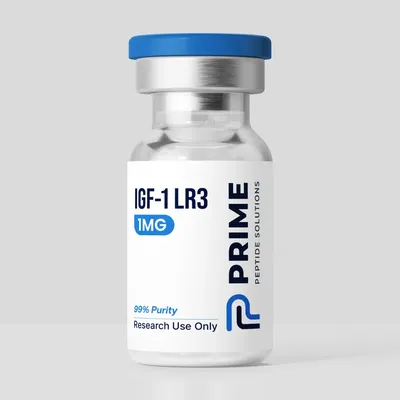
Compounding step losses limit how long a chain SPPS can make in one piece. Native chemical ligation, reported in 1994, joins two unprotected synthetic segments: a thioester-linked intermediate rearranges to give a native peptide bond at the junction, which allowed one-step preparation of a cytokine with multiple disulfides (Dawson et al., 1994). Larger chains are often expressed in cells instead. The 83-residue Long [Arg3]-IGF-I, sold here as IGF-1 LR3, was first described from an E. coli expression system (Francis et al., 1992); see the IGF-1 LR3 research overview.
Handling and Storage of the Lyophilized Material
Keep freeze-dried vials sealed, cold, dry and away from light, and let a cold vial reach room temperature, ideally in a desiccator, before opening so that moisture does not condense on the powder. General conditions are covered in the peptide storage guide.
Key Studies
- Merrifield et al., 1988 (Anal Biochem): deletion and insertion by-products measured by mass spectrometry; 99.93% stepwise yield. PubMed 3239745
- Fields and Noble, 1990 (Int J Pept Protein Res): review of Fmoc solid-phase synthesis as an orthogonal scheme. PubMed 2191922
- Coin et al., 2007 (Nat Protoc): standard Fmoc/tBu synthesis and aggregation-prone sequences. PubMed 18079725
- Palasek et al., 2007 (J Pept Sci): racemization and aspartimide formation under microwave heating. PubMed 17121420
- King et al., 1990 (Int J Pept Protein Res): TFA cleavage side reactions and scavenger mixtures (Reagent K). PubMed 2279849
- Chen et al., 2007 (J Chromatogr A): preparative reversed-phase HPLC on columns of different diameters. PubMed 17156789
- D'Hondt et al., 2014 (J Pharm Biomed Anal): review of synthesis- and degradation-related peptide impurities. PubMed 25044089
- Dawson et al., 1994 (Science): native chemical ligation of unprotected peptide segments. PubMed 7973629
Frequently Asked Research Questions
What is the difference between Fmoc and Boc chemistry?
Fmoc chemistry removes the temporary protecting group with a base and the side-chain groups with TFA at the end. Boc chemistry removes the temporary group with TFA at every round and needs a stronger acid for the final cleavage.
Why does TFA end up in the finished peptide?
TFA is used to cleave the peptide from the resin and as an additive in HPLC purification, so cationic peptides are usually isolated as trifluoroacetate salts unless the counter-ion is exchanged.
What impurities come from synthesis?
Deletion and insertion sequences, racemized residues, aspartimide products, protection adducts, oxidized side chains and residual counter-ions.
How is a finished batch checked?
By analytical HPLC for purity and mass spectrometry for identity. Peptide content, water and counter-ion content are separate tests.
Conclusion
A synthetic research peptide is built on a resin with Fmoc chemistry, released with TFA and scavengers, purified by preparative HPLC and freeze-dried, usually as a trifluoroacetate salt. Each stage leaves characteristic impurities, which is why finished batches are checked by HPLC and mass spectrometry.
Disclaimer: This article is provided for educational and research purposes only. It summarizes publicly available scientific literature and does not constitute medical advice. All peptide compounds sold by Prime Peptide Solutions are intended strictly for laboratory research, are not approved for human use, and are not for human or animal consumption. Researchers are responsible for compliance with all applicable regulations in their jurisdiction.
Shop IGF-1LR3
- Ships the same business day
- Free US shipping on $199.99+
- 14-day money-back guarantee on damaged items
References & Further Reading
- PubMed: Fmoc solid-phase peptide synthesis literature
- Related: What is a peptide? A researcher's primer
- Related: Research peptide reference table
Research Peptides from Prime Peptide Solutions
Our research peptides are supplied as lyophilized powders; browse the full catalog. Published batch reports are listed on the lab reports page and the COAs page.
Sold strictly for in-vitro laboratory research. Not for human or animal consumption.