

What Is IGF-1 LR3?
IGF-1 LR3 (also written IGF1 LR3, IGF-1LR3, LR3-IGF-I or Long R3 IGF-I) is a recombinant analog of human insulin-like growth factor I (IGF-I) used in research on the IGF-1 receptor pathway. It is a single chain of 83 amino acids: a 13-residue N-terminal extension followed by the 70-residue IGF-I sequence, with arginine in place of glutamic acid at IGF-I position 3. "L" stands for long, after the extension, and "R3" for that arginine.
The analog was described in 1992 as one of a set of IGF-I fusion-protein analogues made in E. coli (Francis et al., 1992). It is more potent than native IGF-I in cell culture, and the original papers trace that gain mainly to much weaker binding to IGF-binding proteins (IGFBPs), not to stronger receptor binding (King et al., 1992).
This article is a scientific overview for laboratory researchers. The research-grade IGF-1 LR3 supplied by Prime Peptide Solutions is sold strictly for in-vitro laboratory research. It is not approved for human use and is not for human or animal consumption.
Structure and Identity
How the 83-residue chain is built
Native human IGF-I is a single-chain polypeptide of 70 residues cross-linked by three disulfide bridges, with a calculated molecular weight of 7649 (Rinderknecht and Humbel, 1978). The 1992 paper describes each "Long" analogue as the first 11 amino acids of methionyl porcine growth hormone, then Val-Asn, then an IGF-I sequence; in Long [Arg3]-IGF-I, Glu-3 of IGF-I is replaced by Arg (Francis et al., 1992).
Counting from the start of the extension, IGF-I position 3 becomes position 16 and the three IGF-I disulfide bonds move 13 places, to Cys19-Cys61, Cys31-Cys74 and Cys60-Cys65 (the native bonds are listed in UniProt entry P05019). The chain carries three methionines, two in the extension and one in the IGF-I portion.
Molecule at a Glance
- Other names: Long R3 IGF-I, LR3-IGF-I, Long [Arg3]-IGF-I, IGF1 LR3
- Type: recombinant single-chain protein
- Length: 83 residues (13-residue N-terminal extension + 70-residue IGF-I sequence)
- Sequence:
MFPAMPLSSL FVNGPRTLCG AELVDALQFV CGDRGFYFNK PTGYGSSSRR APQTGIVDEC CFRSCDLRRL EMYCAPLKPA KSA - Disulfide bonds: 3 (Cys19-Cys61, Cys31-Cys74, Cys60-Cys65)
- Molecular weight: about 9,111 Da (9.1 kDa), calculated from the sequence with all three disulfides formed
- Molecular formula: not listed (no PubChem compound record)
- CAS number: 143045-27-6
- PubChem CID: none (recombinant protein)
- UNII (FDA GSRS): M9L22Y19H9
Why sources disagree: as a protein, IGF-1 LR3 has no PubChem compound entry. The CAS number and length come from the Global Substance Registration System, and the mass is calculated from the sequence with all three disulfides formed. A measured mass should be compared with about 9.1 kDa, not with the 7.6 kDa of native IGF-I.
Proposed Mechanism of Action
The IGF-1 receptor
The human IGF-1 receptor was cloned in 1986: a 1,367-residue precursor cut into alpha and beta chains, closely parallel to the insulin receptor (Ullrich et al., 1986). IGF binding to the alpha chain switches on the beta chain's tyrosine kinase, which phosphorylates insulin receptor substrates (IRSs) and SHC and activates the PI 3-kinase and Ras-MAP kinase pathways; these pathways are required for the cell proliferation, differentiation and survival responses to IGFs (Hakuno and Takahashi, 2018).
IGF-binding proteins, and why LR3 slips past them
Six homologous IGFBPs bind IGF-I and IGF-II with high affinity, and all six can inhibit IGF action (Baxter, 2000). [Arg3]-IGF-I bound very poorly to bovine IGFBP-2 and only slightly less well than IGF-I to the type-1 receptor on rat L6 myoblasts, so the authors concluded that reduced IGFBP binding explains its higher potency (King et al., 1992). A 1993 comparison found roughly 1,000-fold higher affinity of IGF-I than LR3IGF-I for IGFBP-3, IGFBP-4 and total rat plasma IGFBPs, and 5- to 10-fold greater potency of LR3IGF-I in L6 cultures (Ballard et al., 1993).
Insulin receptor and the growth hormone axis
In H35 hepatoma cells, where IGFs act through the insulin receptor, the Long analogues kept about the same potency relative to IGF-I as in L6 myoblasts (Francis et al., 1992), so insulin-receptor cross-talk is a variable to control for. In the classic somatomedin model, pituitary growth hormone acts largely through liver-derived IGF-I; later work showed that most, if not all, tissues make IGF-I (Le Roith et al., 2001). IGF-1 LR3 enters this system at the receptor, downstream of growth hormone. It is not a secretagogue like CJC-1295 no DAC; the upstream side is covered in our CJC-1295 and Ipamorelin research overview.
Findings by Study Model
Cell culture
- L6 rat myoblasts. The Long analogues were more potent than IGF-I at stimulating protein and DNA synthesis and inhibiting protein breakdown (Francis et al., 1992).
- With and without binding proteins. In IGFBP-secreting cell lines, Long [Arg3]-IGF-I and des(1-3)IGF-I were the most potent. In chicken embryo fibroblasts, which secrete no detectable IGFBPs, Long [Arg3]-IGF-I was less potent than IGF-I (Francis et al., 1992). Remove the binding proteins and the advantage disappears.
- CHO production cultures. In two serum-free Chinese hamster ovary lines, LongR3 sustained viability under production conditions better than insulin (Morris and Schmid, 2000), and a 2014 microarray study linked it to faster cell growth, delayed cell death and cytoskeletal gene changes (Becker et al., 2014).
Rodent and other animal models
- Rats. LR3IGF-I was removed from plasma much faster than IGF-I. In pregnant rats, whose IGFBP levels fall sharply, IGF-I clearance became almost as rapid (Ballard et al., 1993). Labeled LR3IGF-I also left the blood faster and reached gut tissue at 37 to 50% higher levels per gram than IGF-I (Shoubridge and Read, 2003).
- Guinea pigs. LR3IGF-I increased the fractional weight of the adrenals, gut, kidneys and spleen while whole-animal growth was not stimulated, and plasma IGF-I, IGF-II and IGFBP concentrations fell (Conlon et al., 1995).
Human studies
The primary literature is cell and animal work; a PubMed search found no controlled human study of IGF-1 LR3 itself.
Key Studies
- King et al., 1992, J Mol Endocrinol (PMID 1311930): [Arg3]-IGF-I made in E. coli; very poor IGFBP-2 binding, near-normal receptor binding in L6 myoblasts.
- Francis et al., 1992, J Mol Endocrinol (PMID 1378742): the Long IGF-I analogues; potency with and without IGFBPs.
- Ballard et al., 1993, Growth Regul (PMID 7683526): about 1,000-fold lower IGFBP affinity; faster plasma clearance in rats.
- Shoubridge and Read, 2003, Endocrinology (PMID 12697696): blood clearance and gut delivery of labeled LR3IGF-I in rats.
- Morris and Schmid, 2000, Biotechnol Prog (PMID 11027158): LongR3 against insulin in serum-free CHO cultures.
Stability and Laboratory Handling
Storing the lyophilized protein
The IGF-1 LR3 in our catalog is a lyophilized powder in a sealed vial; the product page gives storage at 2-8 °C, or -20 °C for long-term storage. Proteins are freeze-dried because the dry solid usually keeps far longer than a solution, though dried proteins can still have limited long-term stability (Wang, 2000). Keep vials cold, dry, dark and sealed until needed, and avoid repeated warming and re-cooling. The three methionines deserve care: methionine oxidation in aqueous environments is a documented cause of activity loss in growth hormone-releasing factor, for example (Campbell et al., 1994). See our guides to storing research peptides and lyophilization.
Verifying identity and purity
A batch Certificate of Analysis normally gives an HPLC purity figure and a mass spectrometry identity check; the observed mass should sit close to the calculated 9.1 kDa. Liquid chromatography-mass spectrometry (LC-MS) has been used to characterize Long R3 IGF-I directly, including locating a single fluorescent label on its N-terminal methionine (Harvey and Banks, 2003). Our guides to HPLC and mass spectrometry and reading a peptide COA explain each field.
Frequently Asked Research Questions
What is IGF-1 LR3?
An 83-residue recombinant analog of human IGF-I: a 13-residue N-terminal extension (the first 11 amino acids of methionyl porcine growth hormone, then Val-Asn) joined to IGF-I with arginine at position 3.
What do "L" and "R3" stand for?
"L" means long, for the N-terminal extension. "R3" is the arginine (one-letter code R) that replaces glutamic acid at position 3 of IGF-I.
Why is IGF-1 LR3 more potent than IGF-I in cell culture?
Mainly because it binds IGF-binding proteins about 1,000-fold more weakly, so less of it is held away from the receptor. In cells that make no detectable binding proteins, it was less potent than IGF-I.
Does IGF-1 LR3 stay in circulation longer than IGF-I?
Not in the rat studies. It was cleared from plasma faster than IGF-I, consistent with weak binding to plasma IGFBPs, so its extra potency is not explained by a longer stay in the blood.
Is IGF-1 LR3 the same as IGF-1 DES?
No. Des(1-3)IGF-I is a truncated IGF-I lacking the first three residues. Both bind IGFBPs poorly, but they are different molecules with different masses. Only IGF-1 LR3 is stocked here.
Conclusion
IGF-1 LR3 is an 83-residue IGF-I analog whose defining property, in cell and rodent work, is weak IGF-binding-protein binding: higher potency in IGFBP-producing cultures, no advantage where binding proteins are absent, and faster clearance from rat plasma. It acts at the IGF-1 receptor, not the pituitary. For laboratories, the practical points are cold, dry storage and identity checks against about 9.1 kDa.
Disclaimer: This article is provided for educational and research purposes only. It summarizes publicly available scientific literature and does not constitute medical advice. IGF-1 LR3 and all peptide compounds sold by Prime Peptide Solutions are intended strictly for laboratory research, are not approved for human use, and are not for human or animal consumption. Researchers are responsible for compliance with all applicable regulations in their jurisdiction.
Shop these products
- Ships the same business day
- Free US shipping on $199.99+
- 14-day money-back guarantee on damaged items
References & Further Reading
- Rinderknecht E and Humbel RE, 1978. J Biol Chem. PMID 632300.
- Conlon MA et al., 1995. J Endocrinol. PMID 7561636.
- Ullrich A et al., 1986. EMBO J. PMID 2877871.
- Hakuno F and Takahashi SI, 2018. J Mol Endocrinol. PMID 29535161.
- Baxter RC, 2000. Am J Physiol Endocrinol Metab. PMID 10826997.
- Le Roith D et al., 2001. Endocr Rev. PMID 11159816.
- Becker J et al., 2014. J Biotechnol. PMID 24613301.
- Harvey MD and Banks PR, 2003. J Chromatogr B Analyt Technol Biomed Life Sci. PMID 12880859.
- Campbell RM et al., 1994. Peptides. PMID 7937325.
- Wang W, 2000. Int J Pharm. PMID 10967427. Review of protein lyophilization and solid-state stability
Research-Grade IGF-1 LR3
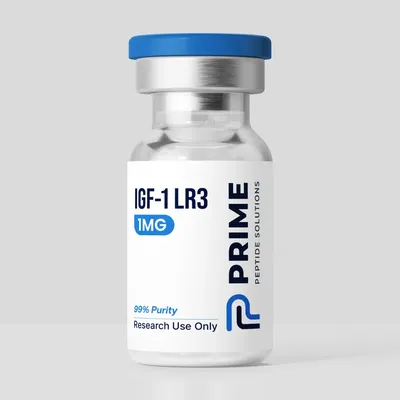
In our catalog, research-grade IGF-1 LR3 is listed as IGF-1 LR3, supplied as a lyophilized powder in one size, a 1mg vial. Published lab reports (COAs) are listed on our COAs page. Related research peptides are grouped on the growth hormone research peptides page.
Sold strictly for in-vitro laboratory research. Not for human or animal consumption.