
TB-500 vs Thymosin Beta-4
TB-500 is a synthetic seven-residue peptide, Ac-Leu-Lys-Lys-Thr-Glu-Thr-Gln-OH (Ac-LKKTETQ), that copies residues 17-23 of thymosin beta-4 and carries an added N-terminal acetyl group. Thymosin beta-4 (Tb4, also listed as timbetasin) is the natural 43-residue protein that contains that stretch. The two names are often used interchangeably, but they are different molecules: TB-500 is about one-sixth of the protein by length and has under a fifth of its mass. Analytical work identified the acetylated 17-23 fragment in a TB-500 product (Esposito et al., 2012).
This comparison sets out what the fragment keeps and what it leaves out, and which published findings belong to which molecule. For the protein's broader research literature, see the TB-500 research overview.
This article is a scientific overview for laboratory researchers. The research-grade TB-500 supplied by Prime Peptide Solutions is sold strictly for in-vitro laboratory research. It is not approved for human use and is not for human or animal consumption.
| Property | TB-500 | Thymosin Beta-4 |
|---|---|---|
| What it is | Synthetic peptide fragment | Natural protein, gene TMSB4X |
| Other names | TB500, TB 500, Ac-LKKTETQ | Tb4, timbetasin, Fx (platelet actin-sequestering peptide) |
| Length | 7 residues | 43 residues |
| Sequence | Ac-LKKTETQ-OH | Ac-SDKPDMAEIE |
| Position in thymosin beta-4 | Residues 17-23 | Residues 1-43 |
| N-terminus | Acetylated leucine (the cap is added; Leu17 is internal in the protein) | N-acetylserine |
| Molecular formula | C38H68N10O14 | C212H350N56O78S |
| Molecular weight | 889.0 g/mol | 4963 g/mol |
| Monoisotopic mass | 888.49 | 4960.49 |
| CAS number | 885340-08-9 | 77591-33-4 |
| PubChem | CID 62707662 | CID 16132341 |
| Methionine | None | One (Met6) |
| Actin-binding regions present | Motif 17-22 plus Gln23 only | N-terminal region 1-16, motif 17-22 and C-terminal helix |
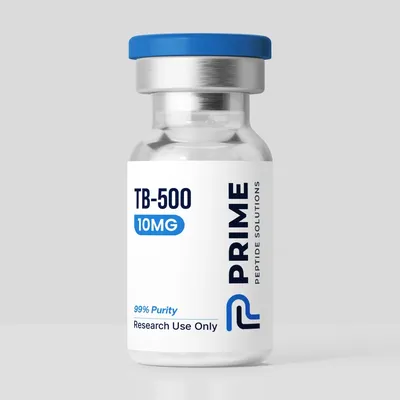
| Sold here | Yes, 10mg vial | No |
About TB-500
TB-500 is a single stretch of thymosin beta-4: Leu17 to Gln23 in mature-protein numbering. UniProt numbers the same stretch 18-24 because it counts the initiator methionine that is removed from the mature protein (entry P62328). The synthetic peptide adds an acetyl group to Leu17, which in the natural chain is an internal residue joined to Lys16, and ends in a free acid at Gln23, where the protein continues with Glu24. The identity values in the table match the specifications box on the product page. The same seven residues, LKKTETQ, also sit at the same positions in human thymosin beta-10 (UniProt P63313), a related beta-thymosin with about 75% sequence homology to thymosin beta-4 that occurs alongside it in many tissues (Erickson-Viitanen et al., 1983).
Analytical chemistry. High-resolution mass spectrometry identified Ac-LKKTETQ in a TB-500 product; the authors also made the peptide by solid-phase synthesis and proposed a liquid chromatography-mass spectrometry method for detecting it in plasma and urine (Esposito et al., 2012).
In-vitro metabolism. When TB-500 was incubated with human liver microsomes, liver S9 fraction and serum, several metabolites formed, and all three systems showed endopeptidase and exopeptidase activity (Esposito et al., 2015). A 2024 study quantified TB-500 and its metabolites in human serum and in-vitro enzyme systems (Rahaman et al., 2024).
Rat and cell studies. In the same 2024 study, Ac-LK was the main metabolite in rat urine samples over 0-6 hours, and Ac-LKK was a long-lived metabolite detected up to 72 hours. In fibroblasts, neither TB-500 nor its metabolites were cytotoxic, and in a gap-closure assay only the metabolite Ac-LKKTE differed significantly from control. The authors state that "the biological effects of TB-500, however, have not been documented," and suggest that the activity previously reported for TB-500 in this kind of assay may come from Ac-LKKTE rather than from the parent peptide (Rahaman et al., 2024).
In short, the published record for TB-500 itself is mostly identity, analytical and metabolism work. Findings on actin binding and cell migration come from the full protein or from motif peptides, which the 2024 study describes in their unacetylated form, LKKTETQ (Rahaman et al., 2024).
About Thymosin Beta-4
Thymosin beta-4 was sequenced in 1981 from calf thymus: 43 residues, an acetyl-blocked N-terminus, an isoelectric point of 5.1 and a reported molecular weight of 4982 (Low et al., 1981). PubChem's computed weight for the human sequence is 4963 g/mol, so published figures differ by about 20 daltons depending on source and method. Despite the name, it is not confined to the thymus: it was found in spleen, thymus, brain, lung, liver and heart muscle of rats and mice, at high levels in peritoneal macrophages, and in tissues of athymic mice (Hannappel et al., 1982).
Biochemistry and structure. Fx, the peptide that holds most of the unpolymerized actin in resting human platelets, turned out to have the same sequence as thymosin beta-4; the protein forms a 1:1 complex with actin monomers and inhibits salt-induced polymerization (Safer et al., 1991). The beta-thymosins are the main intracellular G-actin-sequestering peptides in most vertebrate cells, and the complex has a dissociation constant in the micromolar range, which allows fast binding and release (Hannappel, 2007). Mutational work on synthetic full-length variants found that actin binding uses two separate parts of the protein: the N-terminal region (residues 1-16), which must form an alpha-helix and contacts actin through a hydrophobic patch formed by Met6, Ile9 and Phe12, and the hexapeptide motif at residues 17-22; electrostatic contacts involving Lys14 and Lys18 also appear important (Van Troys et al., 1996). By NMR, the protein is mostly unstructured in solution and folds completely on binding G-actin, with a central extended region between N- and C-terminal helices (Domanski et al., 2004). A 2 Å structure of actin bound to a hybrid of gelsolin domain 1 and the C-terminal half of thymosin beta-4 showed that thymosin beta-4 sequesters actin by capping both ends of the monomer (Irobi et al., 2004).
Cell culture. In human umbilical vein endothelial cell migration and chick aortic-arch sprouting assays, thymosin beta-4 and a synthetic peptide carrying its seven-amino-acid actin-binding motif showed near-identical activity at about 50 nM, while peptides lacking any part of the motif were inactive (Philp et al., 2003). Oxidizing Met6 to the sulfoxide attenuates G-actin sequestering, and the sulfoxide inhibited neutrophil chemotaxis in vitro (Young et al., 1999).
Fragments released from the protein. The N-terminal tetrapeptide Ac-SDKP can be generated from thymosin beta-4 by a single enzymatic cleavage at the Pro4-Asp5 bond (Grillon et al., 1990). In kidney cortex homogenates, Ac-SDKP formed from added thymosin beta-4, and its formation was significantly reduced by prolyl oligopeptidase inhibitors, and a prolyl oligopeptidase inhibitor lowered Ac-SDKP levels in rats (Cavasin et al., 2004). A 2010 review maps separate active sites to Ac-SDKP (residues 1-4), an N-terminal 1-15 sequence and the LKKTETQ stretch, and lists other activities, such as ILK/PINCH/Akt activation, that have not been localized to any part of the molecule (Sosne et al., 2010). A 2001 review notes that the molecular mechanisms behind effects attributed to extracellular beta-thymosins were unknown (Huff et al., 2001).
Which Fits the Research Question?
The two molecules answer different laboratory questions. Matching the material to the question comes down to which part of the protein the design needs.
- Actin sequestration with the full binding interface: full-length thymosin beta-4. The N-terminal helix (1-16) and the 17-22 motif both contribute to binding, and the 7-residue fragment carries only the motif. Thymosin beta-4 is not stocked here.
- The 17-23 motif on its own: TB-500 is the acetylated form of that stretch. The 2024 study describes the motif's documented functions in its unacetylated form, so a design built on the motif-peptide data should note the acetyl difference.
- Analytical methods and metabolism of the fragment: TB-500, the molecule studied in the analytical and metabolism papers above.
- Ac-SDKP or the N-terminal region: neither fits. TB-500 lacks residues 1-16, so it cannot release Ac-SDKP.
- Methionine oxidation: only the full protein carries Met6; TB-500 has no methionine.
- Identity checks: a mass near 889 Da points to TB-500; a mass near 4963 points to the full protein. See HPLC and mass spec explained.
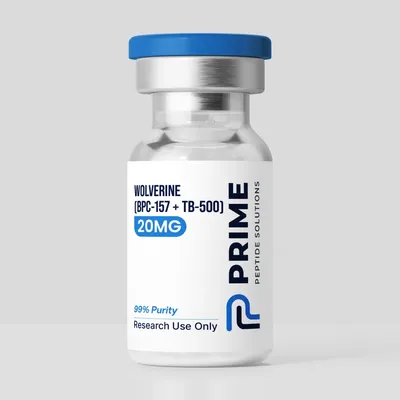
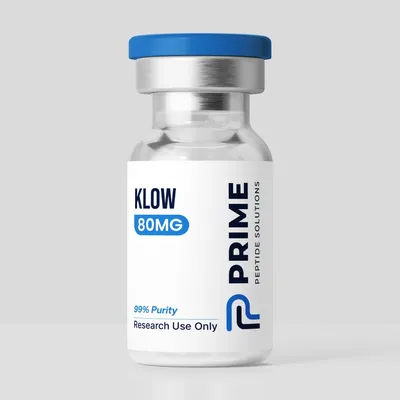
TB-500 is also one of the two peptides in Wolverine (BPC-157 + TB-500) and one of four in KLOW. For TB-500 against an unrelated peptide, see BPC-157 vs TB-500. Despite the shared name, thymosin alpha-1 belongs to a different protein family.
Frequently Asked Questions
Is TB-500 the same as thymosin beta-4?
No. Thymosin beta-4 is the natural 43-residue protein. TB-500 is the synthetic, N-acetylated seven-residue peptide Ac-LKKTETQ, residues 17-23 of that protein, with a molecular weight of 889.0 against 4963 for the protein.
What does "17-23" mean?
The positions of Leu-Lys-Lys-Thr-Glu-Thr-Gln in the mature 43-residue chain. UniProt numbers them 18-24 because it counts the initiator methionine.
Does TB-500 bind actin like thymosin beta-4?
That has not been shown in the sources reviewed here. In the protein, actin binding needs both the N-terminal region (1-16) and the 17-22 motif; TB-500 carries only the motif. A 2024 study states that the biological effects of TB-500 itself have not been documented.
What is TB-500 broken down into?
In a 2024 study, Ac-LK was the main metabolite in rat urine samples over 0-6 hours and Ac-LKK was detected up to 72 hours. Human liver microsomes, S9 fraction and serum also produced several metabolites in vitro.
How is the lyophilized material handled in the lab?
TB-500 ships as a lyophilized powder in a sealed 10mg vial. The product page gives storage at 2-8 °C, or -20 °C for long-term storage; keep vials cold, dry and dark, and let a cold vial reach room temperature before opening. See the peptide storage guide and the lyophilization explainer.
Which products here contain TB-500, and is there a lab report?
TB-500 is sold as a 10mg vial, and it is also in Wolverine (BPC-157 + TB-500) and KLOW. Every batch of Wolverine (BPC-157 + TB-500) is tested by an independent third-party lab. The lab report (COA) is on our COAs page. The current Wolverine report also has its own page: Wolverine 20mg lab report.
Disclaimer: This article is provided for educational and research purposes only. It summarizes publicly available scientific literature and does not constitute medical advice. TB-500 and all peptide compounds sold by Prime Peptide Solutions are intended strictly for laboratory research, are not approved for human use, and are not for human or animal consumption. Researchers are responsible for compliance with all applicable regulations in their jurisdiction.
Shop these products
- Ships the same business day
- Free US shipping on $199.99+
- 14-day money-back guarantee on damaged items