
SS-31 vs NAD+: Cardiolipin-Binding Peptide vs Redox Coenzyme
SS-31 and NAD+ are both studied in mitochondrial biology, but they act at different levels. SS-31 (elamipretide) is a synthetic, amidated tetrapeptide that partitions into the inner mitochondrial membrane and associates with the phospholipid cardiolipin. NAD+ (nicotinamide adenine dinucleotide, oxidized form) is an endogenous metabolite: a coenzyme that carries electrons between dehydrogenases and the respiratory chain and is consumed as a substrate by sirtuins, PARPs and CD38.
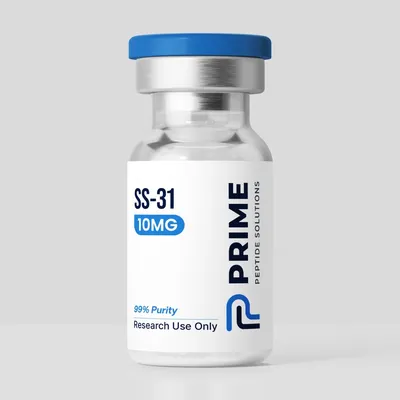
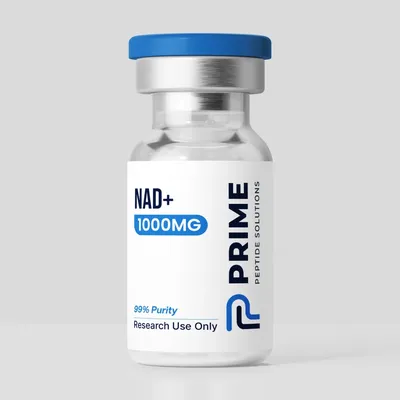
Put simply, SS-31 is studied as a structural modifier of the membrane where electron transport happens, while NAD+ is studied as one of the pools of electrons and ADP-ribose that the membrane and the rest of the cell draw on. This page compares the catalog items SS-31 and NAD+ by structure, cellular location, the assays used to study each, and bench handling. A separate page covers MOTS-c vs NAD+.
Both are sold strictly for in-vitro laboratory research. They are not approved for human use and are not for human or animal consumption.
| Property | SS-31 (elamipretide) | NAD+ |
|---|---|---|
| Compound class | Synthetic Szeto-Schiller (SS) tetrapeptide | Dinucleotide coenzyme; not a peptide |
| Structure | D-Arg-Dmt-Lys-Phe-NH2 (Dmt = 2',6'-dimethyltyrosine); C-terminal amide; alternating cationic and aromatic residues | Nicotinamide riboside and adenosine joined through a pyrophosphate bridge |
| Formula and mass (PubChem) | C32H49N9O5; 639.8 g/mol (free base) | C21H27N7O14P2; 663.4 g/mol |
| Charge at neutral pH | Net cationic (Arg, Lys and the N-terminal amine) | Anionic pyrophosphate with a cationic nicotinamide ring |
| Origin | Designed compound from the Szeto and Schiller labs; not made by cells | Made in cells from tryptophan, nicotinic acid or recycled nicotinamide |
| Primary site studied | Inner mitochondrial membrane, at cardiolipin-rich surfaces | Separate cytosolic, nuclear and mitochondrial pools |
| Core mechanism studied | Cardiolipin binding, membrane surface electrostatics, cytochrome c peroxidase inhibition, cristae preservation | Hydride acceptor (NAD+/NADH couple); substrate for sirtuins, PARPs and CD38 |
| Typical readouts | Oxygen consumption, membrane potential, ROS, ATP content, mitochondrial swelling, cristae ultrastructure | NAD+ and NADH quantification (LC-MS, enzyme-coupled assays), NAD+/NADH ratio, sirtuin or PARP activity |
| Handling notes | Small, water-soluble peptide; lyophilized; may be supplied as a salt | Highly hygroscopic solid; degrades in alkaline solution |
| Listed size | 10mg | 1000mg |
| Nominal molar amount per vial | About 15.6 micromol (free-base basis) | About 1,507 micromol (1.51 mmol) |
About SS-31 (a cardiolipin-targeted tetrapeptide)
Identity. SS-31 is the lead compound of the Szeto-Schiller peptides, a family built on alternating aromatic and basic residues. Its sequence is D-Arg-Dmt-Lys-Phe-NH2: a D-arginine at position 1, the non-natural residue 2',6'-dimethyltyrosine at position 2, and an amidated C-terminus. PubChem lists the free base as C32H49N9O5 at 639.8 g/mol, under the nonproprietary name elamipretide. At four residues it is among the smallest compounds in this catalog, roughly the same mass as NAD+.
Mitochondrial targeting. The founding 2004 study reported that these cell-permeable peptides concentrate about 1000-fold in the inner mitochondrial membrane, lowered intracellular ROS in neuronal N2A cells, and inhibited permeability transition, swelling and cytochrome c release in isolated mitochondria. Analogs lacking Dmt did not suppress mitochondrial ROS or swelling (Zhao et al., 2004).
Cardiolipin binding. Using a polarity-sensitive fluorescent analog, a 2013 study showed that SS-31 binds cardiolipin, the anionic phospholipid of the inner membrane that is required for cristae formation. The SS-31/cardiolipin complex inhibited cytochrome c peroxidase activity, which drives cardiolipin peroxidation; in a rat renal ischemia model, pretreatment preserved cristae, prevented swelling and sped ATP recovery on reperfusion (Birk et al., 2013). In liposome and bicelle experiments, SS-31 interacted only with cardiolipin-containing membranes, at roughly a 1:1 ratio, and NMR placed its aromatic residues deep in the bilayer; it restored cytochrome c reduction and oxygen consumption in the presence of added cardiolipin, and in fresh mitochondria it increased state 3 respiration and the efficiency of ATP synthesis (Birk et al., 2014). A review from the same lab summarizes the model: by binding cardiolipin, SS-31 keeps cytochrome c acting as an electron carrier rather than a peroxidase, protects cristae structure and promotes oxidative phosphorylation (Szeto, 2014).
Membrane biophysics. Later biophysical work refined this picture. SS-31 partitions into the membrane interfacial region with an affinity and binding density tied to surface charge, does not disrupt lamellar bilayers, alters lipid packing in a saturable way, and changes surface electrostatics of model and mitochondrial membranes; it also altered divalent cation handling under calcium stress (Mitchell et al., 2020). A structure-activity study of three analogs found that all bound cardiolipin-containing membranes but differed in effects on surface charge, membrane potential, ATP content and cell survival in serum-withdrawal models (Mitchell et al., 2022).
Clinical research (design level). Elamipretide has been tested in genetic mitochondrial disease. In Barth syndrome, a disorder of cardiolipin remodeling caused by TAZ defects, a randomized, double-blind, placebo-controlled crossover trial of 12 participants did not meet its primary endpoints (6-minute walk test and a Barth syndrome symptom scale) in part 1; the open-label extension reported improvements in walk distance and some secondary measures at 36 weeks (Reid Thompson et al., 2021). The phase 3 MMPOWER-3 trial randomized 218 adults with genetically confirmed primary mitochondrial myopathy and did not meet its primary endpoints (6-minute walk test and fatigue score) at 24 weeks (Karaa et al., 2023).
About NAD+ (a metabolite pool and enzyme substrate)
What it is. NAD+ is a coenzyme for redox reactions and an essential cofactor for non-redox enzymes, including sirtuins, CD38 and poly(ADP-ribose) polymerases (Covarrubias et al., 2021). It is not a peptide and has no fixed binding site in a membrane; its effects depend on how much free NAD+ is present in a given compartment and what fraction is reduced to NADH.
Two kinds of use. In redox reactions NAD+ is recycled, not destroyed: dehydrogenases reduce it to NADH, and complex I of the electron transport chain oxidizes NADH back to NAD+. Sirtuins, PARPs and CD38 instead cleave NAD+ and release nicotinamide, so their activity drains the pool and must be matched by synthesis. That distinction is central to how NAD+ experiments are designed: a change in the NAD+/NADH ratio and a change in total NAD are different measurements.
Compartments. Whether mammalian mitochondria import intact NAD+ was debated for years. A 2020 study identified SLC25A51 as a mitochondrial NAD+ transporter: its loss lowered mitochondrial, but not whole-cell, NAD+, impaired respiration, and blocked NAD+ uptake into isolated mitochondria (Luongo et al., 2020). Where SS-31 is studied at the inner membrane surface, NAD+ is studied as pools on both sides of it.
Decline with age. Tissue and cellular NAD+ levels fall with age in multiple model organisms, including rodents and humans, and this decline has been linked to age-associated disease in model systems (Covarrubias et al., 2021). In mice, expression and activity of the NADase CD38 rose with age, and CD38 was required for the age-related NAD decline and mitochondrial dysfunction, at least partly through SIRT3; CD38 was also the main enzyme degrading the precursor NMN in vivo (Camacho-Pereira et al., 2016). Related precursor comparisons are on the NAD+ vs NMN page.
Which Should Researchers Choose?
SS-31 is a tool for asking how the inner membrane itself behaves when cardiolipin is stressed; NAD+ is a tool for asking how a central metabolite pool and the enzymes that consume it respond. The choice follows the laboratory question:
- Cardiolipin and cristae: SS-31 fits studies of cardiolipin binding, cytochrome c peroxidase activity and cristae ultrastructure, including models of defective cardiolipin remodeling such as TAZ loss.
- Respiration and membrane function: SS-31 is typically read out by oxygen consumption, membrane potential, ATP content, swelling and ROS in isolated mitochondria or stressed cells.
- Redox state and NAD+ pools: NAD+ fits work on the NAD+/NADH ratio, compartment-specific pools and transport by SLC25A51.
- NAD+-consuming enzymes: sirtuin, PARP and CD38 assays use NAD+ as substrate, including studies of age-related NAD decline.
- Background reading: see the SS-31 overview and NAD+ research overview.
They are compared here as separate reagents for separate experimental questions; neither is a substitute for the other.
Frequently Asked Questions
Do SS-31 and NAD+ act on the same target?
No. SS-31 binds cardiolipin at the inner mitochondrial membrane (Birk et al., 2013). NAD+ is a soluble coenzyme and enzyme substrate distributed across cytosolic, nuclear and mitochondrial pools (Covarrubias et al., 2021). Both bear on electron transport, but at different points: SS-31 at the membrane that hosts the respiratory complexes, NAD+ as the electron carrier feeding complex I.
Which assays are used to study each?
SS-31 papers use oxygen consumption and state 3 respiration (Birk et al., 2014), ROS, mitochondrial swelling and cytochrome c release (Zhao et al., 2004), membrane potential and ATP content (Mitchell et al., 2022), plus biophysical binding to model membranes (Mitchell et al., 2020). NAD+ work relies on quantifying NAD+, NADH and their ratio. One methods study found that oxidized and reduced forms interconvert during extraction; a cold acidic acetonitrile:methanol:water mixture gave the least interconversion for LC-MS, and extracts should be neutralized promptly (Lu et al., 2018).
Are fluorescent SS peptide analogs reliable for localization?
With caution. A 2005 study found that the choice of fluorescent label changed where a related SS tetrapeptide went inside cells: one analog stayed in the inner membrane while another reached the matrix and depolarized mitochondria. The authors recommend multiple fluorophores and confirmation with the unlabeled or radiolabeled molecule (Szeto et al., 2005).
How do the vial contents compare by amount?
On a nominal molar basis (labeled mass divided by the PubChem molecular weight), the 10 mg SS-31 vial is about 15.6 micromol of free-base peptide and the 1000 mg NAD+ vial about 1.51 mmol. Peptide salts and counterions lower the true peptide content; see net peptide content vs HPLC purity.
How do the handling concerns differ?
SS-31 is a small, water-soluble, lyophilized peptide; store it dry, cold and tightly closed, and let the vial reach room temperature before opening (see the peptide storage guide). NAD+ is highly hygroscopic, so limit air exposure when weighing. In solution NAD+ is degraded under alkaline conditions, while NADH is the more acid-sensitive form, so buffer pH matters for any stock. Specific steps for the 1000 mg vial are in the NAD+ reconstitution guide.
Are these approved for human use?
No. Both are sold strictly for in-vitro laboratory research, are not approved for human use and are not for human or animal consumption. Clinical trials of elamipretide are cited here only for design and published findings. Batch Certificates of Analysis are published on the COA page as they become available; check it for a report matching the product and batch (see how to read a COA).
Shop these products
- Ships the same business day
- Free US shipping on $149.99+
- 7-day money-back guarantee on damaged items