

What Reconstituting NAD+ Involves: A Coenzyme, Not a Peptide
NAD+ (nicotinamide adenine dinucleotide, oxidized form) is supplied here as a lyophilized powder in a sealed 1000 mg vial. Reconstitution means adding a measured volume of sterile diluent so the powder becomes a stock solution of known concentration. The technique resembles peptide work, but NAD+ is not a peptide. Three things set it apart: the amount of powder in the vial, how readily that powder takes up moisture, and a solution chemistry sensitive to alkaline pH and warmth.
This guide is a laboratory handling reference. Research-grade NAD+ is not approved for human use and is sold strictly for in-vitro research. It is not for human or animal consumption.
NAD+ at a glance
- Identity: nicotinamide adenine dinucleotide, oxidized form (PubChem record title "Nadide"); also known as beta-NAD, coenzyme I and diphosphopyridine nucleotide (DPN)
- Molecular formula: C21H27N7O14P2
- Molecular weight: 663.4 g/mol
- CAS number: 53-84-9
- Structure: ribosylnicotinamide 5'-diphosphate joined to adenosine 5'-phosphate through a pyrophosphate linkage; two nucleotide halves and no amino acids
- Physical form: described on PubChem as a highly hygroscopic white solid
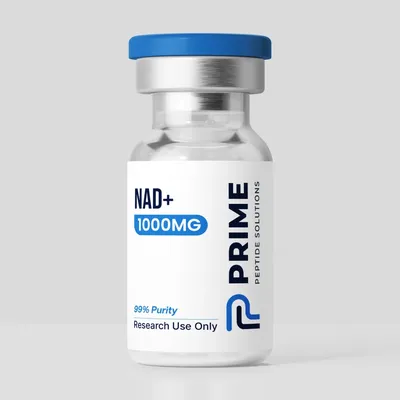
- Vial size in this store: 1000 mg, lyophilized, a single compound
NAD+ is a coenzyme for redox reactions, central to energy metabolism, and an essential cofactor for non-redox enzymes including sirtuins, CD38 and poly(ADP-ribose) polymerases (PARPs). It carries electrons by being alternately oxidized (NAD+) and reduced (NADH). NADH differs by two hydrogen atoms (C21H29N7O14P2, 665.4 g/mol), and the two forms behave differently in solution. This page stays with bench handling.
What You Need
- The lyophilized NAD+ vial (1000 mg), with its batch number noted
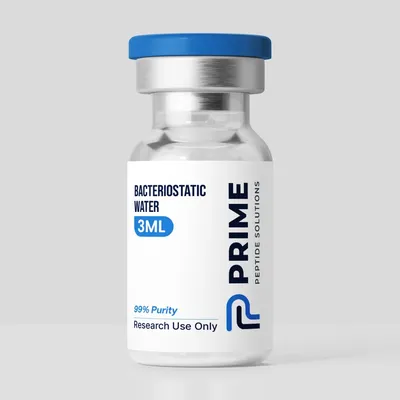
- Diluent: bacteriostatic water, sold separately in 3 mL and 10 mL vials (bacteriostatic water is, by general definition, sterile water with 0.9% benzyl alcohol as a preservative)
- A new sterile syringe and needle used only to move the diluent
- Alcohol wipes, a fine-tip marker and a clean, draft-free bench
- The original box or an opaque container for storage afterwards
The bacteriostatic water explainer compares diluents. Any volume above 3 mL is more than one 3 mL vial holds, so the 10 mL vial is the practical choice.
Concentration Math for a 1000mg Vial
Concentration (mg/mL) = NAD+ in the vial (mg) ÷ diluent added (mL)
A 1000 mg vial holds a hundred times the mass of a 10 mg peptide vial:
- 3 mL of diluent gives about 333.33 mg/mL
- 5 mL gives 200 mg/mL
- 10 mL gives 100 mg/mL
The NAD+ calculator preset serves as a concentration check: it loads the 1000 mg vial and divides by the diluent volume entered. These figures are arithmetic only: no published solubility figure for this product in bacteriostatic water stands behind them, so the 3 mL line is not evidence that 1000 mg dissolves in that volume.
Displacement volume
A dissolved solid adds to the volume of the solution, so the final volume is somewhat larger than the diluent added and the real concentration somewhat lower than the nominal figure. The effect grows with the mass dissolved: it matters far less for a 10 mg peptide cake than for 1000 mg of NAD+. No displacement figure is published for NAD+, so every number above is nominal, and the label should say so.
Headspace and fill volume
The chosen volume has to fit in the vial with room left for gentle swirling. The store does not publish the vial's capacity, so look at the vial before settling on a volume. A vial filled close to the neck is hard to swirl and to sample from cleanly, and 10 mL uses a whole 10 mL diluent vial with no margin.
Stepwise Reconstitution Procedure
- Bring the sealed vial to room temperature before piercing the stopper. The site's peptide stability guide suggests 20-30 minutes on the bench.
- Confirm the plan. Write down the diluent volume and the nominal concentration it gives.
- Disinfect both stoppers with alcohol wipes and let them air dry.
- Draw the planned volume of diluent with a fresh sterile syringe and needle.
- Add it slowly down the vial wall, never directly onto the powder.
- Let the vial stand undisturbed for a few minutes so the powder can wet.
- Swirl or roll gently until dissolved. Do not shake, vortex, sonicate or warm the vial.
- Inspect the solution against a light and a dark background. It should be clear, with no particles, haze or film.
- Label the vial with the nominal concentration in mg/mL, the diluent volume, the date and the batch number.
- Refrigerate promptly at 2-8 °C, in the box or an opaque container.
Why room temperature comes first
PubChem describes NAD+ as a highly hygroscopic solid: it readily takes up moisture. Opening a cold vial in warm, humid air lets condensation form inside it, where the powder can absorb it; equilibrating the sealed vial first prevents that.
No shortcuts to faster dissolving
A large mass of powder calls for patience: more standing time and continued gentle swirling. Warm water baths, sonication (which can warm the sample) and added base or alkaline buffer are all out, because warmth and alkaline conditions are exactly what degrade NAD+.
Light, pH and Solution Stability
NAD+ is sensitive to alkaline pH and elevated temperatures, and once reconstituted it keeps for a shorter window than many peptides. Published chemistry supports that picture.
pH: NAD+ and NADH go opposite ways
The oxidized form, NAD+, undergoes base-catalyzed degradation at high pH, whereas the reduced form, NADH, undergoes acid-catalyzed degradation at low pH. Analytical labs rely on that asymmetry, extracting the oxidized forms under acidic conditions, where they are more stable, and the reduced forms under basic ones. Those are measurement conditions, not storage advice: nothing alkaline belongs in an NAD+ stock, and its pH should not be adjusted.
Temperature: keep it cold
Heat has the same destructive effect on the oxidized forms as alkali, which is why some NADH assays deliberately heat sample extracts to destroy the NAD+ in them. In a published cofactor-stability study, even a mild rise in temperature proved significant for long-term stability. Its quantified rates were for NADH in lab buffers, not NAD+ in bacteriostatic water, but the point carries: warmth speeds degradation in solution. Keep the solution at 2-8 °C and keep its time on the bench short.
Why no fixed shelf life is quoted
The same study compared NAD+ in several lab buffers at the same pH. In one buffer it degraded nearly entirely over the study period; in another its absorbance peak fell by only a few percent. How long NAD+ lasts depends strongly on what it is dissolved in, so figures from one solution cannot be carried over to another, and none has been established for NAD+ in bacteriostatic water. The store's guidance stands: keep the solution refrigerated at 2-8 °C and expect a shorter window than for many peptides.
Light: standard protection, without alarm
Protecting NAD+ from light is standard good practice: lyophilized NAD+ is kept cold, sealed and protected from light and moisture. NADH has a dihydropyridine ring that absorbs strongly at 340 nm, in the near-UV; NAD+ has a pyridine ring that absorbs at 260 nm but not at 340 nm. Under low-oxygen conditions, near-UV irradiation breaks NADH down to ADP-ribose and a second product thought to be nicotinamide, which makes NADH the notably light-reactive form. That does not mean NAD+ is unaffected by light, so keep the vial in its box or an opaque container. The research peptide storage guide covers temperature and light in general terms.
Freezing and thawing
The product guidance is to keep the solution refrigerated. A laboratory protocol for NAD+ and NADH extracts allows a pause at -80 °C but advises carrying on without one where possible, to minimize the risk of degradation from freezing and thawing. Repeated freezing and thawing is avoided; keep the stock at a steady 2-8 °C, away from the refrigerator door and cooling vents.
Discard signals
A clear solution is the goal. Any change in color, any haze or turbidity, and any particles, flakes or film on the glass mean the solution should not be used: set it aside and record its batch number with what was seen. With no established window for reconstituted NAD+, check it visually each time the vial is opened or sampled.
Storage summary
- Sealed lyophilized vial: 2-8 °C, or -20 °C for long-term storage, per the product page
- Reconstituted solution: refrigerated at 2-8 °C, in the box or an opaque container
- Avoid: warmth, alkaline additives, shaking, and repeated freezing and thawing
- Discard: on any color change, haze, turbidity, particles or film
Frequently Asked Research Questions
How is the concentration of a 1000mg NAD+ stock solution worked out?
Divide the 1000 mg in the vial by the diluent volume in mL; the target concentration is set by the experimental design or assay, not by this guide. Every figure is nominal, before displacement volume. Check that the chosen volume fits the vial with headspace to spare; the calculator preset handles the arithmetic.
How long does reconstituted NAD+ last?
No fixed figure is established for NAD+ in bacteriostatic water, and published work shows its stability depends heavily on the solution. Refrigerate at 2-8 °C, expect a shorter window than for many peptides and reconstitute close to when the material is needed.
Can warming or a pH adjustment speed up dissolving?
Neither is advisable. Heat and alkaline conditions both degrade NAD+. Give the powder more standing time and keep swirling gently.
Is NAD+ a peptide?
No. It is a dinucleotide coenzyme with no amino acids. The reconstitution technique is similar, but its chemistry, and so its handling priorities, differ.
How do I confirm identity and purity?
Record the batch number from the vial. Batch Certificates of Analysis are published on the COA page as they become available; check it for a report matching the product and batch. A COA reports identity and purity for that batch only; it is not a measure of how long a solution keeps.
Conclusion
Reconstituting NAD+ looks like peptide work but asks different questions. The 1000 mg vial makes concentration math and headspace the first decisions, the hygroscopic powder makes room-temperature equilibration essential, and the chemistry sets the storage rules: nothing alkaline, nothing warm, light protection as standard and refrigeration at 2-8 °C. Label concentrations as nominal, inspect the solution each time the vial is opened, and discard anything that changes color or clarity.
Disclaimer: This guide is provided for educational and laboratory reference purposes only and does not constitute medical advice. NAD+ and all compounds sold by Prime Peptide Solutions are intended strictly for in-vitro laboratory research, are not approved for human use, and are not for human or animal consumption. Researchers are responsible for complying with all regulations that apply in their jurisdiction.
Shop these products
- Ships the same business day
- Free US shipping on $199.99+
- 14-day money-back guarantee on damaged items
References & Further Reading
- PubMed: NAD+ stability and pH
- PubMed: NAD+ and NADH extraction and quantification
- PubMed: NADH photochemistry
- PubMed: NAD+-dependent enzymes: sirtuins, CD38 and PARPs
- Guide: General peptide reconstitution guide
- Guide: How to read a Certificate of Analysis
Research-Grade NAD+
In our catalog, NAD+ is listed as NAD+ in a 1000 mg vial, supplied as a lyophilized powder, with bacteriostatic water sold separately. Batch Certificates of Analysis are published on the COA page as they become available; check it for a report matching the product and batch.
Sold strictly for in-vitro laboratory research. Not for human or animal consumption.