

What Reconstituting a CJC-1295 no DAC + Ipamorelin Blend Involves
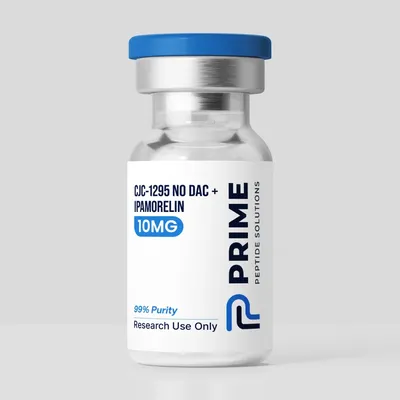
CJC-1295 no DAC + Ipamorelin is supplied as one sealed vial that holds both peptides together as a single lyophilized (freeze-dried) powder. In that dry state the blend is comparatively stable, but it cannot be measured or added to an aqueous assay until it is dissolved. Reconstitution means adding a measured volume of sterile diluent, normally bacteriostatic water, so the powder cake becomes one stock solution of known concentration.
A blend adds one detail that single-peptide guides do not cover: there are two numbers to track, the combined peptide concentration and the concentration of each component. This guide works through the combined figure for the 10 mg and 20 mg vials and the per-component figure for the 10 mg vial, whose batch COA lists a 1:1 split, then covers technique and storage.
This guide is a laboratory handling reference. CJC-1295 no DAC and Ipamorelin are not approved for human use, and the material sold here is strictly for in-vitro research. It is not for human or animal consumption.
The two peptides in the vial
- CJC-1295 no DAC: a 29-residue analog of GRF(1-29) amide with four substitutions (D-Ala2, Gln8, Ala15, Leu27) and a C-terminal amide. PubChem lists it as C152H252N44O42, molecular weight 3367.9 g/mol.
- Ipamorelin: a pentapeptide, Aib-His-D-2-Nal-D-Phe-Lys-NH2, containing two D-amino acids and a C-terminal lysinamide. PubChem lists it as C38H49N9O5, molecular weight 711.9 g/mol.
- Composition: the listed size is the combined total of both peptides. The 10 mg vial's published batch COA lists 5 mg of CJC-1295 no DAC and 5 mg of ipamorelin (1:1 by mass); for the 20 mg vial, read the split from its vial label and batch COA. Where a batch COA is published, its component table reports each component's labeled and measured amount.
- Supplied form: lyophilized powder in a sealed vial, with the diluent sold separately.
"No DAC" matters. The CJC-1295 described in a 2005 paper carries an extra lysine bearing a maleimide group that bonds to serum albumin; the peptide in this blend lacks that extension, so the albumin-related properties of the DAC form do not carry over. Literature naming is inconsistent, so check the sequence rather than the name alone. For the receptor pharmacology, see the research overview; this page stays on bench handling.
What You Need
- The lyophilized blend vial, 10 mg or 20 mg, and its batch COA where one is published
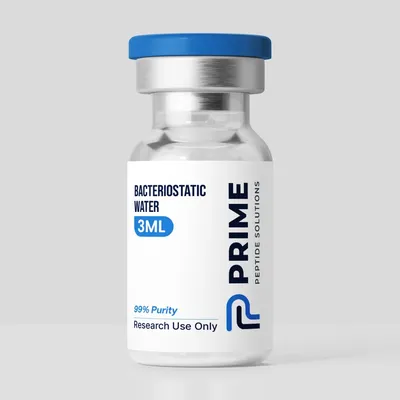
- Diluent: bacteriostatic water, sold separately in 3 mL and 10 mL vials. The product page states that it contains a preservative; as a general reference, bacteriostatic water is sterile water with 0.9% benzyl alcohol added as a bacteriostatic preservative, supplied in a multi-use vial
- Sterile transfer supplies: a new sterile syringe and needle used only to move the diluent
- Alcohol wipes for both rubber stoppers
- A fine-tip marker for the label
- A clean workspace, such as a wiped-down bench or laminar flow hood
Concentration Math for 10mg and 20mg Blend Vials
Combined concentration (mg/mL) = vial total (mg) ÷ diluent (mL)
In the 10 mg vial the two peptides are present in equal mass, so each component's concentration is half the combined figure. For example, a 10 mg vial plus 2 mL gives 5 mg/mL combined, which is 2.5 mg/mL of each peptide. For the 20 mg vial, work each component out from the split on its label and COA.
10 mg blend vial
- 1 mL of diluent gives 10 mg/mL combined
- 2 mL gives 5 mg/mL combined
- 2.5 mL gives 4 mg/mL combined
- 3 mL gives about 3.33 mg/mL combined
20 mg blend vial
- 2 mL of diluent gives 10 mg/mL combined
- 2.5 mL gives 8 mg/mL combined
- 3 mL gives about 6.67 mg/mL combined
- 4 mL gives 5 mg/mL combined
Two pairings line up across sizes. The 10 mg vial at 1 mL and the 20 mg vial at 2 mL both give 10 mg/mL, and the 10 mg vial at 2 mL and the 20 mg vial at 4 mL both give 5 mg/mL. Matching stocks like these keep records simple when a study uses both vial sizes.
Mass ratio is not molar ratio
Ipamorelin's molecular weight (711.9 g/mol) is about one-fifth that of CJC-1295 no DAC (3367.9 g/mol), so a milligram of ipamorelin holds about 4.7 times as many molecules (using the PubChem molecular weights, so molar figures are approximate). For a protocol written in molar terms, convert each component separately: millimolar = (mg/mL ÷ g/mol) × 1000.
Nominal versus measured concentration
These figures are nominal, calculated from the labeled vial total. The batch Certificate of Analysis reports measured net content separately from the labeled quantity, and the two can differ, so the true concentration follows the measured value. The blend COA also has a component table giving the labeled and measured amount of each peptide; read it with the vial label to compare each peptide's measured amount with its labeled share. Check the COA page for a report that matches the batch in hand.
Choosing a volume
The experiment sets the target concentration and the volume follows from it, so settle it before the stopper is pierced. For other volumes, the CJC-1295 + Ipamorelin preset works on the vial total, so its mg/mL is the combined concentration. A 3 mL vial of diluent covers the 1 to 2.5 mL volumes above with some margin. The 3 mL volume leaves no margin and the 4 mL volume is more than the small vial holds, so use the 10 mL size for those.
Stepwise Reconstitution Procedure
- Bring the vial to room temperature after cold storage to limit condensation on the stopper.
- Prepare the workspace. Clean the bench, wash hands, glove up and lay out every item.
- Disinfect both stoppers. Remove the flip caps, wipe each rubber stopper with an alcohol wipe and let it air dry.
- Measure the planned volume of diluent into a fresh sterile syringe, using aseptic technique.
- Add it slowly down the vial wall. Angle the needle toward the glass so the liquid runs down the inside wall rather than striking the cake.
- Let the vial stand upright and undisturbed for a few minutes so the whole cake wets.
- Swirl or roll gently between the palms. Do not shake.
- Inspect the solution against a light and a dark background. It should be clear, with no flakes, film or undissolved powder.
- Label the vial with the date, the combined concentration and the batch number.
- Refrigerate promptly at 2-8 °C.
Dissolving a two-peptide cake
The cake is one solid built from two peptides of very different size, a 29-residue chain of about 3.4 kDa and a pentapeptide of about 0.7 kDa, and a partly dissolved cake leaves the solution below its nominal concentration. Peptides are more stable in solid form, but for some systems lyophilization has been shown to cause conformational changes that increase aggregation after reconstitution, which is why a clear, fully dissolved solution is worth confirming.
Shaking works against this. Aggregation studies use stirring and shaker tables on purpose to accelerate aggregation, and some peptides aggregate at air-water interfaces. If haze persists after gentle handling, stop and check the batch documentation or contact support. Shaking harder is not the fix.
Storage After Reconstitution and Common Mistakes
Storage
- Keep the reconstituted vial at 2-8 °C in a temperature-stable laboratory refrigerator.
- Hold sealed, unreconstituted vials at 2-8 °C, or at −20 °C for long-term storage.
- Avoid repeated freezing and thawing. A review of protein stability names low temperature, freeze-concentration and ice formation as the chief stresses of freezing; the same reasoning applies to peptides by analogy.
No fixed usable life is quoted for the reconstituted blend; it depends on the diluent, the handling and the protocol's acceptance criteria. The stability guide covers general peptide stability and storage. Preparing only what the study needs is the simplest safeguard.
Common mistakes
- Reading the calculator's mg/mL as a per-peptide figure. The preset works on the vial total, so each component is below its mg/mL (half of it in the 1:1 10 mg vial).
- Confusing CJC-1295 no DAC with the DAC form and carrying over properties that belong to the albumin-binding construct.
- Shaking to speed things up, which introduces air and foam.
- Skipping the label. With two vial sizes and several diluent volumes, stocks are easy to confuse.
Frequently Asked Research Questions
How much bacteriostatic water goes into a CJC-1295 + Ipamorelin vial?
That depends on the target concentration. For the 10 mg vial, 1, 2, 2.5 and 3 mL give 10, 5, 4 and about 3.33 mg/mL combined; for the 20 mg vial, 2, 2.5, 3 and 4 mL give 10, 8, about 6.67 and 5 mg/mL. In the 10 mg vial each peptide is at half the combined figure (for example, 2.5 mg/mL of each at 5 mg/mL combined); for the 20 mg vial, use the split on its label and COA.
Can the two peptides be reconstituted separately?
Not from this vial. Both peptides share one lyophilized cake, so they dissolve into one solution at one diluent volume. Studies that need independent control of each concentration can use the single-peptide listings, CJC-1295 NO DAC (5 mg and 10 mg) and Ipamorelin (10 mg).
Why does CJC-1295 no DAC carry a D-amino acid at position 2?
Native GRF(1-29) amide is cleaved at its N-terminus in plasma, mainly by dipeptidyl peptidase-4, to the inactive 3-29 fragment, and in porcine plasma in vitro it was broken down rapidly. In linear GRF analogs, a D-amino acid at position 2 completely prevented cleavage between positions 2 and 3. These in-vitro findings describe related peptides, not CJC-1295 no DAC itself.
Which receptors do the two components act on?
CJC-1295 no DAC is a GHRH analog, and the GHRH receptor signals predominantly through cAMP. Ipamorelin, a pentapeptide whose development and pharmacology were described in a 1998 paper, acts at the growth hormone secretagogue receptor (the ghrelin receptor), whose signaling raises intracellular Ca2+ in somatotrophs. The two components therefore act at different receptors that signal through different second messengers (cAMP versus Ca2+); the CJC-1295 vs Ipamorelin comparison covers each receptor system in more detail.
How is purity confirmed?
The blend COA reports purity by RP-HPLC (C18 column, detection at 214 nm), identification by LC-MS, measured net content and the component table. Where a report is published for the batch, match it to the vial.
Conclusion
Reconstituting CJC-1295 no DAC + Ipamorelin comes down to planning and gentle handling. Choose the diluent volume from the target combined concentration, remember that each peptide sits below that figure (half of it in the 1:1 10 mg vial), and regard the tables as nominal next to the COA's measured net content. Add the diluent down the glass, swirl rather than shake, confirm a clear solution, label it and refrigerate.
Disclaimer: This guide is provided for educational and laboratory reference purposes only and does not constitute medical advice. CJC-1295 no DAC, Ipamorelin and all compounds sold by Prime Peptide Solutions are intended strictly for in-vitro laboratory research, are not approved for human use, and are not for human or animal consumption. Researchers are responsible for complying with all regulations that apply in their jurisdiction.
Shop these products
- Ships the same business day
- Free US shipping on $199.99+
- 14-day money-back guarantee on damaged items
References & Further Reading
- PubMed: Peer-reviewed Ipamorelin literature
- PubMed: CJC-1295 literature
- PubMed: Growth hormone secretagogue receptor research
- PubMed: GHRH receptor signaling research
- PubMed: Peptide aggregation, lyophilization and agitation
- Guide: General peptide reconstitution guide
Research-Grade CJC-1295 no DAC + Ipamorelin
In our catalog, the blend is listed as CJC-1295 no DAC + Ipamorelin in 10 mg and 20 mg vials, supplied as a lyophilized powder with bacteriostatic water sold separately. Published Certificates of Analysis are on our COA page.
Sold strictly for in-vitro laboratory research. Not for human or animal consumption.