

What Reconstituting GHK-Cu Involves
GHK-Cu is the copper(II) complex of GHK, the tripeptide glycyl-L-histidyl-L-lysine (Gly-His-Lys). It is supplied as a lyophilized (freeze-dried) powder that must be dissolved in a known volume of diluent before it can be measured or added to an aqueous assay. That stock solution of defined concentration is the goal of reconstitution.
Two things set GHK-Cu apart. It comes in 50 mg and 100 mg vials, five to ten times the 10 mg most single-compound vials hold, so the diluent volume deserves planning. And the copper is part of the molecule: the solution is blue, reducing agents and competing chelators can change how the copper is bound, and the copper complex may also be light-sensitive. For structure and research background, see the GHK-Cu scientific overview.
This guide is a laboratory handling reference. Research-grade GHK-Cu is not approved for human use and is sold strictly for in-vitro research. It is not for human or animal consumption.
GHK-Cu at a Glance
- Peptide: GHK, first reported in 1973 as a tripeptide in human serum
- Copper-free GHK: C14H24N6O4, molecular weight 340.38 g/mol, CAS 49557-75-7
- Copper complex: 1:1 copper(II) complex, CAS 89030-95-5, molecular weight about 400 g/mol depending on how the charge and any counterion are drawn
- Copper binding in solution: the N-terminal amine, a deprotonated backbone amide nitrogen and the histidine imidazole nitrogen, plus a labile fourth position
- Affinity: predominantly 1:1, with a conditional dissociation constant of 7.0 ± 1.0 × 10⁻¹⁴ M at pH 7.4
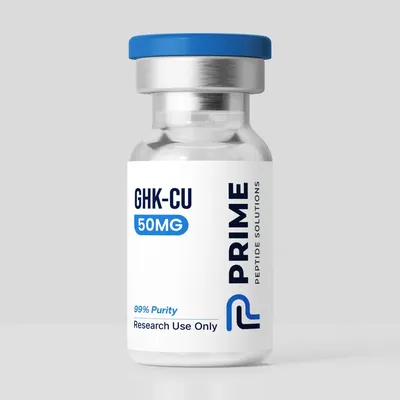
- Vial sizes in this store: 50 mg and 100 mg, lyophilized
In cell and animal models, GHK-Cu has been examined in NF-kB p65 and p38 MAPK signaling, TNF-alpha and IL-6 production, reactive oxygen species and superoxide dismutase activity in LPS models. This page stays with bench handling.
What You Need
- The GHK-Cu vial, 50 mg or 100 mg, with its batch number noted
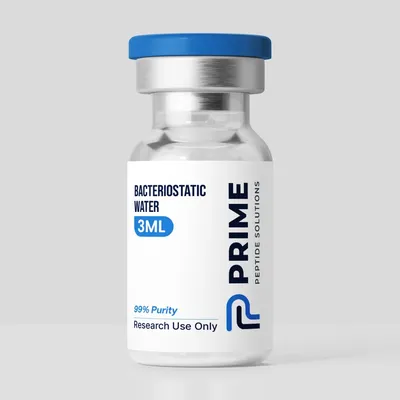
- Diluent: bacteriostatic water (0.9% benzyl alcohol in sterile water), sold separately in 3 mL and 10 mL vials
- A new sterile syringe and needle used only to move the diluent
- Alcohol wipes and a fine-tip marker
- The original box or an opaque container for light protection
- A clean workspace such as a wiped-down bench or laminar flow hood
Nothing else goes into the vial. Ascorbic acid, thiols such as glutathione or 2-mercaptoethanol, EDTA-type (aminopolycarboxylate) chelators, and phosphate or citrate buffers can reduce the copper or compete with GHK for it, as the chemistry below shows.
Concentration Math for 50mg and 100mg Vials
Concentration (mg/mL) = peptide (mg) ÷ diluent (mL)
50 mg GHK-Cu vial
- 2 mL of diluent gives 25 mg/mL
- 2.5 mL gives 20 mg/mL
- 3 mL gives about 16.67 mg/mL
- 4 mL gives 12.5 mg/mL
- 5 mL gives 10 mg/mL
- 10 mL gives 5 mg/mL
100 mg GHK-Cu vial
- 2 mL of diluent gives 50 mg/mL
- 2.5 mL gives 40 mg/mL
- 3 mL gives about 33.33 mg/mL
- 4 mL gives 25 mg/mL
- 5 mL gives 20 mg/mL
- 10 mL gives 10 mg/mL
Matching stocks and diluent supply
Doubling the volume for the 100 mg vial gives the same stock as the 50 mg vial: 2 mL and 4 mL both give 25 mg/mL, 2.5 mL and 5 mL both give 20 mg/mL, and 5 mL and 10 mL both give 10 mg/mL. One 3 mL diluent vial cannot supply more than 3 mL, so any volume above that needs the 10 mL vial or more than one 3 mL vial. One 10 mL vial sets the most dilute single-vial stock at 5 mg/mL (50 mg) and 10 mg/mL (100 mg).
These figures are arithmetic only. We have not found a verified water-solubility limit for GHK-Cu, so the most concentrated rows, such as 50 mg/mL, are not confirmed as practical. The experiment sets the target concentration and the volume follows. For the concentration at other volumes, use the GHK-Cu calculator preset, which takes the peptide mass in mg and the diluent volume in mL; the reconstitution guide covers the method.
Stepwise Reconstitution Procedure
- Bring the vial to room temperature before opening it, to prevent condensation.
- Prepare the workspace. Clean the bench, glove up and lay out every item.
- Disinfect both stoppers with an alcohol wipe and let them air dry.
- Draw the planned volume of diluent with a fresh sterile syringe and needle, decided before either stopper is pierced.
- Add it slowly down the vial wall, not onto the powder cake.
- Let the vial stand for a few minutes so the cake can wet.
- Swirl or roll gently. Do not shake.
- Inspect the solution against a light and a dark background. It should be transparent and blue, with no flakes, strands, film or particles. Clear here means see-through, not colorless.
- Label the vial with the date, vial size, concentration in mg/mL and batch number.
- Refrigerate promptly at 2-8 °C, in the box or an opaque container.
If haze, particles or a film remain after gentle handling, stop and check the batch COA or contact support. Shaking harder is not the fix.
The Blue Copper Complex: Color, Light and Storage
Why the solution is blue
Cu(II)-GHK has a visible d-d absorption band near 600 nm. A 2021 study measured it at 606 nm for 0.50 mM GHK with 0.45 mM Cu(II) at pH 7.4, and a 2026 review of GHK-Cu coordination chemistry places it at 580-600 nm. A substance that absorbs in the roughly 585-647 nm (orange) region looks blue, its complementary color. That is a rough guide, and those wavelengths belong to defined laboratory conditions, not a figure a vial is expected to match.
What the color can and cannot tell you
A 2023 materials-chemistry paper noted that the amount of copper peptide can be estimated by the hue of the system, yet mixing it with an ionic liquid made the color significantly lighter while circular dichroism showed no change in structure. Color intensity shifts with the medium even when the complex is intact. The 2026 review calls the d-d band a convenient confirmation of complex formation, but says any screening of added components needs copper-binding and redox endpoints "rather than appearance and peptide recovery alone", and that lyophilization "may generate a coordination state that differs from the liquid feed".
Blue is therefore a rough, qualitative sign that Cu(II) is bound, not a test of purity, identity or authenticity. Identity and purity come from HPLC and mass spectrometry on the batch Certificate of Analysis.
pH
A 1981 potentiometric and spectrophotometric study found multiple Cu(II)-GHK species across pH 3.5 to 10.6, and the 2026 review describes a mononuclear 1:1 complex at neutral pH, noting that "pH controls peptide deprotonation and donor availability." In a forced-degradation study, the peptide was stable in water and pH 4.5-7.4 buffers for at least two weeks at 60 °C, with hydrolytic cleavage under basic and oxidative stress. That method measured the peptide, not copper occupancy, and a stress test does not set a storage period.
Reducing agents and competing ligands
- Thiols: 1 mM glutathione added to Cu(II)-GHK at pH 7.4 caused an immediate drop in the visible band as part of the Cu(II) was reduced to Cu(I).
- Ascorbate: with ascorbate, Cu-GHK produced more hydroxyl radical than Cu-DAHK, its copper redox-cycling more readily in that system.
- Electrochemistry: Cu(II)-GHK was inert under moderate redox potentials but could be reduced to Cu(I) at around -0.62 V (versus AgCl/Ag), releasing the copper.
- Competing ligands: the 2026 review names phosphate, citrate, aminopolycarboxylate chelators, amino-acid buffers, anionic polymers and proteins. In the 1981 study's equilibrium-dialysis experiments with equimolar albumin (pH 7.5, 6 °C), about 42% of the Cu(II) was bound to the peptide.
Its copper chemistry depends on conditions. Reconstitute in plain diluent, add nothing else, and remember that a later dilution into a buffer or medium containing these components can redistribute the copper.
Light and cold
The 2026 review recommends photostability assessment "because both the peptide and the metal-centered coordination environment may be light-sensitive", and lists light transmission, oxygen ingress and headspace volume among factors in the labile copper trend over shelf life. Protecting the vial from light is a reasonable precaution.
- Lyophilized: -20 °C for long-term storage; 2-8 °C is often acceptable short-term.
- Reconstituted: 2-8 °C, protected from light, not repeatedly frozen and thawed.
The research peptide storage guide and the peptide stability guide cover the general principles.
Frequently Asked Research Questions
How much bacteriostatic water is added to a 50mg GHK-Cu vial?
That depends on the target concentration: 2 mL gives 25 mg/mL, 2.5 mL gives 20 mg/mL, 5 mL gives 10 mg/mL and 10 mL gives 5 mg/mL. In the 100 mg vial, the same volumes give 50, 40, 20 and 10 mg/mL.
Does a paler or deeper blue mean the peptide is degraded?
Not on its own. Color intensity changes with concentration and medium even when the complex is intact, so a paler stock made with more diluent is simply more dilute. Blue that fades in the same stock over time can reflect a change in the copper's binding and is worth checking, as are haze, flakes or particles. Mixing in another medium can also lighten the color while the complex stays intact, so color alone does not settle it; the batch COA confirms identity and purity.
Can ascorbic acid or a buffer be added to the stock to protect the copper?
No. Ascorbate and thiols can reduce Cu(II), and phosphate, citrate, chelators and proteins compete with GHK for copper.
How long does reconstituted GHK-Cu last?
No fixed period is quoted for a reconstituted vial; the 60 °C data come from a stress test that tracked the peptide only. Keep it at 2-8 °C and away from light, and prepare only what the study needs.
Conclusion
Reconstituting GHK-Cu starts with the arithmetic: at 50 mg and 100 mg, the diluent volume and diluent vial size are real planning decisions. The handling is the familiar gentle routine of adding diluent down the glass, swirling rather than shaking, inspecting, labeling and refrigerating. What sets GHK-Cu apart is its copper: expect a transparent blue solution, read the color as a rough sign rather than a specification, keep reductants and chelators out of the stock, and protect it from light.
Disclaimer: This guide is provided for educational and laboratory reference purposes only and does not constitute medical advice. GHK-Cu and all compounds sold by Prime Peptide Solutions are intended strictly for in-vitro laboratory research, are not approved for human use, and are not for human or animal consumption. Researchers are responsible for complying with all regulations that apply in their jurisdiction.
Shop these products
- Ships the same business day
- Free US shipping on $199.99+
- 14-day money-back guarantee on damaged items
References & Further Reading
- PubMed: Peer-reviewed GHK-Cu literature
- PubMed: Copper(II) coordination by the GHK tripeptide
- PubMed: GHK and DAHK copper-binding studies
- PubMed: Cu(II)-GHK and thiol reduction
- PubMed: GHK-Cu stability and HPLC methods
- Compare: GHK-Cu vs AHK-Cu
Research-Grade GHK-Cu
In our catalog, GHK-Cu is listed as GHK-Cu, a copper-binding peptide, in 50 mg and 100 mg vials supplied as a lyophilized powder. Batch-specific Certificates of Analysis are published on our COA page.
Sold strictly for in-vitro laboratory research. Not for human or animal consumption.