

What is NAD+?
NAD+ (nicotinamide adenine dinucleotide, oxidized form) is a coenzyme found in every living cell. Structurally, it consists of two nucleotides — one containing adenine and the other nicotinamide — joined by phosphate groups. It exists in two interconvertible forms: NAD+ (oxidized) and NADH (reduced). The NAD+/NADH ratio is one of the most fundamental indicators of cellular metabolic state in research literature.
Few molecules occupy as central a position in cellular biology as NAD+. It participates in over 500 enzymatic reactions, serves as a cofactor for the sirtuin family of enzymes, and provides the substrate for poly-ADP-ribose polymerases (PARPs) involved in DNA repair. Its role makes it a focal point in longevity, metabolic, and DNA damage research.
This article is intended as a scientific overview for laboratory researchers. All compounds discussed are sold strictly for in-vitro research and are not for human consumption.
NAD+ in Cellular Metabolism
The primary role of NAD+ in cellular metabolism is as an electron carrier. Energy-yielding reactions transfer electrons to NAD+, converting it to NADH; NADH then donates these electrons to the electron transport chain to drive ATP synthesis.
Key Metabolic Reactions Using NAD+
Published biochemistry literature describes NAD+ involvement in:
- Glycolysis — NAD+ accepts electrons during the conversion of glyceraldehyde-3-phosphate, producing NADH.
- Citric acid (Krebs) cycle — Multiple steps generate NADH, including the conversion of isocitrate, alpha-ketoglutarate, and malate.
- Fatty acid beta-oxidation — Each cycle produces one NADH per acetyl-CoA released.
- Oxidative phosphorylation — NADH donates electrons at Complex I of the electron transport chain to ultimately drive ATP synthesis.
The cellular concentration of NAD+ and the NAD+/NADH ratio thus directly reflect cellular energetic state and metabolic activity.
NAD+ Beyond Energy Metabolism
Sirtuin Activity
The sirtuin family of NAD+-dependent enzymes has received substantial research attention. Seven mammalian sirtuins (SIRT1 through SIRT7) act as deacetylases or ADP-ribosyltransferases, with each catalytic cycle consuming one NAD+ molecule and producing nicotinamide as a byproduct.
Research literature characterizes sirtuins as regulators of metabolism, mitochondrial biogenesis, DNA repair, and cellular stress response. Because sirtuin activity requires NAD+, the cellular NAD+ pool serves as a regulatory rheostat for sirtuin function.
PARP Activity and DNA Repair
Poly-ADP-ribose polymerases (PARPs) consume NAD+ during the DNA damage response, transferring ADP-ribose units to target proteins. Heavy DNA damage results in extensive PARP activation, which can substantially deplete cellular NAD+ pools — a finding research literature has linked to metabolic dysfunction in aging and disease models.
CD38 and NAD+ Consumption
CD38 is a glycoprotein enzyme that consumes NAD+ as a substrate. Research has characterized CD38 activity as increasing with age in animal models, contributing to the observed age-related decline in tissue NAD+ levels.
NAD+ Decline with Age
One of the most-cited findings in NAD+ research is the observed decline in tissue NAD+ levels with chronological age. Published research has documented decreases in NAD+ across multiple tissues including skeletal muscle, liver, and brain in animal models.
The mechanisms proposed in research literature for this decline include:
- Reduced expression of biosynthetic enzymes (NAMPT in particular).
- Increased NAD+ consumption by CD38 and PARP enzymes.
- Reduced precursor availability.
- Mitochondrial dysfunction reducing the regeneration of NAD+ from NADH.
This age-related decline has positioned NAD+ as a central molecule in longevity research.
NAD+ Restoration Pathways in Research
Research literature describes several pathways by which cellular NAD+ levels can be restored or enhanced:
Direct NAD+ Administration
NAD+ itself has been investigated in research models, though bioavailability is a primary consideration. Research literature describes gastrointestinal degradation as one factor limiting its bioavailability.
Precursor Supplementation
Several NAD+ precursors have been investigated in research literature:
- Nicotinamide riboside (NR) — Phosphorylated to NMN intracellularly, then converted to NAD+.
- Nicotinamide mononucleotide (NMN) — Direct precursor to NAD+; one of the most-studied compounds in NAD+ restoration research.
- Niacin (nicotinic acid) — Classic vitamin B3 form, converted to NAD+ via the Preiss-Handler pathway.
- Nicotinamide — Another vitamin B3 form; differs from niacin in metabolic pathway.
Research Applications
Aging Research
The most extensive research application area involves longevity research in cellular and animal models. Animal-model studies have characterized NAD+ restoration in longevity research contexts, with research literature describing associated changes in mitochondrial function, sirtuin activity, and various age-associated markers.
Metabolic Research
NAD+ research extends into metabolic disease models, where research has characterized effects on insulin sensitivity, hepatic steatosis, and glucose handling in animal models.
Neurological Research
Brain NAD+ levels and their relationship to neurological function are an active research area. Published work has investigated NAD+ in models of cognitive aging and neurodegenerative disease processes.
Storage and Handling
Research-grade NAD+ in lyophilized form is reported in research literature as stable at controlled cold temperatures (-20 degrees C for long-term, 2-8 degrees C for working stocks) when sealed and protected from light and moisture. NAD+ is sensitive to alkaline pH and elevated temperatures, both of which can degrade the molecule.
Following reconstitution, storage at 2-8 degrees C is typical, with shorter stability windows than many peptides due to NAD+'s chemical sensitivity. Always refer to the published Certificate of Analysis for batch-specific stability data.
Conclusion
NAD+ occupies a central role in cellular biology that few other molecules can match. Its position as an electron carrier in fundamental metabolic reactions, substrate for the sirtuin and PARP enzyme families, and subject of an active age-related decline make it one of the most-researched molecules in modern longevity and metabolic research.
For laboratory researchers, NAD+ and its precursors represent a rich research area with substantial published literature, well-characterized biochemistry, and ongoing investigation into restoration strategies and cellular consequences.
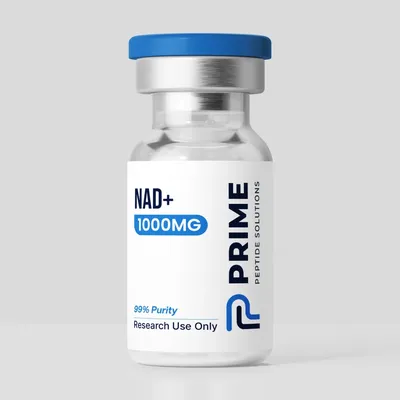
Prime Peptide Solutions offers NAD+ at >99% purity with batch-specific Certificates of Analysis.
Shop NAD+
- Ships the same business day
- Free US shipping on $149.99+
- 7-day money-back guarantee on damaged items