

What is Ipamorelin?
Ipamorelin is a synthetic peptide studied as a growth hormone secretagogue, meaning a compound examined for its influence on the body's own growth hormone signaling pathways. It belongs to the class of growth hormone releasing peptides (GHRPs) and is noted in research literature for its selectivity.
Ipamorelin acts on the growth hormone secretagogue receptor (the ghrelin receptor), and is frequently studied alongside GHRH analogs such as CJC-1295 because the two engage complementary pathways.
This article is intended as a scientific overview for laboratory researchers. Ipamorelin is sold strictly for in-vitro research and is not for human consumption.
Background: Growth Hormone Secretagogues
Growth hormone release is regulated by more than one signal, and Ipamorelin acts on one of them.
The ghrelin / GHS receptor pathway
The growth hormone secretagogue receptor (GHS-R), also known as the ghrelin receptor, is one of the pathways that influences growth hormone signaling. Growth hormone releasing peptides like Ipamorelin act here. This pathway works alongside the separate GHRH-receptor pathway, which is why GHRPs are often studied in combination with GHRH analogs.
The GHRP class
Ipamorelin is part of the growth hormone releasing peptide family. Earlier peptides in this class were noted for engaging additional hormone systems beyond growth hormone signaling. Ipamorelin is studied specifically because of its comparatively selective profile within this family.
Structure and Design
Ipamorelin is a synthetic pentapeptide, a chain of five amino acids. Its relatively short, defined structure is part of what makes it practical to synthesize and handle in a research setting, and it carries the structural features needed to engage the ghrelin receptor.
Proposed Mechanism of Action
In research literature, Ipamorelin is studied as a selective agonist of the GHS-R (ghrelin receptor). Its defining research characteristic is selectivity: it is noted for engaging the ghrelin receptor pathway with comparatively little effect on other hormone systems that some earlier growth hormone releasing peptides also influenced. This selectivity is a primary reason it appears so often in research designs. As with all peptides in this area, the evidence base is laboratory and animal research, and proposed mechanisms remain under study.
Current Research Areas
Ipamorelin appears in growth hormone secretagogue research, particularly in studies of the ghrelin-receptor pathway and pituitary signaling. It is frequently studied in combination with GHRH analogs such as CJC-1295, because engaging both the ghrelin-receptor and GHRH-receptor pathways at once is a common research design. The CJC-1295 plus Ipamorelin pairing is one of the most referenced combinations in this area for that reason.
Stability and Laboratory Handling
General Handling Considerations
Ipamorelin arrives lyophilized and is reconstituted with bacteriostatic water for research use. Lyophilized peptide is stored cold and protected from light and moisture. Reconstituted material is refrigerated and used within a defined window, as reconstituted peptides are less stable than their dry form.
Verifying Quality
Identity and purity should be confirmed by a Certificate of Analysis backed by HPLC and mass spectrometry. As a short, well-characterized peptide, Ipamorelin is straightforward to verify analytically against its expected mass and purity specification.
Frequently Asked Research Questions
What receptor does Ipamorelin act on?
Ipamorelin is studied as a selective agonist of the growth hormone secretagogue receptor (GHS-R), also known as the ghrelin receptor.
Why is Ipamorelin described as selective?
In the literature it is noted for engaging the ghrelin receptor pathway with comparatively little effect on other hormone systems that some earlier growth hormone releasing peptides also influenced.
Why is Ipamorelin often paired with CJC-1295?
CJC-1295 is a GHRH analog acting on a different receptor. Studying the two together lets researchers engage both the GHRH and ghrelin-receptor pathways at once, which neither does alone.
Is Ipamorelin approved for human use?
Ipamorelin is sold by Prime Peptide Solutions strictly as a research compound for in-vitro laboratory study and is not for human consumption or in-vivo human use.
What purity should research-grade Ipamorelin have?
High purity verified by HPLC and confirmed by mass spectrometry, with the exact figure stated on a batch-specific Certificate of Analysis.
Conclusion
Ipamorelin is a selective growth hormone releasing peptide studied for its activity at the ghrelin receptor and its comparatively clean selectivity within the GHRP family. Its frequent pairing with GHRH analogs like CJC-1295 reflects the complementary nature of the two pathways. For laboratories, the relevant considerations are its selectivity, its short well-defined structure, and its role as a standard component of combination growth hormone secretagogue research.
Disclaimer: This article is provided for educational and research purposes only. Information contained herein is a summary of publicly available scientific literature and does not constitute medical advice. Ipamorelin and all peptide compounds sold by Prime Peptide Solutions are intended strictly for laboratory research and are not for human consumption, in-vivo human use, or therapeutic application. Researchers are responsible for compliance with all applicable regulations governing peptide use in their jurisdiction.
Shop these products
- Ships the same business day
- Free US shipping on $199.99+
- 14-day money-back guarantee on damaged items
References & Further Reading
- PubMed: Current peer-reviewed Ipamorelin literature
- PubMed: Ghrelin receptor research overview
- Related: CJC-1295 and Ipamorelin: A Research Overview
- Related: Peptide Reconstitution Guide
- Tool: Peptide Reconstitution Calculator
- For batch-specific COAs, see our published Certificates of Analysis
- Related compound: IGF-1 LR3, a long-acting IGF-1 analogue for research on the IGF-1 receptor pathway, downstream of growth hormone
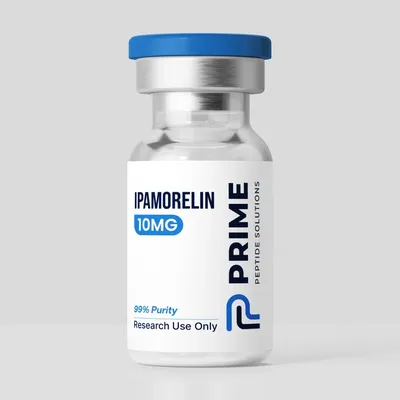
Research-Grade Ipamorelin
In our catalog, Ipamorelin is available as Ipamorelin, supplied as a lyophilized powder and third-party tested for purity. Certificates of Analysis are available for every batch on our COA page.
Sold strictly for in-vitro laboratory research. Not for human or animal consumption.