
Retatrutide vs MOTS-c: Receptor Agonist vs Mitochondrial Peptide
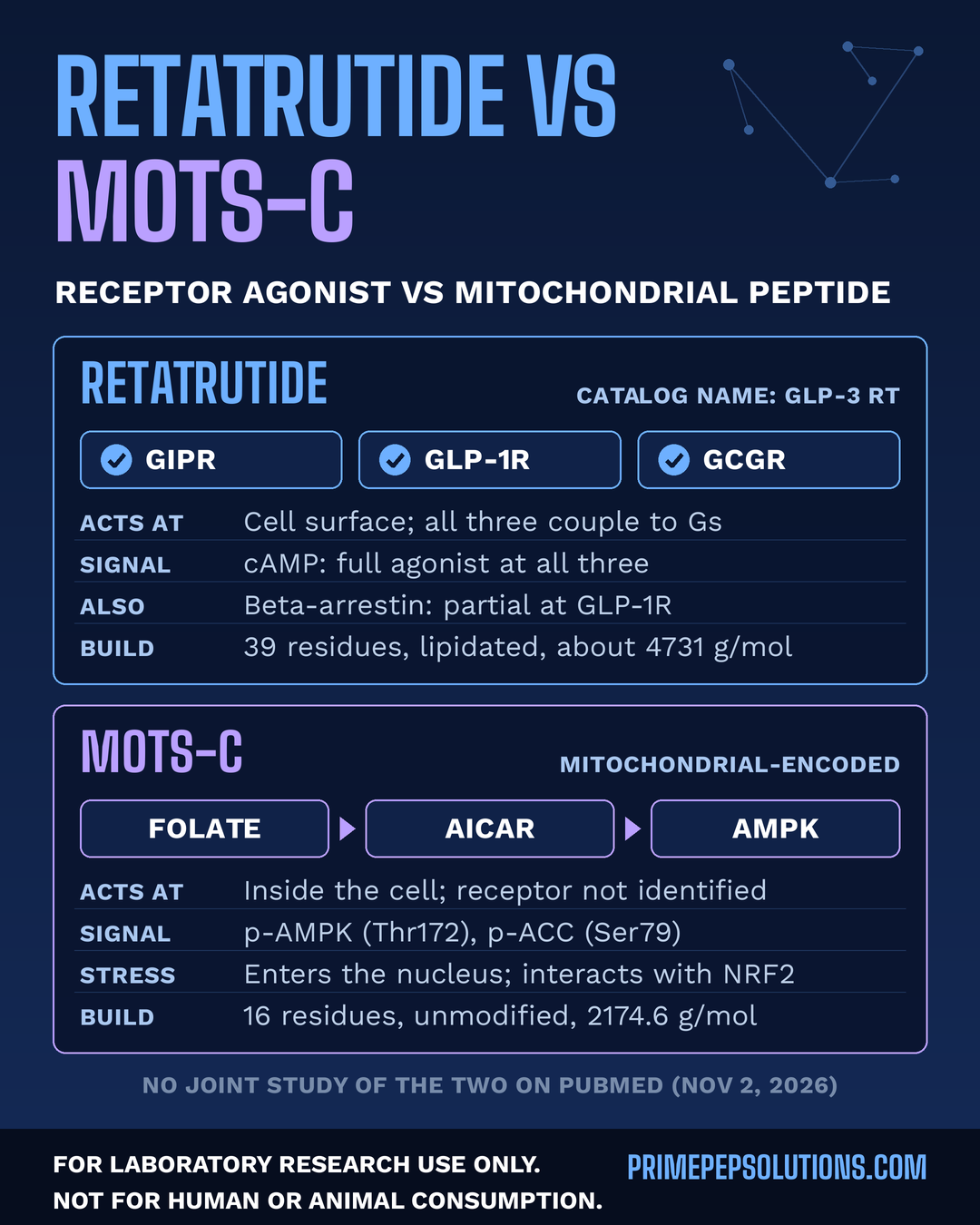
Retatrutide and MOTS-c work at opposite ends of the cell. Retatrutide is a 39-residue, lipidated synthetic peptide that activates three cell-surface receptors (Coskun et al., 2022; Mateescu et al., 2026): the GIP, GLP-1 and glucagon receptors (GIPR, GLP-1R, GCGR), all class B receptors that couple to Gs and raise cAMP (Müller et al., 2019). MOTS-c is a 16-residue peptide encoded in mitochondrial DNA with no identified receptor (Thoudam et al., 2026); its reported actions run inside the cell, through the folate pathway, AICAR and AMPK, and into the nucleus under metabolic stress (Lee et al., 2015; Kim et al., 2018).
A PubMed search for the two together, run on November 2, 2026, returned no records, so this page compares the published work on each, from structure to identity checks. In this catalog retatrutide is listed as GLP-3 RT (retatrutide) and MOTS-c as MOTS-C.
Both are sold by Prime Peptide Solutions strictly for in-vitro laboratory research. They are not approved for human use and are not for human or animal consumption. Clinical literature on retatrutide is not summarized here.
| Property | Retatrutide | MOTS-c |
|---|---|---|
| Class | Synthetic triple receptor agonist | Mitochondria-derived peptide |
| Origin | Designed on a GIP-based sequence | Open reading frame in the mitochondrial 12S rRNA |
| Length | 39 residues | 16 residues |
| Modifications | Aib2, Aib20, alpha-methyl-Leu13; C20 diacid on Lys17; amidated | None (free acid) |
| Formula | C221H342N46O68 | C101H152N28O22S2 |
| Molecular weight (PubChem) | About 4731 g/mol | 2174.6 g/mol |
| CAS (catalog data sheet) | 2381089-83-2 | 1627580-64-6 |
| Where it acts | Cell surface: GIPR, GLP-1R, GCGR | Inside the cell; nucleus under stress; no receptor identified |
| First signal | Gs, adenylate cyclase, cAMP | Folate pathway, AICAR, AMPK |
| In-vitro readouts | cAMP; beta-arrestin recruitment | AICAR; phospho-AMPK (Thr172), phospho-ACC (Ser79); nuclear localization |
| Receptor structures | Cryo-EM with Gs at all three (2.68-3.26 Å) | None (no receptor identified) |
| Mouse-study emphasis | GCGR: energy expenditure; GIPR, GLP-1R: calorie intake | Skeletal muscle |
| Studied together | No PubMed record (Nov 2, 2026) | No PubMed record (Nov 2, 2026) |
| In this catalog | GLP-3 RT: 10mg, 20mg, 30mg | MOTS-C: 10mg, 20mg, 40mg |
How Does Retatrutide Signal?
Structure. Retatrutide is a 39-residue peptide built on a GIP-based sequence, with three non-coded residues (aminoisobutyric acid, Aib, at positions 2 and 20; alpha-methyl-L-leucine at 13), an amidated C-terminus and a C20 fatty diacid on Lys17 through a gamma-glutamyl and AEEA spacer. Aib2 reduces susceptibility to DPP-4, and the lipid promotes albumin association (Mateescu et al., 2026). Its formula, C221H342N46O68, gives about 4731 g/mol (PubChem CID 171390338).
Three receptors, one second messenger. GIPR, GLP-1R and GCGR are class B, seven-transmembrane receptors that couple to Gs and raise cAMP through adenylate cyclase (Müller et al., 2019). In HEK-293 lines each expressing one human receptor at low density, retatrutide was about 8.9 times as potent as native GIP at GIPR and about 0.4 and 0.3 times as potent as native GLP-1 and glucagon. It was a full cAMP agonist at all three but a partial agonist for beta-arrestin recruitment at GLP-1R; potencies were measured with and without human serum albumin and differed at the mouse receptors (Mateescu et al., 2026; Li et al., 2024).
Structural basis. Cryo-EM structures with GLP-1R, GIPR and GCGR, each bound to Gs, were solved at 2.68, 3.26 and 2.84 Å. Residues 1-13 sit in the transmembrane core; in GIPR, mutating extracellular loop 1 (R196Y) cut cAMP potency 107.7-fold (Li et al., 2024).
Tissues. In mice, the developers linked increased energy expenditure to the GCGR arm and reduced calorie intake to the GIPR and GLP-1R arms (Coskun et al., 2022). Glucagon acts on the liver to stimulate glycogenolysis and gluconeogenesis (Müller et al., 2019), through cAMP, protein kinase A and CREB (Janah et al., 2019). More in the retatrutide research overview and the GLP-3 naming explainer.
How Does MOTS-c Signal?
Origin. MOTS-c (mitochondrial open reading frame of the 12S rRNA type-c) comes from a short open reading frame in the mitochondrial 12S rRNA and must be translated in the cytoplasm, because the mitochondrial genetic code yields tandem start and stop codons. It was detected in mouse and rat tissues, and by ELISA in human and rodent plasma (Lee et al., 2015). The catalog sequence, H-Met-Arg-Trp-Gln-Glu-Met-Gly-Tyr-Ile-Phe-Tyr-Pro-Arg-Lys-Leu-Arg-OH, carries no lipid or non-coded residue (C101H152N28O22S2, 2174.6 g/mol; PubChem CID 146675088).
From the folate pathway to AMPK. In HEK293 cells overexpressing MOTS-c or exposed to the synthetic peptide, 5-methyl-tetrahydrofolate fell, de novo purine synthesis stalled and AICAR accumulated more than 20-fold in the overexpressing cells; AMPK-alpha (Thr172) and ACC (Ser79) phosphorylation rose although AMP levels were lower. AMPK knockdown or compound C only partly reduced the glycolytic response, folic acid reversed it, and a scrambled peptide and the E5A and G7A variants did not produce it (Lee et al., 2015).
Into the nucleus. Under glucose restriction, serum deprivation or oxidative stress, MOTS-c entered the nucleus of HEK293 cells within 30 minutes and returned to a largely extra-nuclear state within 24 hours. Blocking AMPK prevented the move, and replacing the hydrophobic 8-YIFY-11 core with alanines kept a tagged MOTS-c out of the nucleus; in the nucleus it regulated antioxidant-response-element genes and interacted with NRF2 (Kim et al., 2018).
Receptor and tissues. A 2026 review lists its receptor as unknown, with action through cellular uptake (Thoudam et al., 2026). In mouse clamp studies, insulin-stimulated glucose disposal rose while hepatic glucose production was comparable between groups, consistent with skeletal muscle as its main target organ (Lee et al., 2015). In sedentary young men, endogenous muscle MOTS-c rose 11.9-fold after a stationary-bike session, and plasma levels rose 1.5- to 1.6-fold (Reynolds et al., 2021). See the MOTS-C research overview and the mitochondrial peptides hub.
Where Do the Two Pathways Meet?
Not at a receptor. Retatrutide's signal starts at the cell surface and runs through Gs and cAMP; MOTS-c's starts in folate and purine metabolism and reaches AMPK through AICAR. The sources reviewed here report no shared receptor, and none tested retatrutide on AMPK. Where AMPK does appear in the GLP-1 literature, it moves the other way: in rodent hindbrain studies, GLP-1 receptor activation lowered AMPK activity in the nucleus tractus solitarius (Müller et al., 2019), whereas MOTS-c raised AMPK phosphorylation in HEK293 cells (Lee et al., 2015).
The nearest point of contact is glucagon itself: retatrutide activates the glucagon receptor, while MOTS-c has been reported to change glucagon release. In alphaTC-1 cells MOTS-c raised glucagon secretion without changing glucagon receptor gene expression, and in INS-1E beta cells it lowered insulin secretion (Bień et al., 2024); in isolated rat islets, tested with the rat MOTS-c sequence, it reduced both, while pig islets responded differently (Bień et al., 2025). Neither study included retatrutide.
Which Fits the Research Question?
- Receptor pharmacology: retatrutide, for GIPR, GLP-1R and GCGR activation, cAMP versus beta-arrestin readouts and structure-function work (Li et al., 2024). Related: retatrutide vs survodutide and tirzepatide vs retatrutide.
- Mitochondria-to-nucleus signaling: MOTS-c, for folate and purine metabolism, AICAR, AMPK and NRF2 (Lee et al., 2015; Kim et al., 2018). Related: SS-31 vs MOTS-C and MOTS-C vs NAD+.
How Can a Lab Tell Them Apart?
By mass: about 4731 versus 2174.6 g/mol. MOTS-c's two methionines and tryptophan matter because side-chain oxidation is a recognized impurity type in synthetic peptides (D'Hondt et al., 2014), and an LC-MS method for MOTS-c in plasma included two oxidation products and found considerable differences from ELISA readings (Knoop et al., 2019). See HPLC and mass spectrometry explained.
Each lab report covers one batch: the GLP-3 RT 30mg lab report (BT Labs) gives 99.8% HPLC purity with identity by FTIR, and the MOTS-C 10mg lab report (ILS Labs) gives 99.94%. A chromatographic area percentage is not peptide content or receptor potency (Mateescu et al., 2026); see net peptide content vs HPLC purity.
Frequently Asked Questions
What is the main difference between retatrutide and MOTS-c?
Where they act. Retatrutide activates three cell-surface receptors that signal through Gs and cAMP (Coskun et al., 2022; Müller et al., 2019); MOTS-c, a mitochondrial-encoded peptide with no identified receptor, acts through the folate pathway, AICAR and AMPK (Lee et al., 2015; Thoudam et al., 2026).
Have retatrutide and MOTS-c been studied together?
No record was found: a PubMed search for retatrutide and MOTS-c on November 2, 2026 returned none.
Is MOTS-c a GLP-1 receptor agonist?
Not on current evidence. No source reviewed here reports MOTS-c activating GLP-1R, GIPR or GCGR, and a 2026 review lists its receptor as unknown (Thoudam et al., 2026).
Do both peptides act through AMPK?
AMPK is central to MOTS-c: it is activated downstream of AICAR and is needed for MOTS-c's stress-induced nuclear entry (Lee et al., 2015; Kim et al., 2018). Retatrutide's receptors signal through Gs and cAMP, and no study reviewed here tested retatrutide on AMPK; in rodent hindbrain studies GLP-1 receptor activation lowered AMPK activity rather than raising it (Müller et al., 2019).
How are the vials supplied and stored?
Both ship as lyophilized powder in sealed vials (GLP-3 RT 10mg, 20mg and 30mg; MOTS-C 10mg, 20mg and 40mg), kept at 2-8 °C, or -20 °C long term, dry and away from light (see the peptide storage guide). Bacteriostatic water is sold separately; batch lab reports are on the COAs page.
Are these approved for human use?
No. Both are sold strictly for in-vitro laboratory research and are not for human or animal consumption.
References
- Coskun T, et al. Cell Metab. 2022;34(9):1234-1247.e9. doi:10.1016/j.cmet.2022.07.013. PubMed 35985340
- Li W, et al. Cell Discov. 2024;10(1):77. doi:10.1038/s41421-024-00700-0. PubMed 39019866
- Mateescu DM, et al. Pharmaceutics. 2026;18(10):1277. doi:10.3390/pharmaceutics18101277. PubMed 42942810
- Müller TD, et al. Mol Metab. 2019;30:72-130. doi:10.1016/j.molmet.2019.09.010. PubMed 31767182
- Janah L, et al. Int J Mol Sci. 2019;20(13):3314. doi:10.3390/ijms20133314. PubMed 31284506
- Lee C, et al. Cell Metab. 2015;21(3):443-454. doi:10.1016/j.cmet.2015.02.009. PubMed 25738459
- Kim KH, et al. Cell Metab. 2018;28(3):516-524.e7. doi:10.1016/j.cmet.2018.06.008. PubMed 29983246
- Reynolds JC, et al. Nat Commun. 2021;12(1):470. doi:10.1038/s41467-020-20790-0. PubMed 33473109
- Thoudam T, et al. Hepatol Commun. 2026;10(2):e0885. doi:10.1097/
HC9.0000000000000885. PubMed 41543486 - Bień J, et al. Histochem Cell Biol. 2024;161(6):449-460. doi:10.1007/s00418-024-02274-0. PubMed 38430258
- Bień J, et al. Histochem Cell Biol. 2025;163(1):64. doi:10.1007/s00418-025-02391-4. PubMed 40478460
- Knoop A, et al. Rapid Commun Mass Spectrom. 2019;33(4):371-380. doi:10.1002/rcm.8337. PubMed 30394592
- D'Hondt M, et al. J Pharm Biomed Anal. 2014;101:2-30. doi:10.1016/j.jpba.2014.06.012. PubMed 25044089
- PubChem compound records, National Library of Medicine: CID 171390338 (C221H342N46O68) and CID 146675088 (MOTS-c).
- PubMed search "retatrutide AND MOTS-c", run November 2, 2026 (no records). PubMed search
Disclaimer: This page summarizes published scientific literature for educational and research purposes and is not medical advice. Retatrutide (GLP-3 RT), MOTS-C and all peptides sold by Prime Peptide Solutions are intended strictly for laboratory research, are not approved for human use, and are not for human or animal consumption. Researchers are responsible for compliance with the regulations of their jurisdiction.
Sold strictly for in-vitro laboratory research. Not for human or animal consumption.
Shop these products
- Ships the same business day
- Free US shipping on $149.99+
- 7-day money-back guarantee on damaged items