
What is MOTS-C?
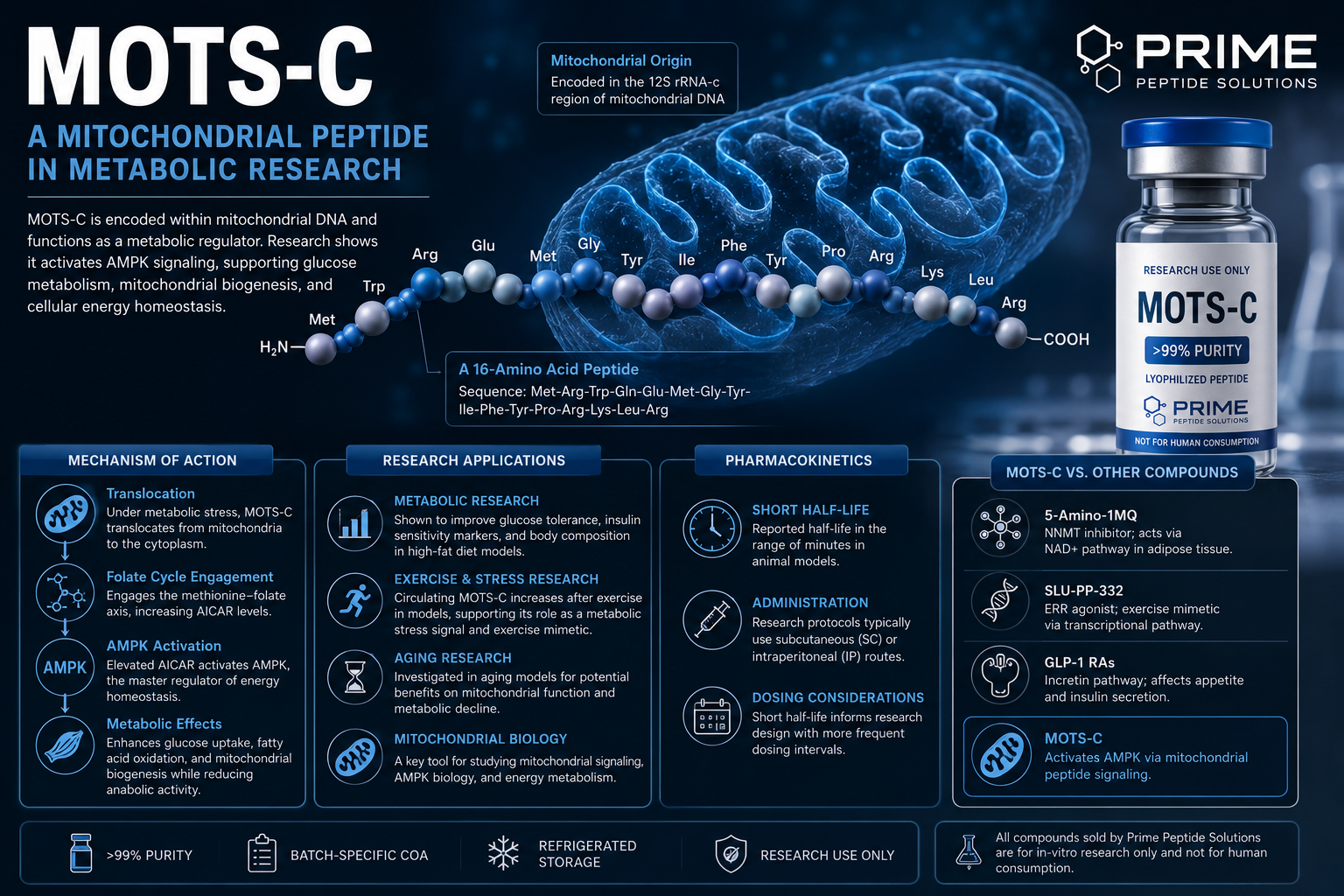
MOTS-C (Mitochondrial Open Reading Frame of the 12S rRNA-c) is a 16-amino acid peptide with the sequence Met-Arg-Trp-Gln-Glu-Met-Gly-Tyr-Ile-Phe-Tyr-Pro-Arg-Lys-Leu-Arg. It is one of the most-studied members of a class of compounds called mitochondrial-derived peptides (MDPs), and is notable for being encoded directly within mitochondrial DNA rather than the nuclear genome.
MOTS-C was identified through computational scanning of mitochondrial DNA in the early 2010s. Its discovery expanded the understanding of mitochondria from purely energy-producing organelles to active signaling participants in cellular metabolism.
This article is intended as a scientific overview for laboratory researchers. All compounds discussed are sold strictly for in-vitro research and are not for human consumption.
Discovery and Mitochondrial Origin
Research published in 2015 first characterized MOTS-C as a peptide product of the 12S rRNA region of mitochondrial DNA. This was a substantive finding in research literature because the predominant view had been that mitochondrial DNA encodes only structural and catalytic components of the electron transport chain — not signaling peptides.
Subsequent research has identified several other mitochondrial-derived peptides, including humanin and SHLP1-6, collectively forming a category of compounds with putative roles in cellular signaling beyond traditional ATP production.
Mechanism of Action
The principal mechanism characterized in published preclinical research involves activation of AMP-activated protein kinase (AMPK), a master regulator of cellular energy homeostasis. Research has described the following sequence in animal models:
- MOTS-C translocates from mitochondria to the cytoplasm under metabolic stress.
- Cytoplasmic MOTS-C engages with the folate cycle, particularly the methionine-folate axis.
- This engagement results in elevated AICAR levels, which activate AMPK.
- AMPK activation promotes catabolic pathways including glucose uptake, fatty acid oxidation, and mitochondrial biogenesis, while suppressing anabolic pathways.
Additionally, research has reported MOTS-C translocation to the nucleus under cellular stress, where it appears to modulate gene expression related to stress response and metabolic homeostasis.
Glucose Handling
One of the most-cited findings in MOTS-C research is its effect on glucose uptake. Published preclinical work has characterized increased glucose uptake in skeletal muscle following MOTS-C administration, with mechanism attributed to AMPK-mediated GLUT4 translocation to the cell surface.
Research Applications
Metabolic Research
The most extensive research application area involves metabolic homeostasis. Animal-model studies have characterized MOTS-C for effects on insulin sensitivity markers, glucose tolerance, and body weight in high-fat diet models. The research literature consistently describes a metabolically protective profile against diet-induced challenges.
Exercise and Cellular Stress Research
Research has identified MOTS-C as responsive to exercise and metabolic stress. Published work characterizes increases in circulating MOTS-C following exercise in research models, supporting hypotheses that MDPs serve as cellular signals during metabolic challenge. This has positioned MOTS-C as a compound of interest in exercise mimetics research.
Aging Research
Mitochondrial dysfunction is a recognized hallmark of cellular aging in research literature. Animal studies have investigated MOTS-C in aging models, with findings characterizing effects on mitochondrial function and metabolic parameters that decline with age in research models.
Pharmacokinetics
MOTS-C has a reported short circulating half-life in the range of minutes following subcutaneous administration in research models. This short half-life is consistent with native peptides of similar size lacking stabilizing modifications.
Research administration in published protocols has typically used subcutaneous or intraperitoneal routes for animal models. The short half-life shapes research protocol design, with dosing frequencies typically adjusted to maintain meaningful exposure windows.
Comparison with Other Metabolic Compounds
MOTS-C operates in a different mechanism than other peptides and small molecules investigated in metabolic research:
- 5-Amino-1MQ — Small-molecule NNMT inhibitor; acts on adipose tissue via NAD+ pathway rather than AMPK.
- SLU-PP-332 — Small-molecule ERR agonist; acts as an exercise mimetic via different transcriptional pathway.
- GLP-1 receptor agonists — Act on incretin signaling and appetite, not direct cellular metabolism.
In research design, MOTS-C is selected when investigators want to engage the AMPK pathway directly via a mitochondrial peptide signal.
Storage and Handling
Lyophilized MOTS-C is reported in research literature as stable at controlled refrigerated temperatures when sealed and protected from light and humidity. Following reconstitution with bacteriostatic water, storage at 2-8 degrees C is typical, with research stability data supporting use within 14-28 days depending on conditions.
As with all peptides, repeated freeze-thaw cycles should be avoided to preserve research integrity. Always refer to the published Certificate of Analysis for batch-specific guidance.
Conclusion
MOTS-C represents an emerging and active area of metabolic research. Its unique mitochondrial origin, characterization as an AMPK pathway activator, and accumulating preclinical literature on glucose handling and metabolic homeostasis make it a frequent compound of interest in modern metabolic research design.
For laboratory researchers studying mitochondrial signaling, AMPK biology, or exercise mimetics, MOTS-C occupies a distinctive position as the most-characterized mitochondrial-derived peptide currently available for research use.
Prime Peptide Solutions offers MOTS-C at >99% purity with batch-specific Certificates of Analysis.