

What Are Mitochondrial Peptides?
"Mitochondrial peptides" is a loose label for two different groups. Mitochondria-derived peptides (MDPs, also written mitochondrial-derived peptides) are encoded by short open reading frames in mitochondrial DNA: humanin and the six small humanin-like peptides (SHLP1-6) come from the 16S rRNA region, and MOTS-c from the 12S rRNA region. Mitochondria-targeted peptides are synthetic: the Szeto-Schiller (SS) tetrapeptides, led by SS-31, were designed to concentrate in the inner mitochondrial membrane.
This hub maps both groups, their identity data and the main findings by study model, and shows where NAD+ fits. Single-compound pages go deeper: the MOTS-C research overview, the SS-31 research overview and the SS-31 vs MOTS-C comparison.
This article is a scientific overview for laboratory researchers. The research-grade MOTS-C and SS-31 supplied by Prime Peptide Solutions are sold strictly for in-vitro laboratory research. They are not approved for human use and are not for human or animal consumption.
Identity at a Glance
- MOTS-C: Mitochondria-derived, 12S rRNA region; 16 residues: H-Met-Arg-Trp-Gln-Glu-Met-Gly-Tyr-Ile-Phe-Tyr-Pro-Arg-Lys-Leu-Arg-OH; C101H152N28O22S2, 2174.6 g/mol; CAS 1627580-64-6, PubChem CID 146675088
- Humanin (not sold here): Mitochondria-derived, 16S rRNA region; 24 residues: Met-Ala-Pro-Arg-Gly-Phe-Ser-Cys-Leu-Leu-Leu-Leu-Thr-Ser-Glu-Ile-Asp-Leu-Pro-Val-Lys-Arg-Arg-Ala; C119H204N34O32S2, 2687.2 g/mol; CAS 330936-69-1, PubChem CID 16131438
- SS-31: Synthetic, mitochondria-targeted; 4 residues: H-D-Arg-Dmt-Lys-Phe-NH2 (Dmt = 2,6-dimethyl-L-tyrosine); C32H49N9O5, 639.8 g/mol; CAS 736992-21-5, PubChem CID 11764719
- NAD+: Dinucleotide coenzyme; not a peptide; C21H27N7O14P2, 663.4 g/mol; CAS 53-84-9, PubChem CID 5892
Mitochondria-Derived Peptides
The human mitochondrial genome is small: 16,569 base pairs carrying the 12S and 16S rRNA genes, 22 tRNA genes and 13 protein-coding genes, with few or no noncoding bases between genes (Anderson et al., 1981). MDPs come from short open reading frames inside the rRNA genes.
Humanin
Humanin was found in 2001 by functional expression screening for a cDNA that blocked neuronal cell death in culture caused by amyloid-beta and by several mutant genes, though not death caused by every insult tested. Transfected cells secreted the encoded peptide into the medium, and the effect depended on its primary structure (Hashimoto et al., 2001). In cell and isolated-mitochondria experiments, the 24-residue peptide bound the pro-apoptotic protein Bax, blocked its move from the cytosol to mitochondria and suppressed cytochrome c release. The mitochondrial genome contains an identical open reading frame, and the mitochondrial version also bound Bax (Guo et al., 2003). A yeast two-hybrid screen for partners of insulin-like growth factor-binding protein 3 (IGFBP-3) pulled out humanin; the binding was high-affinity and mapped to the 18-residue heparin-binding domain of IGFBP-3; a humanin variant with alanine at position 6 (F6A) did not bind (Ikonen et al., 2003).
Small humanin-like peptides (SHLPs)
An in silico search of the same 16S rRNA region found six more open reading frames, named SHLP1 to SHLP6. In cell culture the six differed in their effects on cell viability; SHLP2 and SHLP3 reduced apoptosis and reactive oxygen species and improved mitochondrial metabolism measures in vitro (Cobb et al., 2016).
MOTS-c
MOTS-c (mitochondrial open reading frame of the 12S rRNA-c) is a 16-residue peptide reported in 2015. In that study its cellular actions inhibited the folate pathway and the de novo purine synthesis tied to it, leading to activation of AMP-activated protein kinase (AMPK), and skeletal muscle appeared to be its main target organ in mice (Lee et al., 2015). In cultured cells under metabolic stress, MOTS-c moved to the nucleus in an AMPK-dependent way, regulated a broad set of nuclear genes, including genes with antioxidant response elements, and interacted with the transcription factor NRF2 (Kim et al., 2018). In a human study, exercise raised endogenous MOTS-c levels in skeletal muscle and in circulation (Reynolds et al., 2021).
Synthetic Mitochondria-Targeted Peptides: the SS Series
The SS peptides are built on alternating aromatic and basic residues, with 2,6-dimethyltyrosine (Dmt) supplying radical-scavenging capacity. In a 2004 study they were cell-permeable and concentrated about 1000-fold in the inner mitochondrial membrane. They lowered intracellular reactive oxygen species and cell death from t-butyl hydroperoxide in neuronal N2A cells at nanomolar concentrations, and in isolated mitochondria they reduced ROS production, inhibited permeability transition and swelling, and blocked calcium-induced cytochrome c release. Analogs without Dmt did not inhibit mitochondrial ROS generation or swelling (Zhao et al., 2004). A 2006 review attributes the antioxidant action to the tyrosine or Dmt residue and describes scavenging of hydrogen peroxide and peroxynitrite (Szeto, 2006).
Cardiolipin and the inner membrane
Using a polarity-sensitive fluorescent analog, a 2013 study showed that SS-31 binds cardiolipin, the anionic phospholipid of the inner mitochondrial membrane, with high affinity. The SS-31/cardiolipin complex inhibited the peroxidase activity of cytochrome c by protecting its heme iron, and in a rat kidney ischemia model, pretreatment with SS-31 preserved cristae membranes and limited mitochondrial swelling (Birk et al., 2013).
Biophysical and simulation work in model and mitochondrial membranes found that SS-31 partitions into the membrane interface with an affinity and binding density tied to surface charge. It did not destabilize lamellar bilayers, caused saturable changes in lipid packing, modulated surface electrostatics and altered calcium distribution at the interface (Mitchell et al., 2020). Chemical cross-linking with mass spectrometry in mitochondria identified SS-31-interacting proteins, all known cardiolipin binders, in two groups: oxidative phosphorylation and 2-oxoglutarate metabolism (Chavez et al., 2020).
How the Two Groups Differ
- Origin. Mitochondria-derived peptides: Short open reading frames in mitochondrial DNA (rRNA regions). SS peptides: Designed and made synthetically.
- Examples. Mitochondria-derived peptides: Humanin, SHLP1-6, MOTS-c. SS peptides: SS-31 and related tetrapeptides.
- Size. Mitochondria-derived peptides: 16 to 24 residues for MOTS-c and humanin. SS peptides: 4 residues, with D-Arg and Dmt in SS-31.
- Reported location of action. Mitochondria-derived peptides: Cytosol and nucleus (MOTS-c); cytosolic Bax and secreted forms (humanin). SS peptides: Inner mitochondrial membrane.
- Main reported partners. Mitochondria-derived peptides: AMPK and NRF2 (MOTS-c); Bax and IGFBP-3 (humanin). SS peptides: Cardiolipin and cardiolipin-binding proteins.
This list summarizes the studies cited above. MOTS-c and SS-31 are compared directly in SS-31 vs MOTS-C.
Where NAD+ Fits
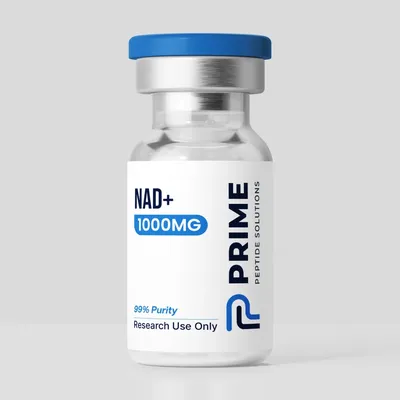
NAD+ is not a peptide, but it is central to the same organelle. Mammalian mitochondria take up intact NAD+ through the inner-membrane carrier SLC25A51 (also called MCART1); losing it lowered mitochondrial, but not whole-cell, NAD+ and impaired respiration in cell models (Luongo et al., 2020; Kory et al., 2020). The free NAD+/NADH ratio also differs sharply by compartment: in well-fed rat liver it was calculated at about 725 in the cytoplasm and about 8 inside mitochondria (Williamson et al., 1967). See the NAD+ research overview and MOTS-C vs NAD+.
Key Studies
- Anderson et al., 1981 (Nature): sequence and organization of the human mitochondrial genome. PubMed 7219534
- Hashimoto et al., 2001 (PNAS): humanin identified by functional screening in neuronal cell culture. PubMed 11371646
- Guo et al., 2003 (Nature): humanin binds Bax; identical mitochondrial reading frame. PubMed 12732850
- Ikonen et al., 2003 (PNAS): humanin binds IGFBP-3. PubMed 14561895
- Zhao et al., 2004 (J Biol Chem): SS peptides concentrate in the inner mitochondrial membrane. PubMed 15178689
- Birk et al., 2013 (J Am Soc Nephrol): SS-31 binds cardiolipin. PubMed 23813215
- Lee et al., 2015 (Cell Metab): MOTS-c discovery; folate pathway and AMPK. PubMed 25738459
- Cobb et al., 2016 (Aging, Albany NY): six small humanin-like peptides. PubMed 27070352
- Kim et al., 2018 (Cell Metab): MOTS-c moves to the nucleus under metabolic stress. PubMed 29983246
- Mitchell et al., 2020 (J Biol Chem): SS-31 and membrane surface electrostatics. PubMed 32273339
- Chavez et al., 2020 (PNAS): SS-31 protein interaction map by cross-linking mass spectrometry. PubMed 32554501
Handling and Storage of the Lyophilized Material
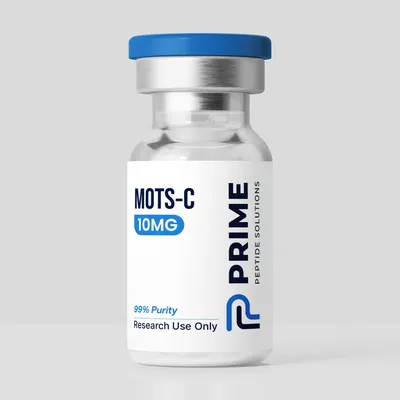
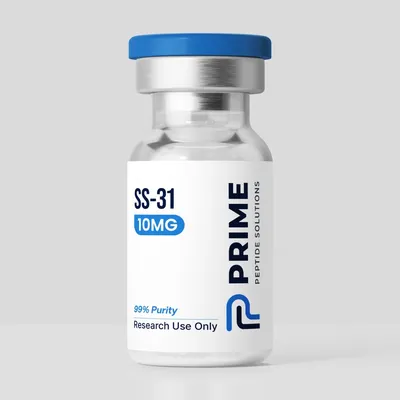
MOTS-C and SS-31 are supplied as lyophilized powders. Keep vials sealed, cold, dry and away from light, and let a cold vial reach room temperature before opening. MOTS-c contains two methionines and a tryptophan, and side-chain oxidation is one of the recognized impurity types in synthetic peptides (D'Hondt et al., 2014), so limiting air and light exposure is sensible. For identity checks, PubChem gives average molecular weights of 2174.6 g/mol for MOTS-c and 639.8 g/mol for SS-31. A published lab report for one MOTS-C batch has its own page, MOTS-C 20mg batch 0423; see how to read a peptide COA and the peptide storage guide.
Frequently Asked Research Questions
What are mitochondria-derived peptides?
Peptides encoded by short open reading frames in mitochondrial DNA. Humanin and SHLP1-6 come from the 16S rRNA region and MOTS-c from the 12S rRNA region.
Is SS-31 a mitochondria-derived peptide?
No. SS-31 is a synthetic tetrapeptide, D-Arg-Dmt-Lys-Phe-NH2, designed to concentrate in the inner mitochondrial membrane. It is not encoded in any genome.
What does SS-31 bind?
Cardiolipin, the anionic phospholipid of the inner mitochondrial membrane, and, by cross-linking mass spectrometry, several cardiolipin-binding proteins involved in oxidative phosphorylation and 2-oxoglutarate metabolism.
Where does MOTS-c act?
Cell studies report actions in the cytosol, through the folate pathway and AMPK, and in the nucleus under metabolic stress, where it regulated nuclear genes and interacted with NRF2.
Is NAD+ a mitochondrial peptide?
No. NAD+ is a dinucleotide coenzyme, not a peptide. Mitochondria import it through the carrier SLC25A51.
What are the MOTS-C and SS-31 sold here intended for?
Only in-vitro laboratory research. They are not for human or animal consumption and are not equivalent to any approved medicine.
Conclusion
Mitochondrial peptides fall into two groups. Mitochondria-derived peptides such as humanin, the SHLPs and MOTS-c are encoded in mitochondrial rRNA regions and act through partners such as Bax, IGFBP-3, AMPK and NRF2. Synthetic SS peptides such as SS-31 are four residues long, concentrate in the inner membrane and bind cardiolipin. NAD+ is not a peptide; it is a redox coenzyme that mitochondria import through SLC25A51.
Disclaimer: This article is provided for educational and research purposes only. It summarizes publicly available scientific literature and does not constitute medical advice. MOTS-C, SS-31 and all peptide compounds sold by Prime Peptide Solutions are intended strictly for laboratory research, are not approved for human use, and are not for human or animal consumption. Researchers are responsible for compliance with all applicable regulations in their jurisdiction.
Shop these products
- Ships the same business day
- Free US shipping on $199.99+
- 14-day money-back guarantee on damaged items
References & Further Reading
- PubMed: Mitochondria-derived peptide research
- Related: MOTS-C research overview
- Related: SS-31 research overview
- Related: SS-31 vs MOTS-C comparison
Research-Grade MOTS-C and SS-31
In our catalog these are listed as MOTS-C and SS-31, both supplied as lyophilized powders, with NAD+ listed separately. Published lab reports (COAs) are listed on our COAs page.
Sold strictly for in-vitro laboratory research. Not for human or animal consumption.