
IGF-1 LR3 vs IGF-1: Long Arg3 Analog vs the Native 70-Residue Protein
IGF-1 LR3 (Long R3 IGF-I) and IGF-I are closely related but not the same molecule. IGF-I is the natural 70-residue protein insulin-like growth factor I. IGF-1 LR3 is a recombinant analog: the 70-residue IGF-I sequence with arginine in place of glutamic acid at position 3, carried on a 13-residue N-terminal extension, for a single chain of 83 residues (Francis et al., 1992; King et al., 1992).
The one change that matters most in the laboratory is binding to the IGF-binding proteins (IGFBPs). IGF-1 LR3 binds them about 1,000-fold more weakly than IGF-I, which is why it is more potent in cell culture that contains IGFBPs (Ballard et al., 1993). This page sets the two side by side on identity, IGFBP binding and receptor assays, and keeps to laboratory questions. For the analog on its own, see the IGF-1 LR3 research overview.
This article is a scientific overview for laboratory researchers. The research-grade IGF-1 LR3 supplied by Prime Peptide Solutions is sold strictly for in-vitro laboratory research. It is not approved for human use and is not for human or animal consumption.
| Property | IGF-1 LR3 | IGF-I (native) |
|---|---|---|
| What it is | Recombinant IGF-I analog | Natural protein, gene IGF1 |
| Other names | Long R3 IGF-I, LR3-IGF-I, Long [Arg3]-IGF-I, IGF1 LR3 | Somatomedin C, IGF-1 |
| Length | 83 residues (13-residue extension + 70-residue IGF-I) | 70 residues |
| Changes from IGF-I | N-terminal extension; Glu3 replaced by Arg | - |
| Sequence | MFPAMPLSSL | GPETLCGAEL |
| Disulfide bonds | 3 (Cys19-Cys61, Cys31-Cys74, Cys60-Cys65) | 3 (Cys6-Cys48, Cys18-Cys61, Cys47-Cys52) |
| Methionines | 3 (two in the extension, one in the IGF-I part) | 1 |
| Molecular weight | About 9.1 kDa (9111 g/mol from the sequence, three disulfides; FDA GSRS estimate 9120 Da) | 7649 g/mol (Rinderknecht and Humbel, 1978) |
| Molecular formula | C400H619N111O115S9 (from the sequence, three disulfides; FDA GSRS estimate C400H623N111O115S9) | C331H512N94O101S7 (from the sequence, three disulfides) |
| CAS number | 143045-27-6 | 67763-96-6 |
| PubChem / database | No compound record; FDA GSRS UNII M9L22Y19H9 | No compound record; UniProt P05019 |
| IGFBP binding | About 1,000-fold weaker than IGF-I (Ballard et al., 1993) | High affinity for all six IGFBPs (Baxter, 2000) |
| IGF-1 receptor binding | Measured for [Arg3]-IGF-I without the extension: slightly below IGF-I in L6 myoblasts (King et al., 1992) | Reference ligand |
| Sold here | Yes, 1mg vial | No |
About IGF-1 LR3
How the 83-residue chain is built. The 1992 paper that described the Long analogues made them in E. coli as fusion proteins: the first 11 residues of methionyl porcine growth hormone, then Val-Asn, then an IGF-I sequence. In Long [Arg3]-IGF-I, glutamic acid 3 of IGF-I is replaced by arginine (Francis et al., 1992). The name encodes both features: "L" for the long extension, "R3" for the arginine (one-letter code R) at position 3. The three IGF-I disulfide bonds are preserved; in the full chain they renumber to Cys19-Cys61, Cys31-Cys74 and Cys60-Cys65.
Why it is more potent in culture. King and colleagues produced [Arg3]-IGF-I and [Gly3]-IGF-I, without the N-terminal extension, and found both bound very poorly to bovine IGFBP-2 and only slightly less well than IGF-I to the type-1 receptor on rat L6 myoblasts; they concluded that reduced IGFBP binding, not stronger receptor binding, explains the higher potency (King et al., 1992). A 1993 comparison put the IGFBP affinity gap at roughly 1,000-fold for IGFBP-3, IGFBP-4 and total rat plasma IGFBPs, with a 5- to 10-fold potency advantage in L6 cultures (Ballard et al., 1993).
Cell-culture behaviour. In the original study the Long analogues were more potent than IGF-I at stimulating protein and DNA synthesis in IGFBP-secreting lines, but in chicken embryo fibroblasts, which secrete no detectable IGFBPs, Long [Arg3]-IGF-I was less potent than IGF-I: remove the binding proteins and the advantage disappears (Francis et al., 1992). Recombinant IGFBP-3 suppressed both IGF-I and LongR3-stimulated proliferation of L6 cells, yet did not suppress LongR3-stimulated differentiation (Xi et al., 2004). In serum-free Chinese hamster ovary (CHO) production lines, LongR3 sustained cell viability better than insulin (Morris and Schmid, 2000), and a microarray study linked it to enhanced growth, delayed cell death and changes in cytoskeletal gene expression (Becker et al., 2014).
Clearance and analytical notes. LR3IGF-I was removed from rat plasma much faster than IGF-I, consistent with its weak plasma-IGFBP binding (Ballard et al., 1993). For identity work, liquid chromatography-mass spectrometry (LC-MS) has characterized Long R3 IGF-I directly, including locating a single fluorescent label on its N-terminal methionine (Harvey and Banks, 2003).
About IGF-I (native)
The protein. The complete sequence of human IGF-I was determined in 1978: a single chain of 70 residues cross-linked by three disulfide bridges, with a calculated molecular weight of 7649 and clear homology to proinsulin (Rinderknecht and Humbel, 1978). A later crystal structure resolved much of the flexible C-region and showed that a detergent molecule binding where IGFBPs dock can block IGFBP interactions (Vajdos et al., 2001).
Its receptor. The human IGF-1 receptor was cloned in 1986: a 1,367-residue precursor predicted to be cut into alpha and beta chains, closely parallel to the insulin receptor (Ullrich et al., 1986). A cryo-EM structure of the active receptor showed that only one IGF-I molecule binds the receptor dimer, a built-in negative cooperativity (Li et al., 2019). Binding to the alpha chain switches on the beta-chain tyrosine kinase, which phosphorylates insulin receptor substrates and SHC and activates the PI 3-kinase and Ras-MAP kinase pathways (Hakuno and Takahashi, 2018).
The binding proteins. Six homologous IGFBPs bind IGF-I and IGF-II with high affinity, and all six can inhibit IGF action (Baxter, 2000). Mutagenesis mapped which parts of IGF-I each system reads: substitutions at B-chain positions 3 and 4 cut affinity for IGFBP-1 and IGFBP-2 more than 20-fold (Clemmons et al., 1992). The IGF-I regions that bind IGFBP-1 and serum binding proteins are distinct from each other but overlap, and both are clearly distinct from the type-1 receptor binding sites (Clemmons et al., 1990), and the C-region is required for high-affinity receptor binding (Bayne et al., 1989). IGFBP-3 binding depends on residues 3-4, the B-domain helix (residues 8-18) and A-domain residues 49-51, while the ternary complex with the acid-labile subunit also depends on IGF-I regions away from that site (Baxter et al., 1992). Because position 3 sits inside the IGFBP-binding surface, replacing Glu3 with Arg weakens binding-protein binding while leaving the receptor sites largely untouched. In the classic somatomedin model IGF-I was seen as liver-derived; later work showed most tissues make it (Le Roith et al., 2001). IGF-I is not sold here; it appears on this page as the reference molecule.
Which Fits the Research Question?
The two molecules answer different laboratory questions. The choice turns on whether IGF-binding proteins are part of the system being studied.
- Receptor stimulation with minimal IGFBP interference: IGF-1 LR3. Its weak IGFBP binding keeps more of the ligand free for the receptor in media or cell lines that secrete binding proteins. In two serum-free CHO production lines it sustained cell viability better than insulin (Morris and Schmid, 2000).
- Physiological IGFBP interactions, ternary complex or clearance: native IGF-I, the molecule that binds all six IGFBPs with high affinity and forms the acid-labile-subunit complex (Baxter, 2000; Baxter et al., 1992). IGF-I is not stocked here.
- A binding-protein-independent control: comparing the two in the same assay, with and without added IGFBP, isolates the IGFBP contribution, as in the chicken-fibroblast and recombinant-IGFBP-3 experiments (Francis et al., 1992; Xi et al., 2004).
- The role of position 3: both, plus des(1-3)IGF-I, which also binds IGFBPs much more weakly than IGF-I because the first three residues, including Glu3, are missing (Ballard et al., 1996). Naming of such changes is covered in our peptide modifications guide.
- Identity checks: a measured mass near 9.1 kDa points to the analog; near 7.6 kDa points to native IGF-I. Three methionines in IGF-1 LR3 make methionine oxidation a point to watch. See HPLC and mass spectrometry explained.
IGF-1 LR3 enters the growth-hormone axis at the receptor, downstream of the pituitary; the upstream secretagogues are covered in GHRH analogs vs ghrelin mimetics, and the analog is paired with a secretagogue blend in IGF-1 LR3 vs CJC-1295 + Ipamorelin. More in the class are grouped on the growth hormone research peptides page.
Key Studies
- Francis et al., 1992 (J Mol Endocrinol): the Long IGF-I analogues made in E. coli; potency with and without IGFBPs. PubMed 1378742
- King et al., 1992 (J Mol Endocrinol): [Arg3]- and [Gly3]-IGF-I; very poor IGFBP-2 binding, near-normal receptor binding in L6 myoblasts. PubMed 1311930
- Ballard et al., 1993 (Growth Regul): about 1,000-fold lower IGFBP affinity for LR3IGF-I and faster plasma clearance in rats. PubMed 7683526
- Rinderknecht and Humbel, 1978 (J Biol Chem): the native IGF-I sequence: 70 residues, three disulfides, molecular weight 7649. PubMed 632300
- Li et al., 2019 (Nat Commun): cryo-EM of the active IGF-1 receptor; only one IGF-I binds the receptor dimer. PubMed 31594955
Frequently Asked Questions
Is IGF-1 LR3 the same as IGF-I?
No. IGF-I is the natural 70-residue protein. IGF-1 LR3 is an 83-residue recombinant analog: IGF-I with arginine at position 3 and a 13-residue N-terminal extension. Its mass is about 9.1 kDa against 7649 for IGF-I.
Why is IGF-1 LR3 more potent in cell culture?
Mainly because it binds IGF-binding proteins about 1,000-fold more weakly than IGF-I, so less of it is held away from the receptor (Ballard et al., 1993). In cells that make no detectable binding proteins, it was less potent than IGF-I (Francis et al., 1992).
What do "L" and "R3" stand for?
"L" means long, for the N-terminal extension. "R3" is the arginine (one-letter code R) that replaces glutamic acid at position 3 of IGF-I, the change that weakens IGFBP binding.
Does IGF-1 LR3 bind the IGF-1 receptor like IGF-I?
Close to it, on the available data. The clearest receptor figure is for [Arg3]-IGF-I without the extension: in rat L6 myoblasts it bound the type-1 receptor only slightly less well than IGF-I, and its extra potency was put down to reduced IGFBP binding, not stronger receptor binding (King et al., 1992). The paper on the long analogues reached the same conclusion about IGFBP interactions (Francis et al., 1992).
How is IGF-1 LR3 told apart from IGF-I in the lab?
By mass, mainly. The analog is about 1.5 kDa heavier because of the extension. Liquid chromatography-mass spectrometry has been used to characterize Long R3 IGF-I directly (Harvey and Banks, 2003). See how to read a peptide COA.
How is the lyophilized protein handled, and is there a lab report?
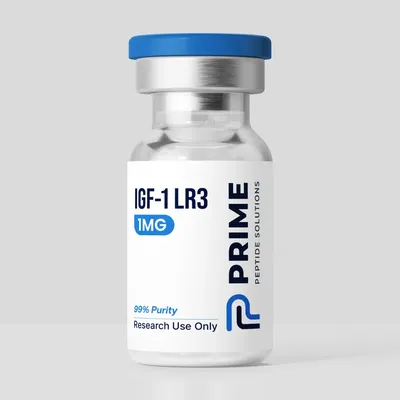
IGF-1 LR3 ships as a lyophilized powder in a sealed 1mg vial. The product page gives storage at 2-8 °C, or -20 °C for long-term storage; keep vials cold, dry and dark, and let a cold vial reach room temperature before opening. Proteins are often made into a dry solid, most commonly by freeze-drying, to reach an acceptable shelf life (Wang, 2000). IGF-1 LR3 has three methionines, and methionine oxidation in aqueous solution has been shown to cut the activity of a related peptide hormone, GRF (Campbell et al., 1994). Published lab reports (COAs) are listed on our COAs page. See the peptide storage guide and the lyophilization explainer.
Disclaimer: This article is provided for educational and research purposes only. It summarizes publicly available scientific literature and does not constitute medical advice. IGF-1 LR3 and all peptide compounds sold by Prime Peptide Solutions are intended strictly for laboratory research, are not approved for human use, and are not for human or animal consumption. Researchers are responsible for compliance with all applicable regulations in their jurisdiction.
Shop IGF-1LR3
- Ships the same business day
- Free US shipping on $199.99+
- 14-day money-back guarantee on damaged items