

What Are Growth Hormone Secretagogues?
Growth hormone secretagogues are compounds that act on the pituitary, or on the cells that feed into it, to stimulate release of endogenous growth hormone (GH) from somatotroph cells. Among the research peptides, they fall into two families that work through two different receptors: GHRH analogs, which copy growth hormone-releasing hormone, and ghrelin mimetics (also called growth hormone-releasing peptides, GHRPs), which copy the stomach hormone ghrelin. This page is a class-level map of how the two families differ and how they relate to a third molecule, IGF-1 LR3, which sits one step downstream.
It is a companion to the compound-level pages: the CJC-1295 and Ipamorelin overview and the Ipamorelin overview. The aim here is to place each one in the wider signaling picture rather than repeat those pages.
This article is a scientific overview for laboratory researchers. All research-grade peptides discussed are supplied by Prime Peptide Solutions strictly for in-vitro laboratory research. They are not approved for human use and are not for human or animal consumption.
The Two Receptors
The GHRH receptor
Growth hormone-releasing hormone is made in the hypothalamus and acts on the GHRH receptor on pituitary somatotroph cells. That receptor was cloned in 1992 and 1993: a seven-transmembrane G protein-coupled receptor of the secretin family, which on binding GHRH raises intracellular cyclic AMP, and whose mRNA is found mainly in the anterior pituitary (Mayo, 1992; Gaylinn et al., 1993). Native GHRH has a very short life in plasma because dipeptidyl peptidase IV (DPP-IV) cuts it at the Ala2-Asp3 bond to a near-inactive product, which is the central problem every GHRH analog is designed around (Frohman et al., 1986).
The ghrelin / GHS receptor
The second pathway runs through the growth hormone secretagogue receptor (GHS-R, also GHS-R1a). It was characterized in 1996 as a distinct pituitary and hypothalamic G protein-coupled receptor that mediates the action of small synthetic secretagogues (Howard et al., 1996). Its natural ligand, ghrelin, was identified in 1999 as a 28-residue stomach peptide carrying an essential octanoyl group on serine 3 (Kojima et al., 1999); the enzyme that adds that acyl group, GOAT, was described in 2008 (Gutierrez et al., 2008). The synthetic hexapeptide now known as GHRP-6 (His-D-Trp-Ala-Trp-D-Phe-Lys-NH2) was reported in 1984 to release GH specifically, without a matching release of LH, FSH, TSH or prolactin, in rat pituitary incubations and in several animal species (Bowers et al., 1984).
Why engaging both matters
The two receptors sit on the same somatotroph cells but use different internal signals. GHRH analogs act largely through cyclic AMP; GHRP-6 does not raise cyclic AMP on its own and acts at least partly through protein kinase C, and when both are applied to the cells together the GH response is synergistic and the GRF-induced rise in cyclic AMP is potentiated (Cheng et al., 1989; Cheng et al., 1991). That synergy, seen in rat pituitary cell culture, is the usual research rationale for studying the two families together.
Family 1: GHRH Analogs
These copy GHRH and bind the GHRH receptor. The research design question within the family is mostly about duration.
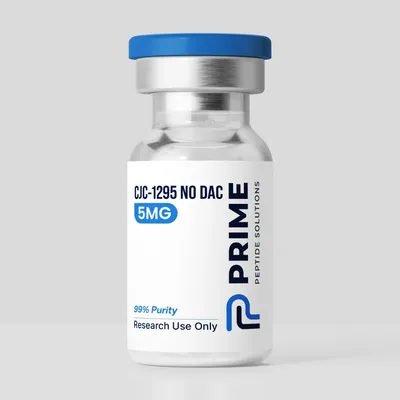
- CJC-1295 no DAC (Mod GRF 1-29). A 29-residue analog (Mod GRF 1-29) with four stabilizing substitutions. The GRF(1-29) fragment keeps about half the potency of full GHRH in rat pituitary cells (Ling et al., 1984), and the D-Ala2 substitution lowers metabolic clearance in human volunteers (Soule et al., 1994). Short-acting.
- CJC-1295 with DAC. The same core plus a lysine that binds serum albumin, giving a long duration: in adult volunteers an estimated half-life of 5.8 to 8.1 days (Teichman et al., 2006), with GH secretion staying pulsatile under continuous stimulation (Ionescu and Frohman, 2006). Not sold here; covered only for contrast, in the with vs without DAC comparison.
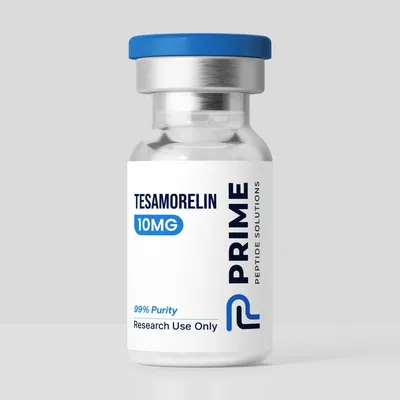
- Tesamorelin. The full 44-residue GHRH sequence with a trans-3-hexenoyl group on Tyr1 that resists DPP-IV; an animal and plasma pharmacology study reported an apparent elimination half-life of 21 to 45 minutes in dogs and marked rises in plasma GH and IGF-1 in pigs, rats and dogs (Ferdinandi et al., 2007).
Family 2: Ghrelin Mimetics (GHRPs)
These copy ghrelin and bind the GHS receptor.
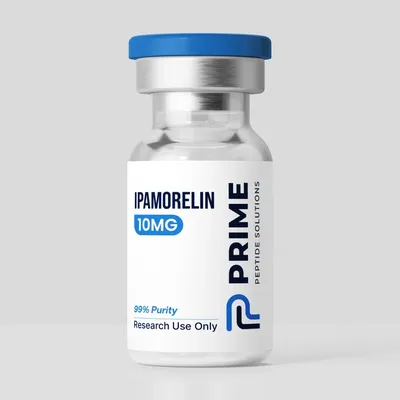
- Ipamorelin. A pentapeptide, Aib-His-D-2Nal-D-Phe-Lys-NH2, described in 1998 as the first selective growth hormone secretagogue: it released GH from rat pituitary cells, and in rats and swine, with potency and efficacy similar to GHRP-6, and in swine, unlike GHRP-6 and GHRP-2, it did not raise ACTH or cortisol above the levels seen with GHRH, even well above the range that releases GH (Raun et al., 1998). That selectivity is its defining research feature; see the Ipamorelin overview.
GHRH analog + ghrelin mimetic together
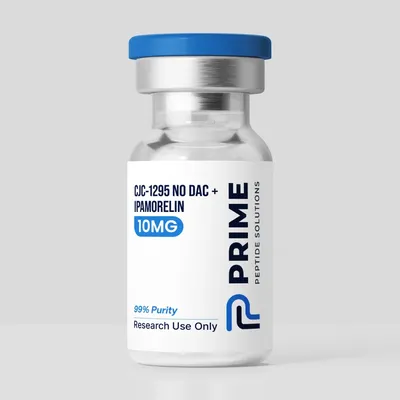
Pairing a GHRH analog with a ghrelin mimetic such as ipamorelin engages both receptors at once. The pre-mixed CJC-1295 no DAC + Ipamorelin vial uses the no-DAC form; the pairing and its rationale are set out in the CJC-1295 and Ipamorelin overview and the CJC-1295 vs Ipamorelin comparison.
One Step Downstream: IGF-1 LR3
Growth hormone drives the liver and other tissues to make insulin-like growth factor I (IGF-I); in the classic somatomedin model, much of GH's action is carried by circulating IGF-I, though most tissues make their own as well (Le Roith et al., 2001). That places IGF-1 LR3 in a different spot from everything above: it is not a secretagogue at all but an IGF-I analog that acts at the IGF-1 receptor, the output end of the axis. Its extra potency in culture comes from weak binding to IGF-binding proteins rather than from any pituitary action (Ballard et al., 1993). The contrast is useful: a secretagogue acts upstream, on the cells that release GH, while IGF-1 LR3 engages the receptor the axis ultimately signals to.
Class Map at a Glance
- CJC-1295 no DAC: GHRH analog; acts at the GHRH receptor; short-acting.
- Tesamorelin: GHRH analog; acts at the GHRH receptor; apparent elimination half-life of minutes in dogs.
- Ipamorelin: ghrelin mimetic; acts at the GHS receptor; GH-selective in swine.
- CJC-1295 no DAC + Ipamorelin: one peptide from each family; both receptors.
- IGF-1 LR3: not a secretagogue; acts at the IGF-1 receptor downstream; cleared from rat plasma faster than IGF-I.
Key Studies
- Howard et al., 1996, Science (PMID 8688086): cloning of the GHS receptor in pituitary and hypothalamus.
- Kojima et al., 1999, Nature (PMID 10604470): ghrelin identified as the endogenous, octanoylated GHS-R ligand.
- Mayo, 1992, Mol Endocrinol (PMID 1333056): cloning of the pituitary GHRH receptor.
- Cheng et al., 1989, Endocrinology (PMID 2541999): synergy of GHRP-6 and GRF on GH release in rat pituitary cells.
- Raun et al., 1998, Eur J Endocrinol (PMID 9849822): ipamorelin as the first selective GH secretagogue.
Handling the Lyophilized Peptides
All of these are supplied as lyophilized powders in sealed vials; the product pages give storage at 2-8 °C, or -20 °C for long-term storage. The dry, freeze-dried solid generally keeps far longer than a solution (Wang, 2000). Keep vials cold, dry, dark and sealed until needed. One handling point is shared across the GHRH analogs: native GHRH loses activity by Asn8 rearrangement and Met27 oxidation in water, and the Mod GRF 1-29 substitutions were made partly to remove those two routes (Campbell et al., 1994). General guidance is in our storing research peptides and lyophilization guides; identity and purity are documented on a batch Certificate of Analysis, explained in reading a peptide COA and HPLC and mass spectrometry.
Frequently Asked Research Questions
What is the difference between a GHRH analog and a ghrelin mimetic?
They act on different receptors on the same pituitary cells. GHRH analogs (such as CJC-1295 no DAC and Tesamorelin) bind the GHRH receptor and signal largely through cyclic AMP. Ghrelin mimetics or GHRPs (such as Ipamorelin) bind the ghrelin / GHS receptor and use a different internal route.
Why are the two classes studied together?
Because the two receptors feed the same cell through separate signals, engaging both at once produced a synergistic GH response in rat pituitary cell culture. That synergy is the usual research rationale for pairing a GHRH analog with a ghrelin mimetic.
Is IGF-1 LR3 a growth hormone secretagogue?
No. It does not act on the pituitary. It is an IGF-I analog that binds the IGF-1 receptor, downstream of growth hormone, so it is included here only as a contrast to the secretagogues.
What makes Ipamorelin "selective"?
In swine it released GH similarly to GHRP-6 but, unlike GHRP-6 and GHRP-2, did not raise ACTH or cortisol above GHRH levels, even well above the range that releases GH.
Which of these does PPS sell?
CJC-1295 no DAC, Tesamorelin and Ipamorelin individually, the CJC-1295 no DAC + Ipamorelin blend, and IGF-1 LR3. The DAC form of CJC-1295 is not sold here.
Conclusion
Growth hormone secretagogues split into GHRH analogs, which bind the GHRH receptor and signal through cyclic AMP, and ghrelin mimetics, which bind the GHS receptor through a separate route; the two synergize on the same somatotroph cells, which is why pairings like CJC-1295 no DAC with Ipamorelin are studied. IGF-1 LR3 sits apart, at the IGF-1 receptor one step downstream. For laboratories the practical constants are the same across the class: cold, dry, sealed storage and identity confirmed on a batch COA.
Disclaimer: This article is provided for educational and research purposes only. It summarizes publicly available scientific literature and does not constitute medical advice. All peptide compounds sold by Prime Peptide Solutions are intended strictly for laboratory research, are not approved for human use, and are not for human or animal consumption. Researchers are responsible for compliance with all applicable regulations in their jurisdiction.
Shop these products
- Ships the same business day
- Free US shipping on $199.99+
- 14-day money-back guarantee on damaged items
References & Further Reading
- Mayo KE, 1992. Mol Endocrinol. PMID 1333056.
- Gaylinn BD et al., 1993. Mol Endocrinol. PMID 7680413.
- Frohman LA et al., 1986. J Clin Invest. PMID 3093533.
- Howard AD et al., 1996. Science. PMID 8688086.
- Kojima M et al., 1999. Nature. PMID 10604470.
- Gutierrez JA et al., 2008. Proc Natl Acad Sci U S A. PMID 18443287.
- Bowers CY et al., 1984. Endocrinology. PMID 6714155.
- Cheng K et al., 1989. Endocrinology. PMID 2541999.
- Cheng K et al., 1991. Endocrinology. PMID 1659529.
- Ling N et al., 1984. Biochem Biophys Res Commun. PMID 6435620.
- Soule S et al., 1994. J Clin Endocrinol Metab. PMID 7962295.
- Teichman SL et al., 2006. J Clin Endocrinol Metab. PMID 16352683.
- Ionescu M and Frohman LA, 2006. J Clin Endocrinol Metab. PMID 17018654.
- Ferdinandi ES et al., 2007. Basic Clin Pharmacol Toxicol. PMID 17214611.
- Raun K et al., 1998. Eur J Endocrinol. PMID 9849822.
- Le Roith D et al., 2001. Endocr Rev. PMID 11159816.
- Ballard FJ et al., 1993. Growth Regul. PMID 7683526.
- Campbell RM et al., 1994. Peptides. PMID 7937325.
- Wang W, 2000. Int J Pharm. PMID 10967427. Review of protein lyophilization and solid-state stability.
Research-Grade Secretagogues at PPS
In our catalog these research peptides are listed as CJC-1295 no DAC, Ipamorelin, CJC-1295 no DAC + Ipamorelin, Tesamorelin and IGF-1 LR3, each a lyophilized powder. Published lab reports (COAs) are listed on our COAs page; the CJC-1295 no DAC + Ipamorelin report and the Tesamorelin report also have their own pages. They are grouped on the growth hormone research peptides page.
Sold strictly for in-vitro laboratory research. Not for human or animal consumption.