
Tesamorelin vs Sermorelin: Full-Length GHRH(1-44) vs the GHRH(1-29) Fragment
Tesamorelin and sermorelin are synthetic peptides built on the sequence of human growth hormone-releasing hormone (GHRH, also called GRF), and both act at the same pituitary receptor, the GHRH receptor (GHRHR). They differ in length and in how their ends are finished. Tesamorelin carries all 44 residues of native human GHRH plus a trans-3-hexenoyl group on the N-terminal tyrosine. Sermorelin is GHRH(1-29)-NH2, the N-terminal 29-residue fragment that retains the full intrinsic GH-releasing activity of GHRH, at lower in-vitro potency than native full-length hGRF in rat pituitary cells (a comparison with the native hormone, not with tesamorelin).
This page compares structure, susceptibility to the plasma enzyme dipeptidyl peptidase-4 (DPP-4), half-life as a qualitative property, cAMP signalling and pulsatile GH release in animal models. No direct comparative study was found, so no potency or duration ranking is given.
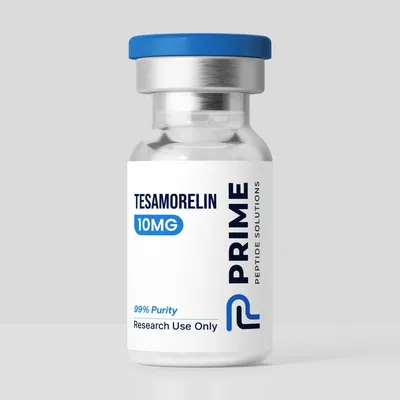
Tesamorelin is listed in this catalog as a synthetic peptide studied for its interaction with growth hormone-releasing pathways. Sermorelin is not sold here and is included as a reference compound. The research-grade material sold here is not approved for human use and is not for human or animal consumption.
| Property | Tesamorelin | Sermorelin |
|---|---|---|
| Relation to native GHRH | Full-length GHRH(1-44), N-terminally acylated | N-terminal fragment, GHRH(1-29)-NH2 |
| Length | 44 residues | 29 residues |
| N-terminus | Trans-3-hexenoyl group on the Tyr1 amine; Tyr1 hydroxyl left free | Free, unmodified Tyr1 |
| C-terminus | Leu44 amide | Arg29 amide |
| Residues 30-44 (QQGESNQERGARARL) | Present | Absent |
| Molecular formula (PubChem) | C221H366N72O67S | C149H246N44O42S |
| Molecular weight (PubChem) | 5136 g/mol (about 5.14 kDa) | 3357.9 g/mol (about 3.36 kDa) |
| CAS number | 218949-48-5 | 86168-78-7 |
| Charge character | Basic peptide | Basic peptide |
| Receptor | GHRHR, a class B GPCR coupled through Gs to cAMP | Same receptor and pathway |
| DPP-4 at the 2-3 bond | Resistant, relative to native GHRH | Substrate; rapidly cleaved in plasma in vitro |
| Half-life (qualitative) | Minutes-scale; extended relative to native GHRH | Minutes-scale |
| Asp3, Asn8, Met27 | Native residues kept | Native residues kept |
| In this catalog | Tesamorelin, 10mg and 20mg vials | Not sold |
About Tesamorelin (full-length GHRH with an N-terminal hexenoyl group)
Structure. ChEBI describes tesamorelin as a synthetic analogue of human GRF comprising the full 44-amino-acid sequence with a hex-3-enoyl moiety on the N-terminal tyrosine. Its systematic name places the trans (3E) acyl group on the N-terminal amine of Tyr1, not on the side-chain hydroxyl, and the chain ends in Leu44-NH2. PubChem lists the sequence YADAIFTNSY RKVLGQLSAR KLLQDIMSRQ QGESNQERGA RARL. Apart from the acyl group, the sequence is native human GHRH.
Why the N-terminus was modified. When native GRH(1-44)-NH2 was incubated with human plasma in vitro, the intact peptide disappeared rapidly and GRH(3-44)-NH2 appeared, a product cleaved at the N-terminus with far lower biological activity than the parent. The enzyme responsible for this 2-3 bond cleavage was characterized as DPP-4. A 2007 preclinical paper reported that hGRF(1-44)NH2 minimally modified with a trans-3-hexenoyl group on Tyr1 was resistant to DPP-4 deactivation. Compared with native hGRF(1-44)NH2, the modification slowed in vitro degradation of the peptide in rat, dog and human plasma and prolonged plasma elimination kinetics in animal studies. That comparison is with native GHRH, not with sermorelin, and elimination is still minutes-scale: longer-lived than native GHRH, but not a long-acting molecule.
Position 1 and the free hydroxyl. In rat anterior pituitary cells, position-1 analogs of hGRF showed that potent activity requires an aromatic residue at position 1, and the authors suggested that full receptor-ligand interaction requires hydrogen bonding by that residue; methylating the Tyr1 hydroxyl nearly abolished potency. Tesamorelin's hexenoyl group sits on the amine, leaving that hydroxyl free.
Animal models. The same 2007 paper reported that plasma GH and IGF-1 markedly increased in pigs, rats and dogs.
Further reading. See the tesamorelin research overview and a tesamorelin PubMed search.
About Sermorelin (the GHRH(1-29)-NH2 fragment)
Structure. Sermorelin is an amidated synthetic 29-amino-acid peptide, GRF(1-29)-NH2, that corresponds to the amino-terminal segment of the 44-residue human hormone: YADAIFTNSY RKVLGQLSAR KLLQDIMSR, with a free, unmodified N-terminal tyrosine and an Arg29 amide. The MeSH description calls it the biologically active fragment of human GRF and notes that this N-terminal sequence is identical in several mammalian species, such as human, pig and cattle.
Where the 29-residue fragment comes from. The parent 44-residue peptide was isolated in 1982 from a human pancreatic tumor; its synthetic replicate stimulated GH secretion in laboratory bioassays, and the tumor-derived peptide matched the releasing factor in hypothalamic extracts in biological activity. In 1984, C-terminally shortened hGRF analogs were tested in rat anterior pituitary cells. Activity fell gradually down to hGRF(1-34)OH, but further deletion did not reduce it: the (1-31), (1-30) and (1-29) amides were not less active than hGRF(1-34)OH and remained below full-length hGRF. Fragments down to (1-21)NH2 still showed full intrinsic activity at very low potency, and the authors placed the minimal core with full intrinsic activity at (3-21). So GHRH(1-29)-NH2 retains GH-releasing activity at lower in-vitro potency than native full-length hGRF, but it is not the shortest fully active fragment.
Receptor-binding residues. In a rat adenopituitary binding assay with hGRF(1-29)NH2 analogues, removing Tyr1, Ser9, Lys12, Val13, Gly15, Gln16 or Lys21 drastically decreased affinity; the authors rated segment 13-21 as more important than 24-29. In that series, N-terminal acylation generally decreased affinity, and a free C-terminal acid in place of the amide also lowered it. These residues all lie within the 1-29 sequence both peptides share.
DPP-4 and plasma cleavage. With an unmodified Tyr1-Ala2 N-terminus, sermorelin is a DPP-4 substrate: GRH(1-29)-NH2 was rapidly cleaved at the 2-3 bond in plasma, as were native GRH and GRH(1-32)-NH2. Native GRH also showed trypsin-like cleavage at the 11-12 bond, while cleavage at the 12-13 bond appeared only with the shortened (1-32) and (1-29) fragments. PubChem describes the sermorelin half-life as minutes-scale. See a sermorelin PubMed search.
Which Should Researchers Choose?
Both peptides reach the same receptor through the same N-terminal sequence, so the choice follows the structural variable a study isolates:
- Shared receptor and signalling: both act at GHRHR (UniProt Q02643), a 423-residue class B (secretin-like) GPCR of the pituitary with seven transmembrane helices and an extracellular N-terminal domain. It couples to G proteins that activate adenylyl cyclase; reviews describe cAMP accumulation, protein kinase A phosphorylation of CREB at Ser133, and the pituitary factor Pit-1 (GHF-1) regulating the GH gene. Somatostatin is thought to act on the same pathway by suppressing cAMP signalling.
- Receptor-engagement studies: a cryo-EM structure of GHRHR bound to GHRH and Gs modeled GHRH residues 1-28 as an alpha helix whose N-terminus inserts deep into the transmembrane core, with the Tyr1 hydroxyl hydrogen-bonded to receptor residue H210. The extracellular domain was not resolved, though the model suggests residues after 20 may interact with it. The structure does not resolve what residues 30-44 contribute, which tesamorelin carries and sermorelin lacks.
- DPP-4 as a variable: sermorelin keeps the native, DPP-4-sensitive N-terminus; tesamorelin's hexenoyl group gives DPP-4 resistance relative to native GHRH. Both remain minutes-scale molecules.
- Pulsatile GH release: in rats, GRF secretion into hypophysial-portal plasma was episodic, peaking during periods of expected GH secretory episodes, and antibodies against rat GRF inhibited pulsatile GH release. In rats, pulsatile but not continuous delivery of the same total amount of GHRF(1-29)NH2, the sermorelin sequence, established an episodic GH secretory pattern and increased pituitary GH content; no comparable animal data were gathered for tesamorelin.
- Solution chemistry: in water, both GRF(1-44)-NH2 and GRF(1-29)-NH2 undergo Asp3-Ala4 cleavage, Asp3 isomerization and Asn8 deamidation, giving products of much lower in vitro potency; GRF is most stable at pH 4-5, and Met27 can oxidize. Neither peptide alters these residues; the hexenoyl group addresses DPP-4 only.
- Related pages: see ipamorelin vs sermorelin, tesamorelin vs ipamorelin and CJC-1295 with vs without DAC.
Frequently Asked Questions
Is sermorelin the shortest fully active GHRH fragment?
No. In rat pituitary cells, fragments down to (1-21)NH2 still showed full intrinsic activity at very low potency, and the minimal core was placed at residues 3-21. Sermorelin retains full intrinsic GH-releasing activity at lower in-vitro potency than native full-length hGRF, a comparison with the native hormone, not with tesamorelin.
Is tesamorelin a modified GRF(1-29), like CJC-1295?
No. Tesamorelin keeps all 44 native residues and changes only the N-terminus. CJC-1295 no DAC is a substituted GRF(1-29) analog, and it is not the same molecule as sermorelin, which has the unmodified native 1-29 sequence. See tesamorelin vs CJC-1295.
Which has the longer half-life?
No head-to-head comparison was found. Both are short-lived, minutes-scale molecules. Tesamorelin's N-terminal modification slows DPP-4 inactivation relative to native GHRH; it does not make tesamorelin a long-acting molecule.
How is tesamorelin handled in the lab?
It is supplied as lyophilized powder in 10mg and 20mg vials. General storage of lyophilized and reconstituted peptide is covered in the peptide storage guide, and freeze-drying in the lyophilization guide.
Is sermorelin sold here, and what is the tesamorelin listing for?
Sermorelin is not sold in this catalog. Tesamorelin is sold strictly for in-vitro laboratory research. The research-grade material is not approved for human use and is not for human or animal consumption. The tesamorelin batch Certificate of Analysis is published on the COA page.
Shop Tesamorelin
- Ships the same business day
- Free US shipping on $199.99+
- 14-day money-back guarantee on damaged items