
Selank vs Tuftsin: The Parent Tetrapeptide and Its Extended Analog
Selank and tuftsin are a parent peptide and its extended analog. Tuftsin is a natural tetrapeptide, Thr-Lys-Pro-Arg (one-letter code TKPR), released from the Fc region of immunoglobulin G (Fridkin and Najjar, 1989). Selank is a synthetic heptapeptide, Thr-Lys-Pro-Arg-Pro-Gly-Pro (TKPRPGP): the tuftsin sequence with a Pro-Gly-Pro extension added at the C-terminus (Kost et al., 2001; Semenova et al., 2009).
That three-residue addition is the whole point of the comparison. It changes the peptide's stability and, in some models, what it does. This page sets the two side by side on sequence, the stability chemistry of the glyproline tail, and the study models each has been examined in, and it keeps to laboratory questions. For Selank on its own, see the Selank research overview.
This article is a scientific overview for laboratory researchers. The research-grade Selank supplied by Prime Peptide Solutions is sold strictly for in-vitro laboratory research. It is not approved for human use and is not for human or animal consumption.
| Property | Selank | Tuftsin |
|---|---|---|
| What it is | Synthetic heptapeptide; tuftsin analog | Natural tetrapeptide from immunoglobulin G |
| Sequence | H-Thr-Lys-Pro-Arg-Pro-Gly-Pro-OH (TKPRPGP) | H-Thr-Lys-Pro-Arg-OH (TKPR) |
| Relationship | Tuftsin + a Pro-Gly-Pro extension | Residues 1-4 of Selank |
| Length | 7 residues | 4 residues |
| Molecular formula | C33H57N11O9 | C21H40N8O6 |
| Molecular weight | 751.9 g/mol | 500.6 g/mol |
| Monoisotopic mass | 751.43 Da | 500.31 Da |
| CAS number | 129954-34-3 | 9063-57-4 |
| PubChem | CID 11765600 | CID 156080 |
| Sulfur residues | None (no Cys or Met) | None |
| Prolines | Three (positions 3, 5, 7) | One (position 3) |
| Origin | Designed and made synthetically | Cleaved from the IgG heavy chain |
| Reported receptor | No direct receptor identified | Neuropilin-1 (von Wronski et al., 2006; Nissen et al., 2013) |
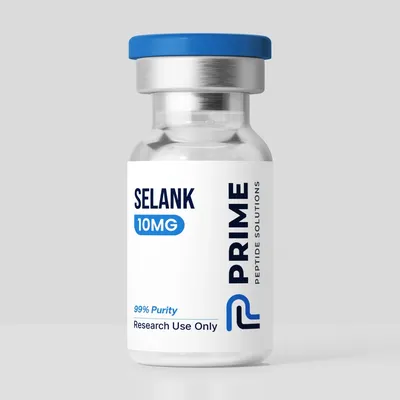
| Sold here | Yes, 10mg vial | No |
About Selank
Sequence and design. Selank is the tuftsin tetrapeptide, Thr-Lys-Pro-Arg, extended with Pro-Gly-Pro. A 2005 paper places Pro-Gly-Pro-containing peptides among the glyprolines, a group it describes as unusually stable for regulatory peptides, and presents Selank as a hybrid peptide whose parts help stabilize the whole molecule (Ashmarin et al., 2005). The free peptide has the formula C33H57N11O9 and a molecular weight of 751.9, with no cysteine or methionine and no aromatic side chains; these identity values match the specifications box on the product page.
What it does in the lab. No receptor that binds Selank directly has been identified. In radioligand assays with brain plasma membranes, Selank changed [3H]GABA binding in the manner of a positive allosteric modulator, and its effect was not additive with benzodiazepines (Vyunova et al., 2018). In human IMR-32 neuroblastoma cells it did not change the expression of 84 GABAergic-signalling genes on its own, but added together with GABA it strongly suppressed the expression changes GABA caused alone (Filatova et al., 2017). In human serum it inhibited enkephalin-degrading enzymes with an IC50 of about 20 micromolar, against about 10 micromolar for Semax; the pentapeptide fragments of both were also active (Kost et al., 2001).
Rodent study models. Real-time PCR of 84 neurotransmission genes in rat frontal cortex found significant changes in 45 genes one hour after exposure to Selank or GABA and in 22 genes three hours after either, and at one hour the changes after Selank correlated with those after GABA (Volkova et al., 2016). A microarray study in rat hippocampus reported more than two-fold changes in 36 genes after a single exposure and 20 after repeated exposure (Kolomin et al., 2013), part of a wider transcriptomic response seen in both hippocampus and spleen (Kolomin et al., 2010). Selank also regulated brain-derived neurotrophic factor (BDNF) in the rat hippocampus in vivo (Inozemtseva et al., 2008). In mouse spleen, 34 of 84 inflammation-related genes (chemokines, cytokines and their receptors) changed after Selank, and a time-course study of four of those genes found that the dipeptide Gly-Pro gave a matching profile in most cases (Kolomin et al., 2011; Kolomin et al., 2014). In two mouse strains Selank raised hypothalamic norepinephrine in both, but moved dopamine metabolites in opposite directions (Narkevich et al., 2008).
About Tuftsin
Origin. Tuftsin was first described in 1970 as a natural peptide that stimulates phagocytosis (Najjar and Nishioka, 1970). It is the tetrapeptide Thr-Lys-Pro-Arg carried in the Fc region of the immunoglobulin G heavy chain and released by enzymatic processing (Fridkin and Najjar, 1989). A 1983 overview set out two cleavage steps: a splenic enzyme that cuts after the arginine and a membrane enzyme that cuts before the threonine (Najjar, 1983).
Receptor and signalling. Unlike Selank, tuftsin has an identified binding partner. It binds the receptor neuropilin-1 through a sequence resembling the region encoded by exon 8 of vascular endothelial growth factor, and blocks VEGF binding to that receptor (von Wronski et al., 2006). Downstream, tuftsin signals through neuropilin-1 and the transforming growth factor beta pathway, promoting an anti-inflammatory shift in microglia (Nissen et al., 2013). In a mouse experimental autoimmune encephalomyelitis model, tuftsin and the tripeptide TKP were used to change the timing of microglial and macrophage activation; this altered the course of the model and shifted the systemic immune response toward T helper 2 genes (Bhasin et al., 2007).
Conformation and stability. By NMR in DMSO solution tuftsin adopts two conformer families, with the trans Lys-Pro form a folded inverse gamma-turn (D'Ursi et al., 1992); earlier work proposed a beta-turn as its biologically active conformation (Siemion et al., 1980). The tetrapeptide is sensitive to peptidases, which is why many analogs were built for resistance: a retro-inverso tuftsin was completely resistant to aminopeptidases and human plasma enzymes in vitro (Verdini et al., 1991), and cyclobutane-amino-acid analogs at the proteolytically sensitive Thr-Lys bond were highly resistant to enzymatic hydrolysis in human serum compared with tuftsin (Gershonov et al., 1996). Selank reaches stability by a different route: it keeps the natural residues and adds the glyproline tail (Ashmarin et al., 2005). Tuftsin is not sold here; it appears on this page as the parent sequence.
Which Fits the Research Question?
The two peptides are not interchangeable. The question decides which belongs in the design.
- Neuropilin-1 pharmacology: tuftsin, the member of the pair with an identified receptor and a mapped VEGF-related binding sequence (von Wronski et al., 2006; Nissen et al., 2013). Tuftsin is not stocked here.
- Phagocyte and microglial activation: tuftsin, the classic activity of the tetrapeptide and the focus of its microglia work (Najjar, 1983; Bhasin et al., 2007).
- GABAergic membrane binding and brain or spleen gene expression: Selank, the molecule studied in the radioligand, neuroblastoma and rodent-transcriptome work above (Vyunova et al., 2018; Filatova et al., 2017; Volkova et al., 2016).
- The contribution of the Pro-Gly-Pro tail: both, read side by side. In rats given a serotonin-synthesis inhibitor beforehand, Selank raised brain-stem serotonin metabolism 30 minutes later while tuftsin did not and instead lowered it in the neocortex, a direct parent-versus-analog contrast (Semenova et al., 2009).
- Fragment effects: Selank, whose breakdown fragment Gly-Pro matched most of its expression profiles in a four-gene spleen time-course (Kolomin et al., 2014), with plasma breakdown yielding TKPRP, TKP, RP and GP (Zolotarev et al., 2006).
- Identity checks: a monoisotopic mass near 751 Da points to Selank, near 500 Da to tuftsin. Selank absorbs little at 280 nm because it has no aromatic residues, so low-UV detection is used. See HPLC and mass spectrometry explained.
Selank shares its Pro-Gly-Pro ending with Semax, which is built on an ACTH fragment; see the Selank vs Semax comparison, the combined Selank and Semax overview, and DSIP vs Selank. How such sequence extensions are named is covered in our peptide modifications guide. More in the class are on the neuro research peptides page.
Key Studies
- von Wronski et al., 2006 (J Biol Chem): tuftsin binds neuropilin-1 through a VEGF exon-8-like sequence and blocks VEGF binding to that receptor. PubMed 16371354
- Ashmarin et al., 2005 (Pathophysiology): glyprolines such as Pro-Gly-Pro are unusually stable; Selank and Semax described as stabilized hybrid peptides. PubMed 15837162
- Vyunova et al., 2018 (Protein Pept Lett): Selank behaves like a positive allosteric modulator of [3H]GABA binding in rat brain membranes. PubMed 30255741
- Semenova et al., 2009 (Eksp Klin Farmakol): Selank and tuftsin had different effects on brain serotonin metabolism in rats given PCPA beforehand. PubMed 19803361
- Zolotarev et al., 2006 (Bioorg Khim): Selank breaks down in plasma to TKPRP, TKP, RP and GP. PubMed 16637290
Frequently Asked Questions
Is Selank the same as tuftsin?
No. Tuftsin is the natural four-residue peptide Thr-Lys-Pro-Arg from immunoglobulin G. Selank is the synthetic seven-residue peptide TKPRPGP: tuftsin with a Pro-Gly-Pro extension. In one rat study the two had different effects on brain serotonin metabolism (Semenova et al., 2009).
Why was the Pro-Gly-Pro tail added?
For stability. Pro-Gly-Pro-containing peptides belong to the glyprolines, described as unusually stable regulatory peptides, and a 2005 paper presents Selank as a hybrid peptide whose parts help stabilize the whole molecule (Ashmarin et al., 2005). Tuftsin itself is sensitive to peptidases, which is why separate tuftsin analogs were built for enzyme resistance (Verdini et al., 1991; Gershonov et al., 1996).
What receptor does each act on?
Tuftsin binds neuropilin-1 and signals through the transforming growth factor beta pathway (von Wronski et al., 2006; Nissen et al., 2013). No direct receptor has been identified for Selank; in brain membrane preparations it behaves like a positive allosteric modulator of GABA binding (Vyunova et al., 2018).
Why do Selank studies also test Gly-Pro?
Gly-Pro is one of the fragments Selank breaks down into (Zolotarev et al., 2006). In mouse spleen, Gly-Pro gave expression profiles that matched Selank's in most cases across four immune-related genes, which the authors read as a sign that the dipeptide contributes to the parent peptide's effects (Kolomin et al., 2014).
How is Selank detected and checked?
Because it has no tryptophan, tyrosine or phenylalanine, Selank absorbs little at 280 nm, so HPLC reads it at low UV (around 214-220 nm, where the peptide bond absorbs); mass spectrometry checks the mass against about 751.43 Da (monoisotopic). See how to read a peptide COA.
How is the lyophilized material handled, and is there a lab report?
Selank ships as a lyophilized powder in a sealed 10mg vial. The product page gives storage at 2-8 °C, or -20 °C for long-term storage; keep vials cold, dry and dark, and let a cold vial reach room temperature before opening. With no methionine or cysteine it lacks the residues most prone to oxidation. Published lab reports (COAs) are listed on our COAs page. See the peptide storage guide and the lyophilization explainer.
Disclaimer: This article is provided for educational and research purposes only. It summarizes publicly available scientific literature and does not constitute medical advice. Selank and all peptide compounds sold by Prime Peptide Solutions are intended strictly for laboratory research, are not approved for human use, and are not for human or animal consumption. Researchers are responsible for compliance with all applicable regulations in their jurisdiction.
Shop these products
- Ships the same business day
- Free US shipping on $199.99+
- 14-day money-back guarantee on damaged items