Introduction to Selank and Semax
Selank and Semax are two short synthetic peptides that emerged from Russian research institutes during the late 20th century. Both were developed at the Institute of Molecular Genetics of the Russian Academy of Sciences, and both have accumulated a substantial body of research literature characterizing effects on neurochemical signaling, anxiety models, and cognitive function in animal studies.
While the two compounds are often discussed together, they differ in structure, parent compound, and primary research focus. This article reviews each separately and then examines how they are positioned in research design.
This article is intended as a scientific overview for laboratory researchers. All compounds discussed are sold strictly for in-vitro research and are not for human consumption.
Selank
Structure and Origin
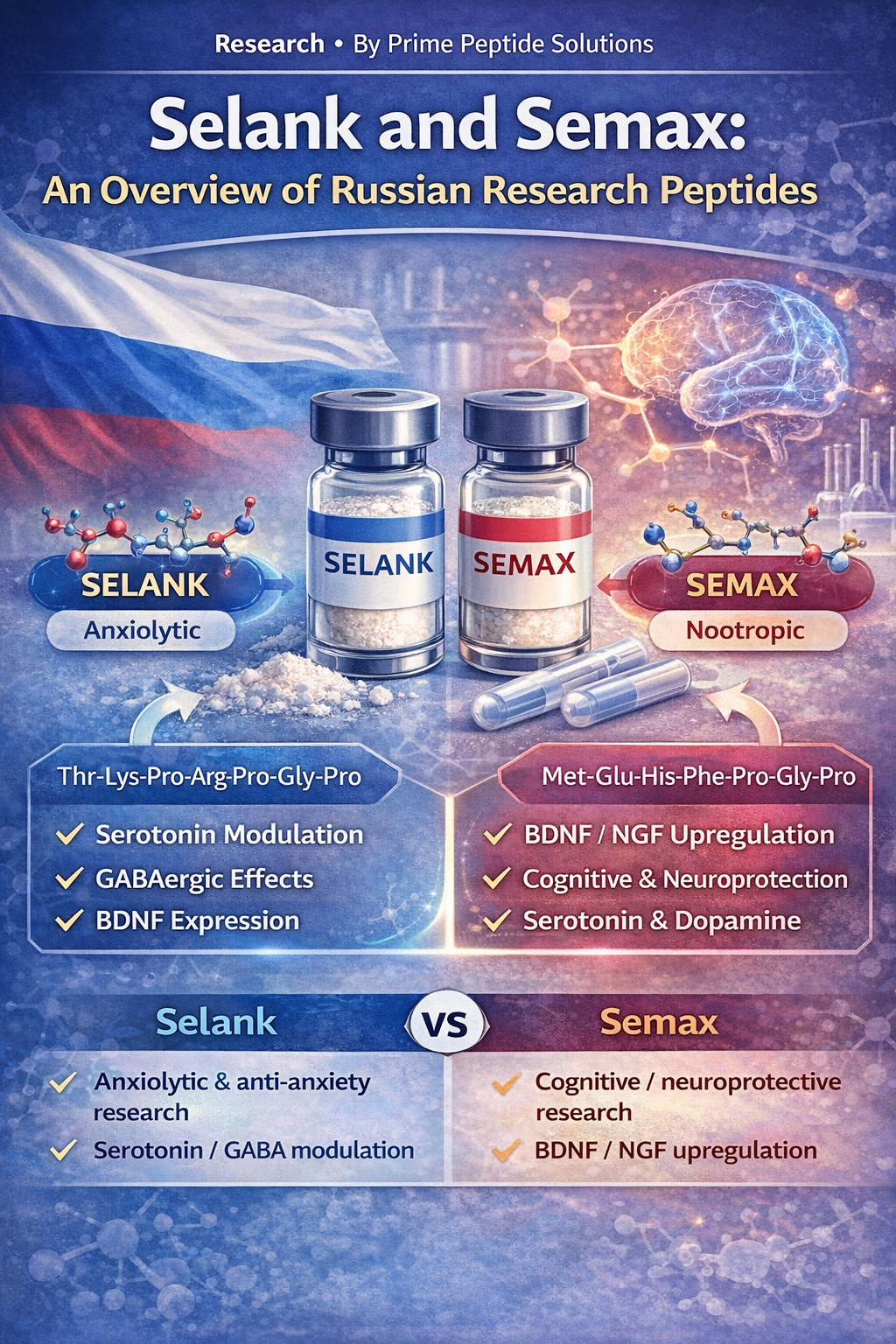
Selank is a synthetic heptapeptide with the sequence Thr-Lys-Pro-Arg-Pro-Gly-Pro. It is derived from tuftsin, a natural tetrapeptide produced by enzymatic cleavage of immunoglobulin G in the spleen. Russian researchers modified the tuftsin sequence to produce a more stable molecule with extended duration of action.
The "Sel-" prefix derives from the developing institute. Selank received Russian regulatory approval in the early 2000s for use in anxiety research and clinical applications, making it one of the few research peptides with formal national clinical approval outside the United States.
Mechanism in Research Literature
Selank's mechanism is characterized as multi-system. Published preclinical research describes effects on:
- Serotonin signaling — Modulation of serotonin metabolism in central nervous system tissue.
- GABAergic transmission — Effects on GABA-mediated inhibitory signaling.
- BDNF expression — Increases in brain-derived neurotrophic factor expression in research models.
- Immune modulation — Retained immunomodulatory activity from the parent tuftsin compound.
Notably, research literature describes Selank as producing anxiolytic effects in animal models without the sedation associated with benzodiazepine GABA-A agonists.
Research Applications
The primary research application area is anxiolytic and behavioral research. Animal-model studies have characterized Selank in anxiety paradigms including elevated plus-maze and open field tests. A secondary research focus involves cognitive performance and learning models.
Semax
Structure and Origin
Semax is a synthetic heptapeptide with the sequence Met-Glu-His-Phe-Pro-Gly-Pro. It is a synthetic analog of adrenocorticotropic hormone (ACTH 4-10), with the natural sequence modified to remove hormonal activity while retaining neuroactive properties. Semax was developed at the same institute as Selank, beginning in the 1980s.
Like Selank, Semax has Russian clinical approval and is included in their official medicine registry. The "Sem-" prefix similarly relates to the developing institute's nomenclature.
Mechanism in Research Literature
Semax mechanism in published research involves multiple central nervous system pathways:
- BDNF and NGF upregulation — Research characterizes increases in brain-derived neurotrophic factor and nerve growth factor expression.
- Dopaminergic and serotonergic modulation — Effects on monoamine systems characterized in animal models.
- Neuroprotective effects — Research literature describes protection in ischemia and oxidative stress models.
- Enkephalinase inhibition — Indirect effects on endogenous opioid signaling through enzymatic inhibition.
Semax has notably been investigated in ischemic stroke research models in Russian literature, with characterized effects on neuronal survival and functional recovery markers.
Research Applications
The primary research applications involve cognitive research, neuroprotection in ischemia models, and neurodevelopmental research. Animal studies have characterized effects on learning, memory consolidation, and recovery from neurological insults in preclinical models.
Selank vs Semax: Research Comparison
While both compounds emerged from the same research institute and share a similar approach to short-peptide neuropharmacology, they target different primary research questions:
- Selank — Anxiolytic-focused research; tuftsin-derived; serotonergic and GABAergic modulation.
- Semax — Cognitive and neuroprotective research; ACTH-derived; BDNF/NGF upregulation and neuroprotection.
In research protocols, the choice between them depends primarily on the research question. Some protocols investigate both in parallel to leverage their complementary profiles in models of combined anxiety and cognitive impairment.
Pharmacokinetics and Administration in Research
Both compounds have short circulating half-lives in research models, on the order of minutes for subcutaneous administration. However, both are characterized in research literature as having effects that persist beyond the circulation window, suggesting downstream mechanisms outlast the peptide presence — common for compounds acting via gene expression and neurotrophic factor induction.
Intranasal administration has been investigated as a research route for both compounds, with research literature characterizing this as effective for direct CNS delivery in animal models — a route of particular interest given the short systemic half-lives.
Storage and Handling
Lyophilized Selank and Semax are reported in research literature as stable at controlled refrigerated temperatures (2-8 degrees C) when sealed. Following reconstitution, both should be maintained at 2-8 degrees C with use within 14-28 days depending on conditions and bacteriostatic water concentration. As with all peptides, freeze-thaw cycling and exposure to moisture or light should be minimized.
Conclusion
Selank and Semax represent a distinctive contribution to peptide research, emerging from a research tradition outside the Anglo-American mainstream. Their characterization in published research as multi-system neuromodulators with anxiolytic (Selank) and cognitive-protective (Semax) profiles makes them ongoing subjects of research interest.
For laboratory researchers, both compounds offer well-characterized mechanisms via BDNF and monoamine system modulation, making them useful tools in neuroscience research design.
Prime Peptide Solutions offers Selank and Semax at >99% purity with batch-specific Certificates of Analysis.