
MOTS-c vs Humanin: Two Mitochondria-Derived Peptides Compared
MOTS-c and humanin are both mitochondria-derived peptides: short chains encoded not in the nucleus but by small open reading frames inside mitochondrial DNA. They come from different parts of the mitochondrial ribosomal RNA genes. Humanin is encoded within the 16S rRNA region (gene MT-RNR2) and MOTS-c within the 12S rRNA region (gene MT-RNR1) (Cobb et al., 2016; Lee et al., 2015; Gruschus et al., 2023).
Beyond that shared origin they are different molecules with different sequences, lengths and reported partners. This page compares them on mitochondrial-DNA origin, identity data and the study models each has been examined in, and keeps to laboratory questions. For the wider class, see the mitochondrial peptides hub.
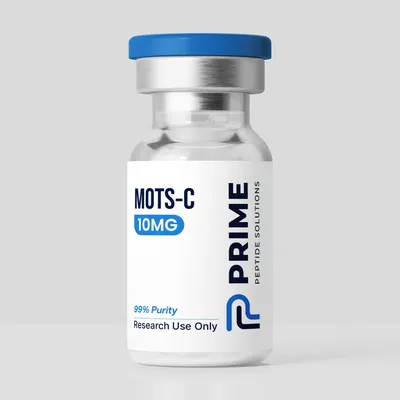
This article is a scientific overview for laboratory researchers. The research-grade MOTS-C supplied by Prime Peptide Solutions is sold strictly for in-vitro laboratory research. It is not approved for human use and is not for human or animal consumption.
| Property | MOTS-c | Humanin |
|---|---|---|
| Class | Mitochondria-derived peptide | Mitochondria-derived peptide |
| mtDNA region | 12S rRNA (gene MT-RNR1) | 16S rRNA (gene MT-RNR2) |
| Length | 16 residues | 24 residues |
| Sequence | H-Met-Arg-Trp-Gln-Glu-Met-Gly-Tyr-Ile-Phe-Tyr-Pro-Arg-Lys-Leu-Arg-OH | Met-Ala-Pro-Arg-Gly-Phe-Ser-Cys-Leu-Leu-Leu-Leu-Thr-Ser-Glu-Ile-Asp-Leu-Pro-Val-Lys-Arg-Arg-Ala |
| Molecular formula | C101H152N28O22S2 | C119H204N34O32S2 |
| Molecular weight | 2174.6 g/mol | 2687.2 g/mol |
| Monoisotopic mass | 2173.11 Da | 2685.48 Da |
| CAS number | 1627580-64-6 | 330936-69-1 |
| PubChem | CID 146675088 | CID 16131438 |
| Reported site of action | Cytosol and nucleus | Secreted; cytosolic Bax; cell-surface receptors |
| Reported partners | Folate pathway, AMPK, NRF2 | Bax, IGFBP-3, a CNTFR/WSX-1/gp130 receptor complex |
| Sold here | Yes, 10, 20 and 40mg vials | No |
About MOTS-c
Origin. MOTS-c (mitochondrial open reading frame of the 12S rRNA type-c) is a 16-residue peptide reported in 2015. It is encoded by a 51-base-pair short open reading frame inside the mitochondrial 12S rRNA; the authors note that the mitochondria-specific genetic code yields tandem start and stop codons, so a readable peptide requires the standard cytoplasmic code, which the authors read as evidence that its transcript is exported before translation (Lee et al., 2015). Multiple-species alignment put its first 11 residues as highly conserved (Lee et al., 2015). A 2023 synonymous-codon-bias analysis found MOTS-c lacks strong codon bias overall but carries a highly conserved N-terminal region (Gruschus et al., 2023).
Reported mechanism and study models. In the 2015 report, its cellular actions inhibited the folate pathway and the de novo purine synthesis tied to it, raising AICAR and activating AMP-activated protein kinase (AMPK), with skeletal muscle appearing to be its main target organ in mice (Lee et al., 2015). In cell studies under metabolic stress, MOTS-c moved to the nucleus in an AMPK-dependent way, regulated a broad set of nuclear genes, including genes with antioxidant response elements, and interacted with the transcription factor NRF2 (Kim et al., 2018); a review frames this as a mitochondrial-encoded peptide acting on the nucleus (Benayoun and Lee, 2019). MOTS-c was detected in various mouse and rat tissues and in human and rodent plasma by a specific ELISA (Lee et al., 2015).
Identity and detection. PubChem lists MOTS-c as C101H152N28O22S2, 2174.6 g/mol. For plasma work, a mass-spectrometry method was validated to a lower limit of detection near 100 pg/mL, and it flagged a wide gap between mass-spectrometry and ELISA readings of endogenous levels (Knoop et al., 2019). The peptide carries two methionines and a tryptophan, and side-chain oxidation is one of the recognized impurity types in synthetic peptides (D'Hondt et al., 2014), so sealed, cold and dark storage is the general lab practice.
About Humanin
Origin. Humanin was found in 2001 by functional screening for a cDNA that blocked neuronal cell death in culture caused by amyloid-beta and by several mutant familial Alzheimer genes, though not death from every insult tested; transfected cells secreted the encoded peptide, which is 24 residues long (Hashimoto et al., 2001). The mitochondrial genome contains an identical open reading frame, and the mitochondrial version also binds and suppresses Bax (Guo et al., 2003); that frame lies in the 16S rRNA region, gene MT-RNR2 (Cobb et al., 2016). A codon-bias analysis found humanin strongly conserved, consistent with a biologically important peptide, and noted that reading it with the vertebrate mitochondrial code would stop at codon 22, giving a 21-residue form rather than 24 (Gruschus et al., 2023).
Reported partners and study models. In cell and isolated-mitochondria experiments humanin bound the pro-apoptotic protein Bax, blocked its move to mitochondria and suppressed cytochrome c release (Guo et al., 2003). A yeast two-hybrid screen pulled it out as a high-affinity partner of insulin-like growth factor-binding protein 3 (IGFBP-3), binding its heparin-binding domain; an F6A variant did not bind (Ikonen et al., 2003). Substitution scanning found that the Leu9-Leu11 and Pro19-Val20 stretches are needed for secretion, and that Pro3, Ser7, Cys8, Leu9, Leu12, Thr13, Ser14 and Pro19 are needed for its activity in the cell assay (Yamagishi et al., 2003). In mononuclear phagocytes humanin acted through the G-protein-coupled formylpeptide receptor-like-1 (FPRL1) (Ying et al., 2004), and in neuronal cells its activity depended on a cell-surface complex involving CNTF receptor alpha, WSX-1 and gp130 (Hashimoto et al., 2009). By NMR humanin is largely unstructured in water with nascent-helix turns, folding to an alpha-helix in a less polar environment (Benaki et al., 2005).
Related peptides. An in silico search of the same 16S rRNA region found six more open reading frames, the small humanin-like peptides SHLP1-6, which differ in their effects on cell viability in culture (Cobb et al., 2016). Humanin is not sold here; it appears on this page as the comparison peptide.
Which Fits the Research Question?
The two peptides share an origin but little else, so the research question points clearly to one or the other.
- Folate pathway, AMPK or NRF2 signalling and nuclear translocation: MOTS-c, the peptide studied in those pathways (Lee et al., 2015; Kim et al., 2018). MOTS-c is stocked here.
- Bax and apoptosis, or IGFBP-3 binding: humanin, which binds Bax and IGFBP-3 in the cited cell and biochemical work (Guo et al., 2003; Ikonen et al., 2003). Humanin is not stocked here.
- Cell-surface receptor pharmacology: humanin, with candidate receptors reported (formylpeptide receptor-like-1; a CNTFR/WSX-1/gp130 complex) (Ying et al., 2004; Hashimoto et al., 2009). No direct cell-surface receptor is reported for MOTS-c.
- mtDNA origin and sequence conservation: both, read side by side, as in the codon-bias study that analyzed them together (Gruschus et al., 2023). Our mitochondrial peptides hub maps the group, and SS-31 vs MOTS-C sets MOTS-c against a synthetic, mitochondria-targeted peptide.
- Identity checks: a mass near 2175 Da points to MOTS-c, near 2687 to humanin. MOTS-c has two methionines; humanin has one cysteine (Cys8). See HPLC and mass spectrometry explained.
MOTS-c is set against the coenzyme NAD+ in MOTS-C vs NAD+, and covered on its own in the MOTS-C research overview.
Key Studies
- Lee et al., 2015 (Cell Metab): MOTS-c discovery; encoded in the 12S rRNA, folate pathway and AMPK, skeletal muscle target in mice. PubMed 25738459
- Hashimoto et al., 2001 (Proc Natl Acad Sci U S A): humanin identified by functional screening as a secreted neuronal rescue factor in cell culture. PubMed 11371646
- Guo et al., 2003 (Nature): humanin binds Bax and suppresses cytochrome c release; an identical mitochondrial reading frame exists. PubMed 12732850
- Kim et al., 2018 (Cell Metab): MOTS-c translocates to the nucleus under metabolic stress and interacts with NRF2. PubMed 29983246
- Gruschus et al., 2023 (Sci Rep): codon-bias analysis of MOTS-c, humanin and the SHLPs; humanin strongly conserved. PubMed 37644144
Frequently Asked Questions
What do MOTS-c and humanin have in common?
Both are mitochondria-derived peptides, encoded by short open reading frames in mitochondrial DNA rather than in the nucleus. Humanin comes from the 16S rRNA region and MOTS-c from the 12S rRNA region (Gruschus et al., 2023).
Are they the same length?
No. MOTS-c is 16 residues (about 2175 Da) and humanin is 24 residues (about 2687 Da). Their sequences are unrelated.
Where does each one act?
Cell studies place MOTS-c in the cytosol, through the folate pathway and AMPK, and in the nucleus under metabolic stress (Kim et al., 2018). Humanin is secreted and has been reported to bind cytosolic Bax and to act through cell-surface receptor complexes (Guo et al., 2003; Hashimoto et al., 2009).
Does MOTS-c have an identified receptor?
No direct cell-surface receptor is reported for MOTS-c; its described actions run through the folate pathway, AMPK and the transcription factor NRF2. Humanin, by contrast, has candidate receptors in the literature (Ying et al., 2004; Hashimoto et al., 2009).
What are the SHLPs?
The small humanin-like peptides, SHLP1-6, are six further open reading frames found in the same 16S rRNA region as humanin; they differ in their effects on cell viability in culture (Cobb et al., 2016).
How is the lyophilized MOTS-c handled, and is there a lab report?
MOTS-C ships as a lyophilized powder in sealed 10, 20 and 40mg vials. The product page gives storage at 2-8 °C, or -20 °C for long-term storage; keep vials cold, dry and dark, and let a cold vial reach room temperature before opening. Its two methionine side chains can oxidize, and side-chain oxidation is a recognized impurity type in synthetic peptides (D'Hondt et al., 2014). Published lab reports (COAs) are listed on our COAs page. The current MOTS-C 20mg report also has its own page: MOTS-C 20mg lab report. See the COA guide and the storage guide.
Disclaimer: This article is provided for educational and research purposes only. It summarizes publicly available scientific literature and does not constitute medical advice. MOTS-C and all peptide compounds sold by Prime Peptide Solutions are intended strictly for laboratory research, are not approved for human use, and are not for human or animal consumption. Researchers are responsible for compliance with all applicable regulations in their jurisdiction.
Shop MOTS-C
- Ships the same business day
- Free US shipping on $199.99+
- 14-day money-back guarantee on damaged items