
Cagrilintide vs Semaglutide
Cagrilintide and semaglutide are both lipidated peptide analogues, but of different hormones and for different receptors. Cagrilintide is a 37-residue amylin analogue that activates the three amylin receptors and the calcitonin receptor (Fletcher et al., 2021; Cao et al., 2025). Semaglutide is a 31-residue analogue of glucagon-like peptide-1 (GLP-1), described in the 2025 cagrilintide structure paper as a selective GLP-1 receptor agonist (Cao et al., 2025). In our catalog semaglutide is listed as GLP-1 SM (semaglutide).
What they share is design logic and receptor family. Both carry a long-chain diacid attached through a gamma-glutamic acid linker; in semaglutide the side chain was chosen to bind serum albumin reversibly while keeping GLP-1 receptor potency (Knudsen and Lau, 2019). And both act at related G protein-coupled receptors: when the GLP-1 receptor was cloned, its sequence resembled the receptors for secretin, calcitonin and parathyroid hormone (Thorens, 1992). This page compares structure, receptor pharmacology and structural biology, and keeps to laboratory questions.
This article is a scientific overview for laboratory researchers. The research-grade cagrilintide and semaglutide supplied by Prime Peptide Solutions are sold strictly for in-vitro laboratory research. They are not approved for human use and are not for human or animal consumption.
| Property | Cagrilintide | Semaglutide |
|---|---|---|
| Hormone template | Amylin, through the pramlintide backbone | GLP-1(7-37) |
| Peptide family | Calcitonin family (calcitonin, amylin, CGRP, adrenomedullin) | Proglucagon-derived peptides |
| Length | 37 residues | 31 residues |
| Changes from the template | N14E, V17R, Y37P on pramlintide (which has P25, P28, P29) | Aib8 and Arg34 (GLP-1 numbering) |
| Sequence | KCNTATCATQ | H(Aib)EGTFTSDV |
| Lipid side chain | C20 diacid on a gamma-Glu linker | C18 diacid on gamma-Glu plus two OEG spacers |
| Attachment point | Alpha-amine of Lys1 (the N-terminus) | Side-chain amine of Lys26 (residue 20 of 31) |
| Disulfide bond | Cys2-Cys7 | None |
| C-terminus | Prolinamide | Free acid (Gly) |
| Molecular formula | C194H312N54O59S2 | C187H291N45O59 |
| Molecular weight | 4409 g/mol | 4114 g/mol |
| Monoisotopic mass | 4406.25 | 4111.12 |
| CAS number | 1415456-99-3 | 910463-68-2 |
| PubChem | CID 171397054 | CID 56843331 |
| Receptor targets | AMY1, AMY2, AMY3 and the calcitonin receptor | GLP-1 receptor |
| Selectivity | Nonselective across those four | Selective for the GLP-1 receptor |
| Coupling | Gs; the calcitonin receptor raises cAMP | Gs; the GLP-1 receptor activates adenylate cyclase |
| Receptor-bound structures | Cryo-EM with AMY1, AMY2, AMY3 and the calcitonin receptor | Cryo-EM with the GLP-1 receptor and Gs |
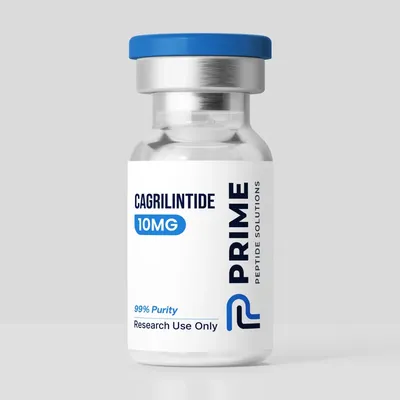
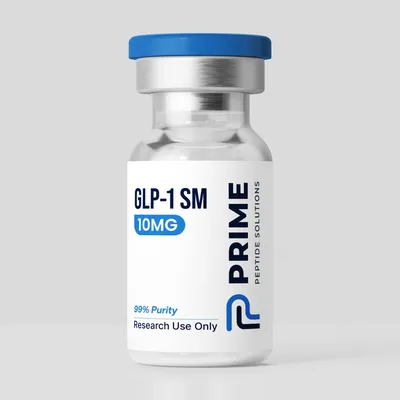
| In this catalog | Cagrilintide, 10mg vial | GLP-1 SM (semaglutide), 10mg vial |
About Cagrilintide
Template and design. Cagrilintide is built on pramlintide, itself human amylin with prolines at 25, 28 and 29. On that backbone, N14E and V17R were added to counteract amyloid fibril formation by stabilizing the N-terminal helix through a salt bridge, Pro37 replaces the C-terminal tyrosine, and the N-terminus carries a C20 diacid on a gamma-Glu linker (Cao et al., 2025). The goal of the program was a stable, lipidated amylin analogue, which is difficult because amylin readily forms amyloid fibrils (Kruse et al., 2021).
Receptors. The amylin receptors are the calcitonin receptor paired with RAMP1, RAMP2 or RAMP3 (Hay et al., 2018); RAMP1 or RAMP3 co-expressed with the calcitonin receptor first produced amylin binding and cAMP responses in COS-7 cells (Christopoulos et al., 1999). The calcitonin receptor itself is coupled to cAMP (Lin et al., 1991). Across 25 binding, activation and regulation endpoints, cagrilintide was a nonselective agonist of the amylin and calcitonin receptors with a profile unlike six comparator agonists (Fletcher et al., 2021), and beside the salmon-calcitonin-based KBP-336 it showed less calcitonin-receptor bias (Larsen et al., 2022).
Structures. Cryo-EM structures of cagrilintide with Gs-coupled AMY1, AMY2, AMY3 and calcitonin receptors show an amylin-like binding mode with distinct receptor dynamics (Cao et al., 2025). Phe23 anchors the peptide at the transmembrane bundle, the Glu14-Arg17 salt bridge reinforces the helix, and Pro37 contacts the receptor extracellular domain (Gu et al., 2026).
About Semaglutide
The hormone and its receptor. GLP-1 is cut from the preproglucagon molecule and secreted by intestinal L cells. Its receptor was cloned in 1992 from a rat pancreatic islet library: a 463-amino-acid receptor with seven transmembrane domains, coupled to activation of adenylate cyclase. It bound GLP-1 specifically and did not bind glucagon, gastric inhibitory peptide, vasoactive intestinal peptide or secretin (Thorens, 1992).
Design. Native GLP-1 is cleaved by the enzyme DPP-IV at its N-terminus. Of the substitutions tried for Ala8, aminoisobutyric acid (Aib) was the one that gave both DPP-IV stability and high GLP-1 receptor affinity. For the lipid, a systematic test of C12 to C20 derivatives found that a C18 diacid with a gamma-Glu plus two-OEG linker gave the highest albumin affinity combined with GLP-1 receptor potency; the chain is attached at Lys26, and Arg34 replaces the native lysine (Knudsen and Lau, 2019). Those potency comparisons were run in baby hamster kidney (BHK) cells expressing the human GLP-1 receptor and a luciferase reporter, with receptor binding measured at 0 and 2% human serum albumin (Knudsen and Lau, 2019).
Structures. A crystal structure of the unacylated semaglutide backbone bound to the GLP-1 receptor matched native GLP-1 overall, and at the receptor's extracellular domain Arg34 adopted a more defined conformation than native Lys34 (Knudsen and Lau, 2019). Cryo-EM structures of semaglutide-bound GLP-1 receptor and Gs complexes showed peptide interactions similar to GLP-1 but different motions within the receptor and the bound peptide (Zhang et al., 2021).
Which Fits the Research Question?
Because the two peptides share no receptor target in the sources reviewed here, the receptor in the question decides.
- Amylin or calcitonin receptor pharmacology: cagrilintide. Note that the RAMPs a cell line expresses decide which of its four targets the cells present.
- GLP-1 receptor signalling: semaglutide, a single-receptor agonist.
- Comparing lipidation designs: both. Cagrilintide puts a C20 diacid on the N-terminal amine; semaglutide puts a C18 diacid with a longer linker on a lysine side chain. Where assay media contain albumin, potency is worth comparing at matched albumin levels, as the semaglutide design work measured binding with and without it. Our guide to peptide modifications covers a different albumin strategy, the covalent DAC group.
- Receptor structural biology: both have published Gs-complex cryo-EM structures.
- A selectivity control: each peptide is a candidate negative control at the other's receptor, to be confirmed in the assay along with the cell line's receptor and RAMP expression.
- Multi-receptor peptides: for a GIP, GLP-1 and glucagon receptor agonist, see retatrutide vs cagrilintide and GLP-3 RT (retatrutide); the naming is explained in what GLP-3 means.
Frequently Asked Questions
Is cagrilintide a GLP-1 receptor agonist?
No. It is an amylin analogue that activates the amylin receptors and the calcitonin receptor. None of the sources reviewed here reports GLP-1 receptor activity for cagrilintide, or amylin or calcitonin receptor activity for semaglutide.
Do cagrilintide and semaglutide have anything in common?
Both are lipidated with a long-chain diacid on a gamma-Glu linker, both act at related G protein-coupled receptors that couple to Gs and cAMP, and both have published receptor-bound cryo-EM structures.
Why is semaglutide's lipid on Lys26 and cagrilintide's on the N-terminus?
They are different design solutions. In the GLP-1 work, N-terminal positions that an alanine scan had shown to be crucial for activity were judged unsuitable for a fatty-acid-derivatized lysine; the native Lys26 was available for derivatization, and the only other lysine, Lys34, could be replaced with arginine (Knudsen and Lau, 2019). In cagrilintide, the acyl group sits on the alpha-amine of Lys1, leaving the lysine side chain free.
What is GLP-1 SM?
GLP-1 SM is our catalog name for semaglutide, a synthetic 31-amino-acid GLP-1 receptor agonist peptide with a lipid side chain. Its identity values are CAS 910463-68-2, C187H291N45O59 and 4114 g/mol.
How do their identity checks differ?
By mass and by the disulfide. Cagrilintide is about 4409 g/mol and has a Cys2-Cys7 disulfide; semaglutide is about 4114 g/mol and has no cysteine. See HPLC and mass spectrometry explained.
How are the lyophilized vials handled, and are there lab reports?
Both ship as lyophilized powders in sealed 10mg vials. Keep them sealed, cold, dry and dark, and let a cold vial reach room temperature before opening; see the peptide storage guide. Batch lab reports are listed by product and batch on our lab reports page as they become available; check it for a report on either vial.
Disclaimer: This article is provided for educational and research purposes only. It summarizes publicly available scientific literature and does not constitute medical advice. Cagrilintide, semaglutide and all peptide compounds sold by Prime Peptide Solutions are intended strictly for laboratory research, are not approved for human use, and are not for human or animal consumption. Researchers are responsible for compliance with all applicable regulations in their jurisdiction.
Shop these products
- Ships the same business day
- Free US shipping on $199.99+
- 14-day money-back guarantee on damaged items