
Cagrilintide vs Pramlintide
Cagrilintide and pramlintide are synthetic analogues of the 37-residue hormone amylin, and one is built from the other: pramlintide was the backbone peptide used to make cagrilintide (Cao et al., 2025). Pramlintide is human amylin with prolines at positions 25, 28 and 29 (da Silva et al., 2016). Cagrilintide keeps those prolines, adds three more substitutions (N14E, V17R and Y37P) and carries a C20 diacid on a gamma-glutamic acid linker at its N-terminus (Cao et al., 2025).
The extra changes alter how the peptide behaves at the receptor. In a 2021 comparison across 25 pharmacological endpoints, pramlintide acted as an amylin-receptor-selective agonist, while cagrilintide (tested as AM833) was a nonselective agonist of the amylin and calcitonin receptors with a profile unlike any of the other peptides tested (Fletcher et al., 2021). This page compares the two molecules on identity, receptor pharmacology and solution chemistry, and maps each to the lab questions it suits.
This article is a scientific overview for laboratory researchers. The research-grade cagrilintide supplied by Prime Peptide Solutions is sold strictly for in-vitro laboratory research. It is not approved for human use and is not for human or animal consumption. Pramlintide is not sold here.
| Property | Cagrilintide | Pramlintide |
|---|---|---|
| What it is | Lipidated amylin analogue | Proline-substituted amylin analogue |
| Other names | AM833, NN0174-0833 (0833) | AC137 (AC-0137), tripro-amylin |
| Built from | Pramlintide | Human amylin |
| Length | 37 residues | 37 residues |
| Changes from human amylin | N14E, V17R, A25P, S28P, S29P, Y37P, plus N-terminal lipid | A25P, S28P, S29P |
| Sequence | KCNTATCATQ | KCNTATCATQ |
| N-terminus | Lys1 alpha-amine acylated: C20 diacid on a gamma-Glu linker | Free amine |
| C-terminus | Prolinamide | Tyrosinamide |
| Disulfide bond | Cys2-Cys7 | Cys2-Cys7 |
| Molecular formula | C194H312N54O59S2 | C171H267N51O53S2 |
| Molecular weight | 4409 g/mol | 3949 g/mol |
| Monoisotopic mass | 4406.25 | 3946.92 |
| CAS number | 1415456-99-3 | 151126-32-8 |
| PubChem | CID 171397054 | CID 70691388 |
| Receptor profile | Nonselective: AMY1, AMY2, AMY3 and the calcitonin receptor | Amylin-receptor-selective |
| Anti-fibril design | Prolines plus a Glu14-Arg17 helix salt bridge | Prolines at 25, 28 and 29 |
| Receptor-bound structures | Cryo-EM with AMY1, AMY2, AMY3 and the calcitonin receptor | Not covered in the sources reviewed here |
| Documented solution chemistry | In-vitro breakdown from both termini; LC-MS/MS methods | Heat-stress deamidation and hydrolysis; pH-dependent fibrils; zinc-induced aggregation |
| Sold here | Yes, 10mg vial | No |
About Cagrilintide
Design. Cagrilintide came out of structure-activity work on a stable, lipidated amylin analogue; the challenge was amylin's high propensity to form amyloid fibrils (Kruse et al., 2021). On the pramlintide backbone, the N14E and V17R pair was added to counteract fibril formation, predicted to stabilize the N-terminal alpha-helix (residues 5-18) through an intramolecular salt bridge. Pro37 replaces the C-terminal tyrosine; in rat amylin that swap was well tolerated and raised affinity and activity at both the calcitonin receptor and the amylin receptors, in some cases with reduced selectivity between them (Cao et al., 2025).
Receptor pharmacology. Across binding, activation and receptor-regulation endpoints, cagrilintide had a profile unlike pramlintide, salmon calcitonin, rat amylin, human calcitonin or two lipidated research analogues (Fletcher et al., 2021). In receptor-specific assays it activated both amylin and calcitonin receptors, while the salmon-calcitonin-based dual agonist KBP-336 was more potent and biased toward the calcitonin receptor (Larsen et al., 2022). Functional assays showed non-selective Gs activation through the calcitonin receptor and AMY1 (Gu et al., 2026).
Structure. Cryo-EM structures with Gs-coupled AMY1, AMY2, AMY3 and calcitonin receptors show an amylin-like binding mode with distinct receptor dynamics (Cao et al., 2025). A second set of structures highlights Phe23 at the transmembrane bundle, the Glu14-Arg17 salt bridge and Pro37 contacting the receptor extracellular domain (Gu et al., 2026).
Analytics and tools. In-vitro metabolism models broke cagrilintide down from both termini, and validated LC-MS/MS methods cover the peptide and its products (Alhalabi et al., 2026). For rodent mode-of-action work, a tool analogue, 0839, shares 95% sequence homology and an identical acylation side chain (Gabery et al., 2025). Cagrilintide has been evaluated in phase 1 and phase 2 clinical trials (Cao et al., 2025); the clinical literature is outside the scope of this page.
About Pramlintide
Where the prolines come from. Synthetic-peptide work traced human amylin's fibril formation to positions 20-29, found Ala-Ile-Leu-Ser-Ser (25-29) strongly amyloidogenic, and showed that a proline-for-serine substitution at 28, as in several rodents, almost completely inhibits fibril formation (Westermark et al., 1990). Rat amylin carries prolines at 25, 28 and 29 (UniProt P12969), the same three positions substituted in pramlintide, a triple-proline analogue designed to address the solubility and amyloid characteristics of human amylin (da Silva et al., 2016).
Solution behaviour. The prolines did not make pramlintide fibril-proof. Ion mobility mass spectrometry showed it can assemble into multimers, and it formed amyloid fibrils in vitro in a pH-dependent process within a few hours (da Silva et al., 2016). An empirical-phase-diagram study found little defined structure in dilute solution, stability in its pH 4 formulation, and a tendency to aggregate at high concentration at pH 6 to 7.5 (Nonoyama et al., 2008). Zn(II) binds its Lys1 amine and His18 imidazole and bends the peptide; the initially soluble complex formed fibrillar, oligomeric aggregates after a lag of about 20 hours (Łoboda and Rowińska-Żyrek, 2017; Dudek et al., 2022).
Degradation chemistry. In a pH 4.0 pramlintide formulation stressed at 40 °C for 45 days, deamidation accounted for about 64% of thermal degradation, cyclic imides about 20% and backbone hydrolysis the rest, with six of eight possible deamidation sites affected (Hekman et al., 1999). Hydrolysis cut the chain at His18-Ser19 and Ser19-Ser20 (Hekman et al., 1998). A forced-degradation study found extensive degradation under hydrolytic, oxidative and thermal stress, minimal degradation under light, and separated the products by reversed-phase and strong-cation-exchange HPLC for LC-MS identification (Yuan et al., 2018).
Receptor pharmacology. In the 2021 seven-agonist comparison, pramlintide was the amylin-receptor-selective reference (Fletcher et al., 2021). A 2016 review notes that little was known about amylin's structure-function relationships, largely because of the native peptide's aggregation and solubility properties, and describes how that knowledge is aiding the design of more potent and stable amylin mimetics (Bower and Hay, 2016).
Which Fits the Research Question?
The two peptides share a backbone, so the choice turns on the four places where they differ and on what each literature covers.
- Amylin-receptor-selective activation: pramlintide is the selective reference in the 2021 comparison. Cagrilintide also activates the calcitonin receptor, so in a cell line that expresses the calcitonin receptor without a RAMP, the two are expected to read out differently.
- Combined amylin and calcitonin receptor activation: cagrilintide, with KBP-336 or salmon calcitonin as calcitonin-backbone comparators.
- Structural biology with a lipidated ligand: cagrilintide, which has published cryo-EM structures at all four of its targets.
- Aggregation and metal-binding chemistry: pramlintide has the larger published record: fibril kinetics, phase behaviour and zinc complexes.
- Degradation and analytical methods: pramlintide's heat-stress products are mapped residue by residue; for cagrilintide, published work covers in-vitro metabolism and LC-MS/MS detection.
- The effect of lipidation alone: neither pair member isolates it, because the peptides also differ at three residues. A matched non-lipidated control is needed.
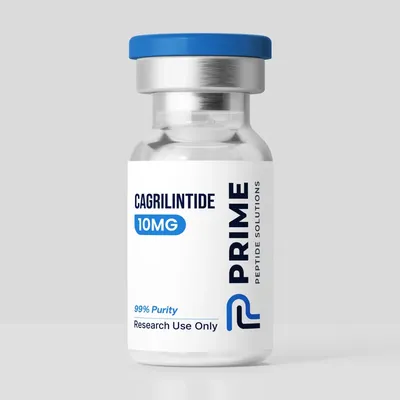
Only cagrilintide is stocked here, as Cagrilintide (10mg vial). For cagrilintide beside a peptide from a different receptor family, see retatrutide vs cagrilintide. Handling guides: peptide storage and HPLC and mass spectrometry.
Frequently Asked Questions
Is cagrilintide made from pramlintide?
Yes. Pramlintide was the backbone peptide used to make cagrilintide, which adds Glu14, Arg17, a C-terminal prolinamide and an N-terminal C20 diacid on a gamma-Glu linker.
Do cagrilintide and pramlintide act on the same receptors?
They overlap at the amylin receptors (AMY1, AMY2 and AMY3: the calcitonin receptor paired with RAMP1, RAMP2 or RAMP3). Cagrilintide also activates the calcitonin receptor on its own, while pramlintide was described as amylin-receptor-selective.
Why do both peptides carry prolines at 25, 28 and 29?
Those positions sit in amylin's fibril-prone 20-29 region. Rat amylin has prolines there, and in synthetic-peptide tests a proline at 28 almost completely inhibited fibril formation by the human segment.
Can pramlintide still form fibrils?
Yes, under some conditions. It formed amyloid fibrils in vitro in a pH-dependent process, tended to aggregate at high concentration at pH 6 to 7.5, and formed fibrillar aggregates as a zinc complex after a lag.
How do their identity checks differ?
By mass: about 4409 g/mol for cagrilintide, including the lipid, against about 3949 g/mol for pramlintide. Both carry the same Cys2-Cys7 disulfide. Our guide to peptide modifications explains C-terminal amides.
How is the lyophilized cagrilintide handled, and is there a lab report?
Cagrilintide ships as a lyophilized powder in a sealed 10mg vial. Keep it sealed, cold, dry and dark, and let a cold vial reach room temperature before opening. Batch lab reports are listed by product and batch on our lab reports page as they become available; check it for a cagrilintide report.
Disclaimer: This article is provided for educational and research purposes only. It summarizes publicly available scientific literature and does not constitute medical advice. Cagrilintide and all peptide compounds sold by Prime Peptide Solutions are intended strictly for laboratory research, are not approved for human use, and are not for human or animal consumption. Researchers are responsible for compliance with all applicable regulations in their jurisdiction.
Shop Cagrilintide
- Ships the same business day
- Free US shipping on $199.99+
- 14-day money-back guarantee on damaged items