
AOD-9604 vs HGH Fragment 176-191
AOD-9604 and "HGH Fragment 176-191" are often assumed to be the same thing, and the two names are often used as if interchangeable. They are closely related but not identical: both are built on the C-terminal stretch of human growth hormone, and they differ at a single residue at the N-terminus. This comparison keeps strictly to sequence identity, mass and chemistry, so researchers can tell which molecule a label actually names. It does not cover biological findings; for those, consult the primary literature.
This comparison is a scientific overview for laboratory researchers. The research-grade AOD-9604 supplied by Prime Peptide Solutions is sold strictly for in-vitro laboratory research. It is not approved for human use and is not for human or animal consumption.
| Property | AOD-9604 | HGH Fragment 176-191 (native) |
|---|---|---|
| Other names | AOD9604, AOD 9604 | Somatotropin (176-191), hGH(176-191) |
| Sequence (one-letter) | YLRIVQCRSVEGSCGF | FLRIVQCRSVEGSCGF |
| Residues | 16: Tyr + hGH 177-191 | 16: hGH 176-191 |
| N-terminal residue | Tyrosine (added) | Phenylalanine (hGH Phe-176) |
| Shared core | hGH residues 177-191 (Leu-Arg-Ile-Val-Gln-Cys-Arg-Ser-Val-Glu-Gly-Ser-Cys-Gly-Phe) | |
| Disulfide bond | Cys7-Cys14 (hGH Cys182-Cys189) | Cys7-Cys14 (hGH Cys182-Cys189) |
| Molecular formula | C78H123N23O23S2 | C78H123N23O22S2 |
| Molecular weight | 1815.1 g/mol | 1799.1 g/mol |
| Monoisotopic mass | 1813.86 | 1797.87 |
| CAS number | 221231-10-3 | 66004-57-7 |
| PubChem CID | 71300630 | 16131230 |
| Sold at PPS | Yes | No |
About AOD-9604
AOD-9604 (also written AOD9604) is a synthetic 16-residue peptide. The specifications box on our product page lists its sequence as Tyr-Leu-Arg-Ile-Val-Gln-Cys-Arg-Ser-Val-Glu-Gly-Ser-Cys-Gly-Phe with a Cys7-Cys14 disulfide: positions 2 to 16 are an exact copy of hGH 177-191, and position 1 is an added tyrosine. The same identity appears in the analytical literature, where AOD9604 is described as the C-terminal fragment of human growth hormone from amino acids 177-191 with an additional tyrosine residue at the N-terminus (Cox et al., 2015).
Its two cysteines, at positions 7 and 14 of the fragment (Cys182 and Cys189 in hGH numbering), are joined by a disulfide bond that closes an eight-residue ring. A two-dimensional 1H NMR study examined the closely related 15-residue peptide hGH 177-191, the same disulfide ring without the added tyrosine (cyclo(6,13) in its own numbering). In water/dimethylsulfoxide its cyclic region adopted type I beta-turns, and the authors noted some structural similarity to residues 177-191 in the hGH crystal structure (Ogru et al., 2000). That paper applies the AOD name to the 15-residue peptide, one more reason to identify these materials by sequence and mass rather than by name.
PubChem gives the monoisotopic mass of AOD-9604 as 1813.86, so the singly protonated ion falls near m/z 1814.87, and its average molecular weight as 1815.1. The sequence contains two arginines and one glutamic acid, and no lysine, histidine, methionine or tryptophan.
About HGH Fragment 176-191 (native)
The name "HGH Fragment 176-191" points, read literally, to residues 176 to 191 of human growth hormone: the same 15-residue core as above but with the natural residue 176, phenylalanine, placed in front of it instead of a tyrosine. PubChem indexes this as Somatotropin (176-191), CID 16131230, with formula C78H123N23O22S2, a molecular weight of 1799.1 and a monoisotopic mass of 1797.87. The hGH residue numbering it uses comes from the established primary structure of the 191-residue hormone, determined in the early 1970s (Niall, 1971; Li and Dixon, 1971).
PPS does not sell this native 176-191 peptide. It is included here only so the identity question can be answered precisely: the difference between it and AOD-9604 is a single residue at the N-terminus, tyrosine in place of phenylalanine, which adds one hydroxyl oxygen and about 16 daltons.
Where These Residues Sit in Growth Hormone
Both molecules correspond to the same stretch of the parent protein. Mature human growth hormone is a single chain of 191 amino acids (UniProt entry P01241), and its crystal structure, solved in complex with its receptor, shows a four-helix bundle with an unusual topology (de Vos et al., 1992). Residues 176-191 are the last 16 residues of that chain. UniProt lists two disulfide bonds in the mature hormone, Cys53-Cys165 and Cys182-Cys189; the second is the pair both fragments carry.
This region of hGH was also mapped by alanine-scanning mutagenesis: single alanine substitutions were introduced across three discontinuous segments implicated in receptor recognition, one of which runs from residue 167 to 191 (Cunningham and Wells, 1989). That work concerns the intact hormone, not either fragment. The NMR study of the cyclic 15-residue peptide describes local turn structure in its cyclic region, not the four-helix fold of the intact hormone (Ogru et al., 2000).
Because the two fragments come from the same 16-residue window of the same protein and keep the same disulfide, they are near-twins on paper. Only the first residue, and the small mass and polarity it carries, sets them apart. That is why a purity and identity check that reports the measured mass, rather than the catalog name, is the dependable way to tell a vial of one from the other.
Which Fits the Research Question?
Which molecule fits depends on what the research design specifies, and on reading labels carefully, because the two names are often used as if interchangeable.
- A study that specifies AOD-9604 (Tyr + 177-191): the matching material is AOD-9604. The added N-terminal tyrosine distinguishes it, and it carries CAS 221231-10-3, formula C78H123N23O23S2 and a mass of about 1815.1.
- A study that specifies the true native 176-191 (Phe-176 start): that is a different molecule, CAS 66004-57-7, formula C78H123N23O22S2, mass about 1799.1, which PPS does not stock.
- A label that just says "HGH Fragment 176-191": check the sequence and mass on the Certificate of Analysis before assuming which one it is. A mass near 1815 points to the tyrosine form (AOD-9604); a mass near 1799 points to the phenylalanine-start native fragment.
Because both molecules share the hGH 177-191 core and the Cys182-Cys189 disulfide, the deciding identity features are the single N-terminal residue and the resulting 16-dalton difference, which comes from the extra hydroxyl oxygen on tyrosine against phenylalanine. The sequence on the COA is the final word; the name alone is not enough.
For the compound as stocked, see the AOD-9604 research overview; related compounds are grouped on the growth hormone research peptides page.
Frequently Asked Questions
Is AOD-9604 the same as HGH Fragment 176-191?
Not exactly. AOD-9604 is residues 177-191 of human growth hormone with an added N-terminal tyrosine. The true native 176-191 stretch starts with phenylalanine (Phe-176). They share the 177-191 core and differ at that one N-terminal residue, which is why their masses differ by about 16 daltons.
Why do the two have different CAS numbers?
Because they are different molecules. AOD-9604 (tyrosine form) is CAS 221231-10-3; Somatotropin (176-191), the phenylalanine-start native fragment, is CAS 66004-57-7. PubChem lists them as separate compounds, CID 71300630 and CID 16131230.
Do they share a disulfide bond?
Yes. Both carry the Cys182-Cys189 disulfide (positions 7 and 14 of the fragment), the same pair that is disulfide-linked in that region of the parent hGH chain, forming an eight-residue ring.
How can I confirm which one a vial contains?
Check the sequence and the mass on the batch Certificate of Analysis. A mass near 1815 indicates the tyrosine form (AOD-9604); a mass near 1799 indicates the phenylalanine-start native 176-191. See reading a peptide COA.
How is the lyophilized material handled in the lab?
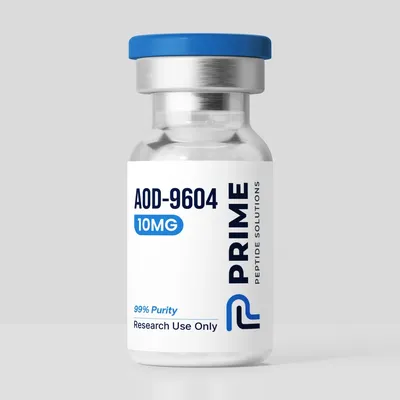
AOD-9604 ships as a lyophilized powder in a sealed vial. The product page gives storage at 2-8 °C, or -20 °C for long-term storage; keep vials cold, dry, dark and sealed until needed. See our storage guide and the lyophilization explainer.
Which does PPS sell?
Only AOD-9604 (the tyrosine form), supplied as a lyophilized powder. Published lab reports (COAs) are listed on our COAs page. The native 176-191 fragment is not stocked.
Disclaimer: This comparison is provided for educational and research purposes only. It summarizes publicly available information on peptide identity and chemistry and does not constitute medical advice. AOD-9604 and all peptide compounds sold by Prime Peptide Solutions are intended strictly for laboratory research, are not approved for human use, and are not for human or animal consumption.
Shop AOD-9604
- Ships the same business day
- Free US shipping on $199.99+
- 14-day money-back guarantee on damaged items