

What Is Semax?
Semax is a synthetic heptapeptide with the sequence Met-Glu-His-Phe-Pro-Gly-Pro (one-letter code MEHFPGP), studied in neuroscience research for its effects on neurotrophin signaling and gene expression in cell and rodent models. It joins the four-residue core Met-Glu-His-Phe, residues 4-7 of adrenocorticotropic hormone (ACTH), to a C-terminal Pro-Gly-Pro tripeptide. The literature usually calls it an analog of ACTH(4-10), and it also appears as ACTH(4-7)PGP or ACTH(4-7)-Pro-Gly-Pro; PubChem indexes it as "ACTH (4-7), Pro-Gly-Pro-".
Semax shares its Pro-Gly-Pro ending with Selank, which is otherwise built on a different parent peptide. This page covers Semax on its own: identity data, findings grouped by study model, the key studies with PubMed links, and handling of the lyophilized material. The two peptides are set side by side in our Selank and Semax overview and the Selank vs Semax comparison.
This article is a scientific overview for laboratory researchers. The research-grade Semax supplied by Prime Peptide Solutions is sold strictly for in-vitro laboratory research. It is not approved for human use and is not for human or animal consumption.
Structure and Background
From the melanocortin core to Semax
ACTH and the alpha-, beta- and gamma-melanocyte-stimulating hormones share a heptapeptide core, the sequence that the melanocortin-3 receptor recognizes (Gantz et al., 1993). In alpha-MSH, Ac-Ser-Tyr-Ser-Met-Glu-His-Phe-Arg-Trp-Gly-Lys-Pro-Val-NH2, residues 4-10 read Met-Glu-His-Phe-Arg-Trp-Gly (Al-Obeidi et al., 1989). Semax keeps Met-Glu-His-Phe and replaces Arg-Trp-Gly with Pro-Gly-Pro.
Pro-Gly-Pro belongs to the glyprolines, a family of proline- and glycine-containing peptides. A 2005 review describes glyprolines and other PGP-containing oligopeptides as unusually stable for regulatory peptides, and presents Semax and Selank as hybrid peptides in which the PGP part helps stabilize the whole molecule (Ashmarin et al., 2005). The tripeptide PGP is also studied on its own as a comparison arm in several of the Semax papers below.
Molecule at a Glance
- Sequence: H-Met-Glu-His-Phe-Pro-Gly-Pro-OH (7 residues)
- Termini: free N-terminal amine and free C-terminal carboxylic acid
- Molecular formula: C37H51N9O10S
- Molecular weight: 813.9 g/mol (monoisotopic mass 813.35 Da)
- CAS number: 80714-61-0
- PubChem CID: 9811102
- Sulfur: one methionine (residue 1), the only sulfur-containing and the most oxidation-prone residue; no cysteine and no tryptophan
- Not the same as: N-acetyl Semax amidate, a separate compound with an acetylated N-terminus and an amidated C-terminus
Why molecular weights differ between sources
The formula and molecular weight above describe the free peptide, as listed in PubChem. Synthetic peptides are often isolated as salts, for example with acetate or trifluoroacetate counter-ions left from purification, so the mass of a weighed powder is not all peptide. Molecular weight, HPLC purity and net peptide content are three different numbers, and a batch lab report states which ones were measured.
Proposed Mechanism of Action
No single receptor for Semax has been identified. In membranes isolated from rat basal forebrain, tritium-labelled Semax bound in a time-dependent, specific and reversible way; the binding required calcium ions and had a dissociation constant (KD) of about 2.4 nM (Dolotov et al., 2006a). The molecule behind that binding site was not identified in that work.
Published mechanistic work groups into four themes: regulation of neurotrophins such as brain-derived neurotrophic factor (BDNF), nerve growth factor (NGF) and the trkB receptor; broad changes in gene expression in rodent brain models; modulation of monoamine and amino-acid transmitter systems; and inhibition of peptide-degrading enzymes. The findings below come from cell culture, isolated tissue and rodent models.
Research Findings by Study Model
Cell culture and isolated cells
- Neurotrophin mRNA in glial cultures. In glial cells cultured from newborn rat basal forebrain, Semax raised BDNF mRNA about eight-fold and NGF mRNA about five-fold, with the largest change 30 minutes after exposure (Shadrina et al., 2001).
- Cholinergic neurons. In primary basal forebrain cultures, Semax increased the survival of cholinergic neurons about 1.5- to 1.7-fold and raised choline acetyltransferase activity, without changing GABA-ergic neuron counts or glial proliferation. The same study checked the stability of Semax in culture by HPLC (Grivennikov et al., 2008).
- Calcium handling under glutamate exposure. In cultured cerebellar granule cells exposed to glutamate, Semax and its PGP fragment delayed calcium dysregulation and the loss of mitochondrial membrane potential, and neuronal survival was on average about 30% higher than without the peptides (Storozhevykh et al., 2007).
- Ion currents. In neurons isolated from rat brain, Semax increased GABA-activated currents in cerebellar Purkinje cells and reduced glycine-activated chloride currents in hippocampal pyramidal neurons. Both effects developed slowly and reversed poorly, which the authors read as a sign of second-messenger involvement rather than direct channel binding (Sharonova et al., 2018).
- Peptidase inhibition. In human serum in vitro, Semax inhibited enkephalin-degrading enzymes with an IC50 of about 10 micromolar, and its pentapeptide fragments were also active (Kost et al., 2001). A later tracer study attributed this effect to inhibition of plasma aminopeptidases (Zolotarev et al., 2006a).
Rodent studies
- BDNF and trkB in the hippocampus. In rats, Semax produced up to a 1.4-fold rise in hippocampal BDNF protein, a 1.6-fold rise in trkB tyrosine phosphorylation, and about 3-fold and 2-fold rises in exon III BDNF and trkB mRNA. Rats given Semax also showed more conditioned avoidance reactions in a learning task (Dolotov et al., 2006b).
- Region-specific gene expression. A real-time PCR study found that Semax raised Bdnf and Ngf expression in the rat hippocampus within an hour, raised Bdnf in the brainstem and cerebellum, and lowered Ngf in the frontal cortex, a pattern the authors describe as gene- and region-specific (Agapova et al., 2007).
- Monoamines. In rodents, Semax increased the serotonin metabolite 5-HIAA in the striatum, both in tissue and in extracellular fluid, while dopamine and its metabolites did not change with Semax alone. Given before D-amphetamine, it enhanced amphetamine-evoked striatal dopamine release and locomotor activity (Eremin et al., 2005).
- Gene expression in focal cerebral ischemia models. In rats with permanent middle cerebral artery occlusion, Semax increased transcription of Bdnf, TrkC and TrkA in the cortex at 3 hours and of Nt-3 and Ngf at 24 hours, while the effects of PGP alone were mainly unspecific (Dmitrieva et al., 2010). A genome-wide analysis in the same model found that, 24 hours after occlusion, immune-response genes made up more than half of the genes whose expression Semax altered, led by immunoglobulin and chemokine genes, alongside 24 vascular-system genes at 3 hours and 12 at 24 hours (Medvedeva et al., 2014). At the protein level, a transient-occlusion study reported more active CREB in subcortical tissue, less MMP-9 and c-Fos in the adjacent cortex, and less active JNK in both (Sudarkina et al., 2021).
Human data
This laboratory overview is limited to cell-free, cell culture and rodent studies. Clinical literature is outside its scope and is not summarized here.
Key Studies
- Shadrina et al., 2001 (Neurosci Lett): rat glial cell cultures; rapid rise in BDNF and NGF mRNA. PubMed 11457573
- Dolotov et al., 2006a (J Neurochem): specific calcium-dependent binding sites in rat basal forebrain membranes; BDNF protein increase. PubMed 16635254
- Dolotov et al., 2006b (Brain Res): BDNF and trkB expression and trkB phosphorylation in rat hippocampus. PubMed 16996037
- Agapova et al., 2007 (Neurosci Lett): gene- and region-specific neurotrophin expression in rat brain. PubMed 17353092
- Eremin et al., 2005 (Neurochem Res): striatal serotonin metabolism and dopamine release in rodents. PubMed 16362768
- Dmitrieva et al., 2010 (Cell Mol Neurobiol): neurotrophin and receptor transcription in a rat focal ischemia model, Semax vs PGP. PubMed 19633950
- Medvedeva et al., 2014 (BMC Genomics): genome-wide transcriptional analysis in a rat focal ischemia model. PubMed 24661604
- Kost et al., 2001 (Bioorg Khim): inhibition of enkephalin-degrading enzymes in human serum in vitro. PubMed 11443939
- Zolotarev et al., 2006b (Amino Acids): degradation pathways of Semax in rat basal forebrain cell cultures and membranes. PubMed 16773243
Stability and Laboratory Handling
Storing the lyophilized peptide
Semax in our catalog is supplied as a lyophilized powder in a sealed vial; the product page gives storage at 2-8 °C, or -20 °C for long-term storage. Keep vials cold, dry and away from light. Methionine is the residue most prone to oxidation, so limiting air exposure matters more for Semax than for peptides without sulfur. Lyophilized peptides tend to take up water, so a cold vial should be allowed to reach room temperature, ideally in a desiccator, before it is opened, and resealed tightly afterward. Our guides to storing research peptides and to lyophilization cover the general practice.
Degradation products to expect in assays
When Semax was incubated with rat basal forebrain glial or neuronal cultures and with plasma membranes, the main processes were the loss of the N-terminal Met-Glu and C-terminal Gly-Pro dipeptides and the formation of pentapeptides (Zolotarev et al., 2006b). With nerve cells, the main products were the pentapeptide His-Phe-Pro-Gly-Pro (HFPGP) and the tripeptide PGP (Zolotarev et al., 2006a, above). Labs that run Semax in biological media can use these fragment masses to read chromatograms and mass spectra.
Verifying identity and purity
Identity and purity of a research peptide are documented on a batch lab report: HPLC separates the peptide from related impurities to give a purity figure, and mass spectrometry checks that the observed mass matches the expected one, about 813.35 Da (monoisotopic) for Semax. See how to read a peptide COA and how HPLC and mass spec verify purity.
Frequently Asked Research Questions
What is Semax?
A synthetic seven-residue peptide, Met-Glu-His-Phe-Pro-Gly-Pro, that joins ACTH(4-7) to a C-terminal Pro-Gly-Pro. It is studied in cell and rodent models for effects on BDNF, NGF and trkB, gene expression and transmitter systems.
Is Semax the same as ACTH(4-10)?
No. ACTH(4-10) ends in Arg-Trp-Gly; Semax keeps residues 4-7 (Met-Glu-His-Phe) and replaces the last three with Pro-Gly-Pro. The literature calls it an ACTH(4-10) analog for that reason.
What receptor does Semax act on?
None has been identified. Rat basal forebrain membranes contain specific, calcium-dependent binding sites with a KD of about 2.4 nM, and isolated-neuron studies point to indirect, second-messenger effects on GABA and glycine currents.
How does Semax differ from Selank?
Both are heptapeptides ending in Pro-Gly-Pro, but Semax starts from the ACTH(4-7) core while Selank starts from tuftsin (Thr-Lys-Pro-Arg). Their published findings differ accordingly; see the Selank vs Semax comparison.
What is the research-grade Semax sold here intended for?
The research-grade Semax sold by Prime Peptide Solutions is supplied strictly for in-vitro laboratory research. It is not for human or animal consumption.
Conclusion
Semax is a seven-residue ACTH(4-7)-Pro-Gly-Pro peptide with a free acid C-terminus and one oxidizable methionine. No receptor has been identified, but rat brain membranes show specific high-affinity binding. In glial cultures and in rat brain it raises BDNF and NGF expression in a gene- and region-specific way, and in focal ischemia models it shifts the expression of neurotrophin, immune and vascular genes. Isolated-cell work adds slow effects on GABA and glycine currents and inhibition of serum aminopeptidases. For laboratories, the practical points are cold, dry, dark storage, attention to methionine oxidation, and identity checks against a monoisotopic mass of about 813.35 Da.
Disclaimer: This article is provided for educational and research purposes only. It summarizes publicly available scientific literature and does not constitute medical advice. Semax and all peptide compounds sold by Prime Peptide Solutions are intended strictly for laboratory research, are not approved for human use, and are not for human or animal consumption. Researchers are responsible for compliance with all applicable regulations in their jurisdiction.
Shop these products
- Ships the same business day
- Free US shipping on $199.99+
- 14-day money-back guarantee on damaged items
References & Further Reading
- PubMed: Current peer-reviewed Semax literature
- PubChem: ACTH (4-7), Pro-Gly-Pro- (CID 9811102)
- Related: Selank and Semax: An Overview of Russian Research Peptides
- Related: Selank vs Semax research comparison
- More neuro research peptides: Neuro research peptides
Research-Grade Semax
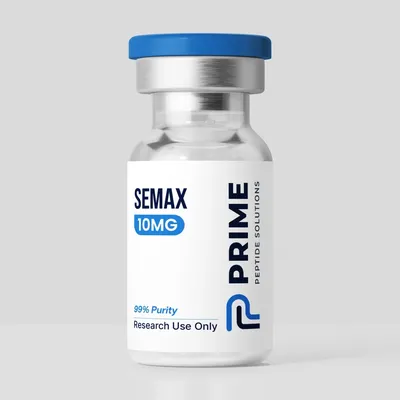
In our catalog, research-grade Semax is listed as Semax, supplied as a lyophilized powder in one size, a 10mg vial. Published lab reports (COAs) are listed on our COAs page.
Sold strictly for in-vitro laboratory research. Not for human or animal consumption.