

What Are Copper Peptides?
Copper peptides are short peptides that bind a copper(II) ion tightly through their N-terminal amine, backbone amide nitrogens and a histidine side chain. In research the term mostly means GHK-Cu (glycyl-L-histidyl-L-lysine copper(II), also written GHKCu or copper tripeptide-1), its alanine analog AHK-Cu (L-alanyl-L-histidyl-L-lysine copper(II)), and the tetrapeptide Asp-Ala-His-Lys (DAHK). GHK and DAHK both occur naturally in human serum as copper(II)-binding motifs (Trapaidze et al., 2012).
This hub covers the chemistry (how these peptides hold copper, how tightly, and what reduction does) and the cell and in-vivo studies behind GHK-Cu. For a single-compound overview see the GHK-Cu scientific overview; the two tripeptides are set side by side in GHK-Cu vs AHK-Cu.
This article is a scientific overview for laboratory researchers. The research-grade GHK-Cu supplied by Prime Peptide Solutions is sold strictly for in-vitro laboratory research. It is not approved for human use and is not for human or animal consumption.
Identity at a Glance
- GHK-Cu (copper complex): Gly-His-Lys, copper(II) complex (1:1); C14H23CuN6O4+, 402.92 g/mol; CAS 89030-95-5, PubChem CID 71587328
- GHK (free tripeptide): H-Gly-His-Lys-OH; C14H24N6O4, 340.38 g/mol; CAS 49557-75-7, PubChem CID 73587
- AHK (free tripeptide): H-Ala-His-Lys-OH; C15H26N6O4, 354.41 g/mol; CAS 126828-32-8, PubChem CID 7408502
The copper complex and the free tripeptide are separate entries with separate CAS numbers, so documents for "GHK-Cu" may cite either one. A PubChem name search for AHK-Cu returns only a hydrochloride entry, not a 1:1 complex comparable to the GHK-Cu record, so no formula is given for AHK-Cu here.
How GHK Binds Copper(II)
Potentiometric titration and visible-absorption work at 25 °C found several copper species across pH 3.5 to 10.6, and showed that the lysine side-chain amine raises the stability constants compared with Gly-His or Gly-His-Gly (Lau and Sarkar, 1981). Electron paramagnetic resonance (EPR) and electron spin-echo studies then showed that at neutral pH GHK forms a mononuclear 1:1 complex in which copper is bound by two or three nitrogens, one of them from the histidine imidazole, with apparent pK values of 3.6, 9.2 and 11.4 in a pH titration (Freedman et al., 1982). Nitrogen superhyperfine splitting in EPR spectra between pH 6.0 and 9.6 indicated three coordinating nitrogens and one oxygen in a square-planar arrangement (Laussac et al., 1983).
A 2011 study combining X-ray crystallography with EPR, X-ray absorption and NMR spectroscopy confirmed the picture. In solution, Cu(II)-GHK is monomeric with three nitrogen ligands: the N-terminal amine, a deprotonated backbone amide nitrogen, and the histidine imidazole. In the solid state it is dimeric, and the fourth equatorial position is occupied by a labile oxygen from a carboxylate. The same study made ternary complexes in which glycine or histidine occupies that fourth site, and found that copper exchanges quickly between GHK molecules, which it attributed to a Cu(GHK)2 species (Hureau et al., 2011).
Two Binding Motifs: GHK and the Albumin-Type ATCUN Site
GHK places histidine at position 2. DAHK places it at position 3. An N-terminal tripeptide ending in histidine is the amino-terminal copper and nickel binding (ATCUN) motif, which is common to serum albumins (Noormägi et al., 2023). That one-residue shift changes the coordination: in Cu(II)-DAHK the copper is held by the N-terminal amine, two amide nitrogens and the imidazole nitrogen, four nitrogens in the plane, the same in crystal and in solution; the X-ray structure also showed a water molecule bound above the copper. Copper exchange between DAHK peptides was very slow, the opposite of GHK (Hureau et al., 2011).
Both motifs bind copper extremely tightly. Isothermal titration calorimetry with glycine as a weaker competitor gave conditional dissociation constants at pH 7.4 of 7.0 × 10⁻¹⁴ M for GHK and 2.6 × 10⁻¹⁴ M for DAHK, with a larger enthalpic contribution for GHK (Trapaidze et al., 2012). An early structure-function study noted the resemblance between GHK and the copper transport sites of albumin and alpha-fetoprotein, where copper sits on a histidine next to a basic residue (Pickart et al., 1980).
AHK keeps histidine at position 2 and changes only the first residue, from glycine to alanine. No crystal or solution structure of its copper complex turned up in a PubMed search for this page. By analogy with GHK the same three nitrogen donors are available, but that is an inference, not a measurement.
Copper Sharing With Albumin
Albumin also binds copper, so the two compete. In equilibrium dialysis at pH 7.5 and 6 °C, GHK bound about 42% of the copper when it was present at the same concentration as albumin; at concentrations modeled on plasma, about 6% of the copper sat with the low-molecular-weight components, histidine included (Lau and Sarkar, 1981). A 2021 study found that GHK and human serum albumin also form ternary Cu(GHK) complexes through albumin histidines, with His3 as one site (conditional binding constant 2,900 M-1 at pH 7.4) and a second, weaker site (1,700 M-1) (Bossak-Ahmad et al., 2021).
Redox Behavior
Peptide-bound copper can in principle switch between Cu(II) and Cu(I). Cyclic voltammetry and ascorbate-oxidation measurements showed that both Cu(II)-GHK and Cu(II)-DAHK are inert under moderate redox potentials. Unlike the DAHK complex, Cu(II)-GHK could be reduced to Cu(I) at around -0.62 V (versus Ag/AgCl), and the copper was then released (Hureau et al., 2011).
Where GHK Comes From
GHK was described in 1973 as a tripeptide in human serum reported to prolong the survival of normal liver cells (Pickart and Thaler, 1973). During its isolation it co-purified with roughly equimolar copper, and the tripeptide readily formed copper(II) complexes (Pickart et al., 1980). Two protein sources of the sequence have been described: proteolysis of the matrix protein SPARC released GHK, KGHK and longer peptides containing them (Lane et al., 1994), and a GHK triplet occurs in the alpha-2(I) chain of type I collagen (Maquart et al., 1988).
Research Findings by Study Model
Cell culture
- Copper uptake. Added at nanomolar concentrations to many cultured systems, the tripeptide produced responses ranging from growth stimulation to toxicity. It enhanced copper uptake into cultured HTC4 hepatoma cells, and several tripeptides with a histidyl-lysyl linkage were nearly as active (Pickart et al., 1980).
- Collagen synthesis in fibroblast cultures. GHK-Cu stimulated collagen synthesis by cultured fibroblasts, starting between 10-12 and 10-11 M and peaking at 10-9 M, without a change in cell number (Maquart et al., 1988).
- Endothelial cells. SPARC-derived peptides containing (K)GHK stimulated endothelial cord formation in vitro. KGHK bound Cu2+ with high affinity, yet pre-loading with copper was not required for activity, and a second copper-binding SPARC peptide was inactive, so the authors concluded the effect was sequence-specific and independent of bound copper (Lane et al., 1994).
In vivo models
The same SPARC-derived peptides stimulated angiogenesis in in-vivo assays, with the KGHK sequence responsible for most of the activity and substitution of its histidine reducing the effect (Lane et al., 1994).
AHK-Cu
AHK-Cu has a much smaller published literature than GHK-Cu, and no structural or binding study of its copper complex turned up in a PubMed search for this page. No human studies of either peptide are summarized here.
Key Studies
- Pickart and Thaler, 1973 (Nat New Biol): GHK described in human serum. PubMed 4349963
- Pickart et al., 1980 (Nature): co-isolation with copper; copper uptake into cultured cells. PubMed 7453802
- Lau and Sarkar, 1981 (Biochem J): copper speciation, stability constants and competition with albumin. PubMed 7340824
- Freedman et al., 1982 (Biochemistry): 1:1 complex with imidazole coordination in solution. PubMed 6291585
- Maquart et al., 1988 (FEBS Lett): collagen synthesis in fibroblast cultures; GHK triplet in type I collagen. PubMed 3169264
- Lane et al., 1994 (J Cell Biol): SPARC as a source of GHK and KGHK. PubMed 7514608
- Hureau et al., 2011 (Chemistry): X-ray and solution structures of Cu-GHK and Cu-DAHK; redox behavior. PubMed 21780203
- Trapaidze et al., 2012 (J Biol Inorg Chem): dissociation constants by isothermal titration calorimetry. PubMed 21898044
- Bossak-Ahmad et al., 2021 (Inorg Chem): ternary GHK-copper-albumin complexes. PubMed 34730942
Handling and Storage of the Lyophilized Material
GHK-Cu is supplied as a lyophilized powder. Keep vials sealed, cold, dry and away from light, and let a cold vial reach room temperature before opening. The chemistry above has three practical consequences for solution work: the copper species present depend on pH (Lau and Sarkar, 1981); added amino acids such as glycine or histidine can occupy the fourth coordination site, and reduction to Cu(I) releases the copper (Hureau et al., 2011); and albumin, where present, competes for the copper (Lau and Sarkar, 1981). General conditions are in the peptide storage guide.
In the KLOW blend, GHK-Cu shares the vial with KPV, BPC-157 and TB-500; its KLOW 80mg batch 0502 lab report shows GHK-Cu as a separately labeled peak. The KLOW overview covers the blend, and how to read a peptide COA explains the report fields.
Frequently Asked Research Questions
What is a copper peptide?
A short peptide that binds a copper(II) ion tightly through its N-terminal amine, backbone amide nitrogens and a histidine. GHK-Cu is the most studied example.
Is GHK-Cu the same as AHK-Cu?
No. AHK-Cu has alanine in place of glycine at position 1. Both keep histidine at position 2, but AHK-Cu has far less published chemistry. See GHK-Cu vs AHK-Cu.
How tightly does GHK bind copper?
Very tightly: a conditional dissociation constant of about 7 × 10-14 M at pH 7.4 by isothermal titration calorimetry, close to the albumin-type DAHK motif.
Why do GHK-Cu documents list two CAS numbers?
PubChem lists the free tripeptide GHK under 49557-75-7 and the copper complex under 89030-95-5. Documents may cite either.
Can GHK-Cu lose its copper?
Yes, under some conditions. The species present shift with pH, other ligands and albumin can share the copper, and Cu(II)-GHK can be reduced to Cu(I) with release of the metal.
What is the GHK-Cu sold here intended for?
Only in-vitro laboratory research. It is not for human or animal consumption and is not equivalent to any approved medicine.
Conclusion
GHK-Cu is a 1:1 copper(II) complex held by three nitrogens with a labile fourth site, a dissociation constant near 10-14 M, fast copper exchange and copper release on reduction. The albumin-type DAHK motif binds about as tightly through four nitrogens but exchanges slowly and was not reduced under the same conditions. AHK-Cu shares the GHK layout but lacks published structural data.
Disclaimer: This article is provided for educational and research purposes only. It summarizes publicly available scientific literature and does not constitute medical advice. GHK-Cu and all peptide compounds sold by Prime Peptide Solutions are intended strictly for laboratory research, are not approved for human use, and are not for human or animal consumption. Researchers are responsible for compliance with all applicable regulations in their jurisdiction.
Shop these products
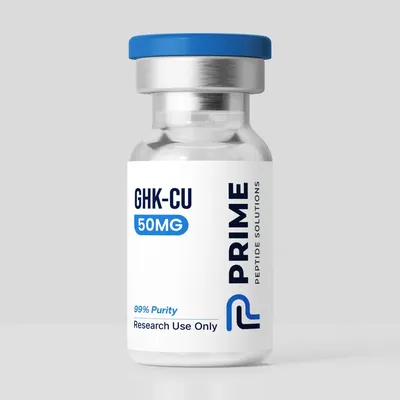
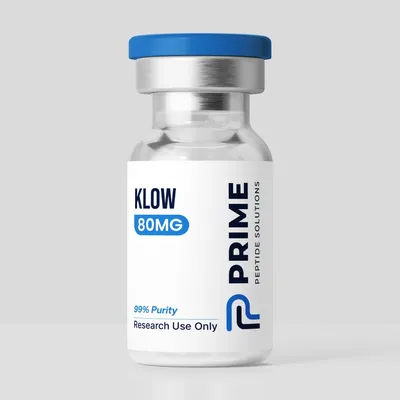
- Ships the same business day
- Free US shipping on $199.99+
- 14-day money-back guarantee on damaged items
References & Further Reading
- PubMed: Copper(II) coordination by the GHK tripeptide
- PubChem: GHK copper complex (CID 71587328)
- Related: GHK-Cu scientific overview
- Related: GHK-Cu vs AHK-Cu comparison
Research-Grade GHK-Cu
In our catalog, research-grade GHK-Cu is listed as GHK-Cu, supplied as a lyophilized powder, and is also one of the four components of KLOW. Every batch of GHK-Cu is tested by an independent third-party lab. The lab report (COA) is on our COAs page.
One published GHK-Cu report also has its own page: GHK-Cu 50mg batch 0425.
Sold strictly for in-vitro laboratory research. Not for human or animal consumption.