

What Is CJC-1295 No DAC?
CJC-1295 no DAC, also called Mod GRF 1-29, modified GRF (1-29) or tetrasubstituted GRF(1-29), is a synthetic 29-residue analog of growth hormone-releasing hormone (GHRH). It keeps the first 29 residues of human GHRH, swaps four of them to make the chain more stable, and ends in a C-terminal amide. It is studied as a ligand of the GHRH receptor on pituitary somatotroph cells.
The name is the main source of confusion. In the paper that introduced it, CJC-1295 is "a tetrasubstituted form of hGRF(1-29) with an added N epsilon-3-maleimidopropionamide derivative of lysine at the C terminus", the group that lets it bind serum albumin (Jetté et al., 2005). The no-DAC peptide is that tetrasubstituted 29-residue chain without the extra lysine. This page covers it on its own; the two forms sit side by side in our CJC-1295 with vs without DAC comparison.
This article is a scientific overview for laboratory researchers. The research-grade CJC-1295 no DAC supplied by Prime Peptide Solutions is sold strictly for in-vitro laboratory research. It is not approved for human use and is not for human or animal consumption.
Structure and Identity
From GHRH(1-44) to GRF(1-29)
Native human GHRH is 44 residues long with an amidated C-terminus, GRH(1-44)-NH2 (Frohman et al., 1986). In 1984, a set of C-terminally shortened analogs tested on rat anterior pituitary cells showed that hGRF(1-29)NH2 kept about 50% of the potency of the full hormone, while deletion down to hGRF(1-19)NH2 abolished activity (Ling et al., 1984). The 29-residue fragment became the base for many later analogs, including this one.
The four substitutions
- Position 2, L-Ala to D-Ala: resists DPP-IV cleavage of the Ala2-Asp3 bond.
- Position 8, Asn to Gln: avoids the Asn8 rearrangement to Asp and beta-Asp in water.
- Position 15, Gly to Ala: raises receptor binding affinity and potency.
- Position 27, Met to Leu: removes the Met27 oxidation site.
Position 2. Dipeptidyl peptidase IV (DPP-IV) in plasma inactivates native GRF by cutting the Ala2-Asp3 bond (Kubiak et al., 1993). In human plasma, GRH(1-44)-NH2 was converted to GRH(3-44)-NH2, which had less than one-thousandth of the original activity (Frohman et al., 1986). With D-Ala at position 2, GHRH(1-29)-NH2 showed lower metabolic clearance in human volunteers, with a disappearance half-time of 6.7 against 4.3 minutes for the unmodified peptide (Soule et al., 1994).
Positions 8, 15 and 27. A 1994 study set out the rationale: in water, native GRF rearranges at Asn8 through an aminosuccinimide intermediate and oxidizes at Met27, both lowering bioactivity, so analogs replace residue 8 to slow isomerization and residue 27 to stop oxidation; Gln8 was among the residue-8 options, and Ala15 had already been shown to raise receptor binding affinity (Campbell et al., 1994). In rat pituitary cells, [Ala15]GRH-(1-29)NH2 was 5 times more potent than the Gly15 form (Coy et al., 1991).
Molecule at a Glance
- Other names: Mod GRF 1-29, modified GRF (1-29), tetrasubstituted GRF(1-29)
- Sequence:
Y-(D-Ala)-DAIFTQSYRKVLAQLSARKLLQDILSR-NH2 - Length: 29 residues, C-terminal amide
- Molecular formula: C152H252N44O42
- Molecular weight: 3367.9 g/mol
- CAS number: 863288-34-0
- PubChem CID: 56841945
- Sulfur atoms: none (Leu27 replaces the native Met)
A note on identifiers: the PubChem record for this structure lists more than one CAS number among its synonyms, and some of those synonyms name the DAC form instead. Because the same numbers are attached to both forms in public records, the sequence and the measured mass are the dependable identity checks, not the name or a CAS number alone.
Proposed Mechanism of Action
The GHRH receptor was cloned in 1992 and 1993. It is a seven-transmembrane G protein-coupled receptor in the secretin receptor family; expressed in cultured cells it bound GHRH with high affinity and raised intracellular cAMP, and its mRNA was found mainly in the anterior pituitary (Mayo, 1992; Gaylinn et al., 1993). Mod GRF 1-29 is designed to engage this receptor as GRF(1-29) does. Most published activity data come from closely related analogs: GRF(1-32) analogs carrying the Gln8 (or Thr8), Ala15 and Leu27 replacements, with a different N-terminal change, released growth hormone from rat pituitary cells in culture (Campbell et al., 1994), and albumin-conjugated hGRF(1-29) derivatives were active in the same rat pituitary cell assay (Jetté et al., 2005).
What the Literature Covers, by Study Model
- Cell culture (rat pituitary cells). Potency of GRF(1-29) and shorter fragments (Ling et al., 1984); the Ala15 and Ala8 substitution effects (Coy et al., 1991); stability-focused analogs with residue 8, 15 and 27 replacements (Campbell et al., 1994); activity of albumin-conjugated GRF(1-29) derivatives (Jetté et al., 2005).
- Plasma stability and clearance. DPP-IV cleavage of native GRF (Frohman et al., 1986; Kubiak et al., 1993); the D-Ala2 clearance study in adult male volunteers (Soule et al., 1994).
- Analytical identification. A 29-residue, C-terminally amidated peptide matching CJC-1295 was identified in an unknown preparation submitted for forensic analysis, by high-resolution tandem mass spectrometry (Henninge et al., 2010), and later analytical work characterized GHRH analogs, including CJC-1295, and their in-vitro metabolites by liquid chromatography-mass spectrometry (Memdouh et al., 2021).
The no-DAC form has little literature under its own names, which is why this overview draws on the GRF(1-29) analog series and on the DAC-form papers where they bear on the shared 29-residue core.
No DAC vs With DAC
The one difference that matters most is duration. The DAC form carries an extra lysine with a maleimidopropionamide group that binds covalently to serum albumin in vivo; in rats it was still present in plasma beyond 72 h and was identified on the albumin band (Jetté et al., 2005). In adult human volunteers the DAC form had an estimated half-life of 5.8 to 8.1 days (Teichman et al., 2006), and continuous stimulation still left growth hormone secretion pulsatile (Ionescu and Frohman, 2006). The no-DAC peptide has no albumin anchor; for comparison, the closest published clearance data, for D-Ala2-GHRH(1-29)-NH2 in adult male volunteers, give a disappearance half-time measured in minutes (Soule et al., 1994). In research terms, the no-DAC peptide is a short-acting GHRH receptor ligand and the DAC form a long-acting, albumin-bound one, the contrast covered in our with vs without DAC comparison.
Key Studies
- Jetté et al., 2005, Endocrinology (PMID 15817669): identification of CJC-1295 as an albumin-binding GRF(1-29) analog; defines the tetrasubstituted core and the DAC group.
- Ling et al., 1984, Biochem Biophys Res Commun (PMID 6435620): C-terminally shortened GRF analogs; GRF(1-29)NH2 keeps about half the potency.
- Frohman et al., 1986, J Clin Invest (PMID 3093533): DPP-IV cleaves GRF to the near-inactive 3-44 product.
- Campbell et al., 1994, Peptides (PMID 7937325): rationale for residue 8, 15 and 27 substitutions against isomerization and oxidation.
- Henninge et al., 2010, Drug Test Anal (PMID 21204297): mass-spectrometric identification of a 29-residue amidated peptide consistent with CJC-1295.
Stability and Laboratory Handling
Storing the lyophilized peptide
The CJC-1295 no DAC in our catalog is a lyophilized powder in a sealed vial; the product page gives storage at 2-8 °C, or -20 °C for long-term storage. The dry, freeze-dried solid generally keeps far longer than a solution (Wang, 2000). Keep vials cold, dry, dark and sealed until needed. Two of the four substitutions were made for stability reasons that carry over to handling: Leu27 removes the oxidation-prone methionine, and Gln8 removes the Asn8 that rearranges in water (Campbell et al., 1994), so the peptide is somewhat less prone to those two routes than native GRF, though cold, dry storage is still the safeguard. See our guides to storing research peptides and lyophilization.
Verifying identity and purity
A batch Certificate of Analysis normally gives an HPLC purity figure and a mass spectrometry identity check against the calculated mass of 3367.9 g/mol. Because the name is shared with the DAC form, the mass is the surest way to tell them apart: the DAC molecule is heavier by the extra modified lysine. Our guides to HPLC and mass spectrometry and reading a peptide COA explain each field.
Frequently Asked Research Questions
Is CJC-1295 no DAC the same as Mod GRF 1-29?
Yes. Modified GRF (1-29), Mod GRF 1-29 and tetrasubstituted GRF(1-29) all name this same 29-residue peptide: GRF(1-29) with D-Ala2, Gln8, Ala15 and Leu27 and a C-terminal amide.
What are the four substitutions and why are they there?
D-Ala at position 2 resists DPP-IV cleavage; Gln at 8 avoids the Asn8 rearrangement in water; Ala at 15 raises receptor binding affinity; Leu at 27 removes the oxidation-prone methionine.
How is no DAC different from CJC-1295 with DAC?
The DAC form adds a lysine carrying a maleimidopropionamide group that binds serum albumin, giving it a much longer duration (an estimated 5.8 to 8.1 days in adult volunteers). The no-DAC peptide has no such anchor and behaves as a short-acting GRF(1-29) analog. They are different molecules with different masses.
What receptor does it act on?
The GHRH receptor, a secretin-family G protein-coupled receptor expressed mainly on anterior pituitary somatotroph cells, which signals through cAMP.
Does PPS sell the DAC form?
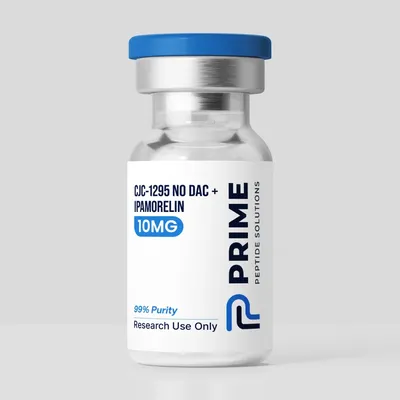
No. Only the no-DAC peptide is stocked, on its own and blended with ipamorelin. The DAC form is a different compound and is not sold here.
Conclusion
CJC-1295 no DAC (Mod GRF 1-29) is a 29-residue GHRH analog with four substitutions, D-Ala2, Gln8, Ala15 and Leu27, and a C-terminal amide. The substitutions trace to published work on DPP-IV resistance, aqueous stability and receptor affinity in the GRF(1-29) analog series. Its defining feature against the DAC form is the absence of the albumin-binding lysine, so it is studied as a short-acting GHRH receptor ligand rather than a sustained one. For laboratories, the identity-critical points are the sequence and a mass near 3367.9 g/mol, which separate it from the heavier DAC molecule.
Disclaimer: This article is provided for educational and research purposes only. It summarizes publicly available scientific literature and does not constitute medical advice. CJC-1295 no DAC and all peptide compounds sold by Prime Peptide Solutions are intended strictly for laboratory research, are not approved for human use, and are not for human or animal consumption. Researchers are responsible for compliance with all applicable regulations in their jurisdiction.
Shop these products
- Ships the same business day
- Free US shipping on $199.99+
- 14-day money-back guarantee on damaged items
References & Further Reading
- Frohman LA et al., 1986. J Clin Invest. PMID 3093533.
- Ling N et al., 1984. Biochem Biophys Res Commun. PMID 6435620.
- Coy DH et al., 1991. Eur J Pharmacol. PMID 1806385.
- Kubiak TM et al., 1993. J Med Chem. PMID 8464043.
- Soule S et al., 1994. J Clin Endocrinol Metab. PMID 7962295.
- Campbell RM et al., 1994. Peptides. PMID 7937325.
- Mayo KE, 1992. Mol Endocrinol. PMID 1333056.
- Gaylinn BD et al., 1993. Mol Endocrinol. PMID 7680413.
- Jetté L et al., 2005. Endocrinology. PMID 15817669.
- Teichman SL et al., 2006. J Clin Endocrinol Metab. PMID 16352683.
- Ionescu M and Frohman LA, 2006. J Clin Endocrinol Metab. PMID 17018654.
- Henninge J et al., 2010. Drug Test Anal. PMID 21204297.
- Memdouh S et al., 2021. Drug Test Anal. PMID 34665524.
- Wang W, 2000. Int J Pharm. PMID 10967427.
Research-Grade CJC-1295 No DAC
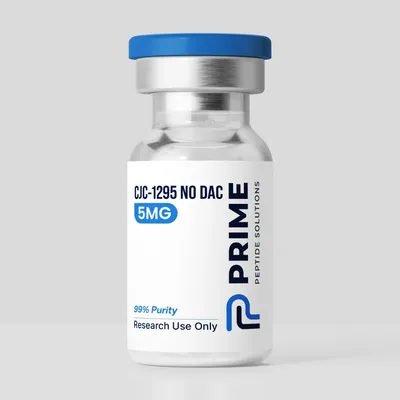
In our catalog, research-grade CJC-1295 no DAC is listed as CJC-1295 no DAC, a lyophilized powder in 5mg and 10mg vials. The same peptide is pre-mixed with ipamorelin in the CJC-1295 no DAC + Ipamorelin blend. Published lab reports (COAs) are listed on our COAs page. The blend's lab report also has its own CJC-1295 no DAC + Ipamorelin report page. Related research peptides are grouped on the growth hormone research peptides page.
Sold strictly for in-vitro laboratory research. Not for human or animal consumption.