

What Reconstituting Tesamorelin Involves
Tesamorelin is supplied as a lyophilized (freeze-dried) powder in a sealed vial. In that dry form it cannot be measured into an aqueous assay. Reconstitution means adding a measured volume of sterile diluent, normally bacteriostatic water, so the powder cake becomes a stock solution of known concentration.
This guide gives worked mg/mL tables for the 10 mg and 20 mg vials, a stepwise procedure, storage notes and the mistakes that are easiest to make with a 44-residue peptide.
This guide is a laboratory handling reference. Research-grade Tesamorelin is not approved for human use and is sold strictly for in-vitro research. It is not for human or animal consumption.
Tesamorelin at a glance
- Identity: a synthetic analog of human growth hormone-releasing factor (GRF, also called GHRH)
- Sequence: the full 44 amino acids of human GRF, YADAIFTNSY RKVLGQLSAR KLLQDIMSRQ QGESNQERGA RARL, ending in a C-terminal leucine amide
- Modification: a trans-3-hexenoyl group on the N-terminal tyrosine, the only change from native GRF(1-44)-NH2
- Molecular formula: C221H366N72O67S
- Molecular weight: 5136 g/mol (PubChem), about 5.14 kDa
- CAS number: 218949-48-5 (PubChem record for the free peptide; salt forms and batch documents may list a different CAS number)
- Supplied form: lyophilized powder in a sealed vial
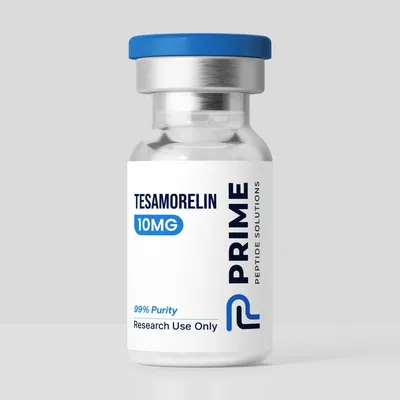
- Vial sizes in this store: 10 mg and 20 mg
The parent 44-residue sequence was first isolated and characterized in 1982. In human plasma in vitro, native GRF(1-44)-NH2 disappeared with a half-life of 17 minutes, cleaved between Ala2 and Asp3 by dipeptidyl peptidase IV (DPP-IV) to a fragment with less than a thousandth of the parent's activity. The hexenoyl group made the analog resistant to DPP-IV deactivation and slowed its in vitro degradation in rat, dog and human plasma.
Tesamorelin acts at the growth hormone-releasing hormone receptor (GHRHR), a class B G protein-coupled receptor in the pituitary that signals through cAMP, protein kinase A and the transcription factor CREB. This page stays focused on bench handling.
What You Need
- The lyophilized Tesamorelin vial, 10 mg or 20 mg, with its batch number noted
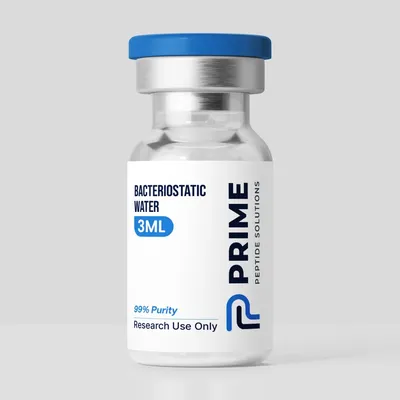
- Diluent: bacteriostatic water, sold separately in 3 mL and 10 mL vials (check the product page for current stock). The page states that it contains a preservative; in general terms, bacteriostatic water is 0.9% benzyl alcohol in sterile water
- Sterile transfer supplies: a new sterile syringe and needle used only to move the diluent
- Alcohol wipes for both rubber stoppers
- A fine-tip marker for the label
- A clean workspace, such as a wiped-down bench or laminar flow hood
Why an aqueous diluent suits Tesamorelin
PubChem lists an isoelectric point of 10.54 (a database value) and a computed XLogP3-AA of -23.3. A pI well above 7 marks a basic peptide with a net positive charge near neutral pH (six arginines and two lysines against two aspartates and two glutamates), and the strongly negative XLogP3 describes a very polar, hydrophilic molecule. Neither is a solubility limit, but together they explain why the cake takes up a water-based diluent.
Concentration Math for 10mg and 20mg Vials
Concentration (mg/mL) = vial (mg) ÷ diluent (mL)
10 mg Tesamorelin vial
- 1 mL of diluent gives 10 mg/mL (about 1.95 mM)
- 2 mL gives 5 mg/mL (about 0.97 mM)
- 3 mL gives about 3.33 mg/mL (about 0.65 mM)
20 mg Tesamorelin vial
- 2 mL of diluent gives 10 mg/mL (about 1.95 mM)
- 3 mL gives about 6.67 mg/mL (about 1.30 mM)
- 4 mL gives 5 mg/mL (about 0.97 mM)
Two pairings line up across sizes: 10 mg in 1 mL and 20 mg in 2 mL both give 10 mg/mL, and 10 mg in 2 mL and 20 mg in 4 mL both give 5 mg/mL, which keeps records simple when a study uses both vials.
Converting to molar units
At PubChem's 5136 g/mol for the free peptide, millimolar = mg/mL ÷ 5.136, which gives the bracketed figures above. They assume the labeled milligrams are free peptide. The product page gives only the labeled amount, and the batch COA reports its own measured content, so regard all these figures as nominal.
Choosing a volume
More diluent gives a more dilute stock; less diluent gives a more concentrated one. The experiment sets the target concentration and the volume follows from it, so settle it before the stopper is pierced.
For other volumes, the Tesamorelin calculator preset preselects the compound with its 10 mg and 20 mg options and returns mg/mL from vial size and diluent volume. On supply, a 20 mg vial made up at 4 mL needs more diluent than a single 3 mL vial holds.
Stepwise Reconstitution Procedure
Work through the procedure in order; it follows the technique in the general reconstitution guide, and the notes below cover the details that matter for Tesamorelin.
- Bring the sealed vial to room temperature before opening. Peptides are often hygroscopic, and opening a cold vial too soon can let condensation form on the material; peptides containing arginine, lysine, aspartate or glutamate, as Tesamorelin does, are prone to taking up moisture from the air. Let it warm on the bench, not in hot water or the hands.
- Prepare the workspace. Clean the bench, glove up and lay out every item.
- Disinfect both stoppers. Remove the flip caps, wipe each rubber stopper with an alcohol wipe and let it air dry.
- Measure the planned volume of diluent into a fresh sterile syringe, using aseptic technique for every entry into the diluent vial.
- Add it slowly down the vial wall. Tilt the vial and angle the needle toward the glass so the liquid runs down the inside wall onto the cake rather than striking it directly.
- Let the vial stand upright and undisturbed until the whole cake wets through.
- Swirl or roll gently between the palms. Do not shake, vortex or sonicate, and avoid creating foam.
- Inspect the solution against a light and a dark background. It should be completely clear and free of particles. Persistent particles or cloudiness mean the material should not be used; check the batch documentation or contact support.
- Label the vial with the date, the concentration in mg/mL (and mM if the protocol uses it) and the batch number.
- Refrigerate promptly. The product page instructs keeping the vial refrigerated after reconstitution.
Why gentle handling matters for a 44-residue peptide
The reasoning comes from protein studies, not Tesamorelin-specific data. Adsorption to interfaces has in some cases been reported to cause aggregation or particle formation, and in a study of agitation at the air-water interface, particles of 1 micrometer or larger and insoluble aggregates formed faster in agitated solutions than in undisturbed ones. For the dry cake the concern is moisture: in lyophilized proteins stored across a range of relative humidities, more weakly bound water went with increased aggregation.
Storage After Reconstitution and Common Mistakes
Storage
- Keep the reconstituted vial refrigerated, as the product page instructs, in a laboratory refrigerator.
- Keep the solution refrigerated rather than frozen, in line with that instruction, and avoid repeated freezing and thawing; peptides taken through freeze-thaw are susceptible to degradation.
- Hold sealed, unreconstituted vials at 2-8 °C, or at −20 °C for long-term storage, tightly capped to limit exposure to air and moisture. The peptide storage guide covers temperature and light in general terms.
No fixed usable life is quoted here for reconstituted Tesamorelin. Peptides in solution have a much shorter shelf life than lyophilized peptides, especially sequences containing methionine, aspartate or glutamine, and Tesamorelin includes one methionine, two aspartates and five glutamines. Studies of native GRF in water describe rearrangement at Asn8, oxidation of Met27 and cleavage or isomerization at Asp3, all giving products with much lower bioactivity. Tesamorelin keeps all three residues, and no source shows the hexenoyl group protecting them. These are native-GRF data, not measurements on Tesamorelin.
Usable life depends on the diluent, the technique and the protocol's acceptance criteria; the stability guide for reconstituted peptides covers the details. Preparing only what a study needs is the simplest safeguard.
Common mistakes
- Opening the vial cold, or rushing the warm-up with hot water or the hands.
- Jetting diluent onto the cake instead of down the glass.
- Shaking, vortexing or sonicating to speed dissolution.
- Confusing Tesamorelin with GRF(1-29)-based peptides. It is the full 44-residue sequence, so molecular weight and molar conversions for shorter analogs do not apply, and their stability data should not be assumed to transfer.
- Skipping the label. With two vial sizes on the bench, a 10 mg/mL and a 5 mg/mL stock are easy to confuse.
- Freezing and thawing the solution repeatedly, or storing it outside the refrigerator.
Frequently Asked Research Questions
How much bacteriostatic water goes into a 10mg Tesamorelin vial?
That depends on the stock concentration the experiment calls for: 1 mL gives 10 mg/mL, 2 mL gives 5 mg/mL and 3 mL gives about 3.33 mg/mL. For the 20 mg vial, 2 mL, 3 mL and 4 mL give 10, about 6.67 and 5 mg/mL.
Is Tesamorelin a modified GRF(1-29)?
No. It keeps all 44 residues of human GRF, unlike GRF(1-29)-based peptides such as sermorelin or CJC-1295 no DAC.
Does the hexenoyl group make Tesamorelin more stable in solution?
No source shows that. Its documented effect is resistance to DPP-IV deactivation in plasma. The residues that change in water in native GRF (Asp3, Asn8 and Met27) are still present.
How long does reconstituted Tesamorelin last?
No Tesamorelin-specific source supports a fixed figure. The store's instruction is to keep the vial refrigerated after reconstitution; beyond that, it depends on the diluent, technique and protocol.
How is purity confirmed?
Identity and purity are checked by HPLC and mass spectrometry, and batch lab reports (COAs) are listed on our lab reports page as they become available. Match the batch number on the vial to its report.
Conclusion
Reconstituting Tesamorelin comes down to planning and gentle handling. Choose the diluent volume from the target concentration, convert at 5136 g/mol if the protocol is molar, and regard every figure as nominal. At the bench, let the sealed vial reach room temperature, add the diluent down the glass, swirl rather than shake, confirm a clear solution, label it and keep it refrigerated.
Disclaimer: This guide is provided for educational and laboratory reference purposes only and does not constitute medical advice. Tesamorelin and all compounds sold by Prime Peptide Solutions are intended strictly for in-vitro laboratory research, are not approved for human use, are not equivalent to or interchangeable with any approved medicine, and are not for human or animal consumption. Researchers are responsible for complying with all regulations that apply in their jurisdiction.
Shop these products
- Ships the same business day
- Free US shipping on $199.99+
- 14-day money-back guarantee on damaged items
References & Further Reading
- PubMed: Peer-reviewed Tesamorelin literature
- PubMed: GRF degradation by dipeptidyl peptidase IV
- PubMed: GHRH receptor signaling research
- PubMed: GRF deamidation and oxidation in solution
- PubMed: Agitation and protein aggregation
- Guide: Bacteriostatic water explained
- Guide: Lyophilization explained
Research-Grade Tesamorelin
In our catalog, Tesamorelin is listed as Tesamorelin in 10mg and 20mg vials, supplied as a lyophilized powder in a sealed vial with bacteriostatic water sold separately. Batch Certificates of Analysis are published on our COA page.
Sold strictly for in-vitro laboratory research. Not for human or animal consumption.