
Melanotan II vs PT-141
What are Melanotan II and PT-141?
Melanotan II and PT-141 are two synthetic peptides in the melanocortin family, and their relationship is unusually direct — PT-141 is actually a metabolite derivative of Melanotan II. This makes them one of the more closely related pairs in research peptide comparisons, yet they are studied for different primary pathways.
Both act on melanocortin receptors, but Melanotan II engages a broader set of these receptors, while PT-141 is studied with a narrower receptor emphasis.
This article is intended as a scientific overview for laboratory researchers comparing these compounds. All peptides discussed are sold strictly for in-vitro research and are not for human consumption.
Background: The Melanocortin Receptor System
Both peptides act within the melanocortin receptor family, a group of related receptors with different tissue distributions and research associations.
MC1R
The melanocortin-1 receptor is associated with pigmentation pathways and is a major reason Melanotan II appears in pigmentation research.
MC4R
The melanocortin-4 receptor is associated with central pathways, and is the receptor most relevant to PT-141's research emphasis. The two peptides differ largely in how their activity distributes across these receptors.
Direct Comparison: Melanotan II vs PT-141
The table below summarizes the practical research differences.
Property — Melanotan II — PT-141
Relationship — parent peptide — metabolite-derived from Melanotan II
Receptor emphasis — broad (multiple MCRs incl. MC1R) — narrower (MC4R-associated)
Common research association — pigmentation pathways — central MC4R pathways
Base molecule — alpha-MSH analog — Melanotan II derivative
Also known as — MT-II — Bremelanotide
Research breadth — broader literature — more focused literature
Melanotan II: A Broad Melanocortin Agonist
Structure and Background
Melanotan II is a synthetic cyclic peptide analog of alpha-melanocyte-stimulating hormone (alpha-MSH). It engages multiple melanocortin receptors, which is why its research associations span more than one pathway.
Proposed Mechanisms in Research
Melanotan II is studied across several melanocortin pathways, most notably MC1R in pigmentation research. Because it engages multiple receptors in the family, its research literature is broader than that of PT-141. As with all these compounds, the evidence base is laboratory and animal research.
PT-141: A Melanocortin Derivative with Narrower Emphasis
Structure and Background
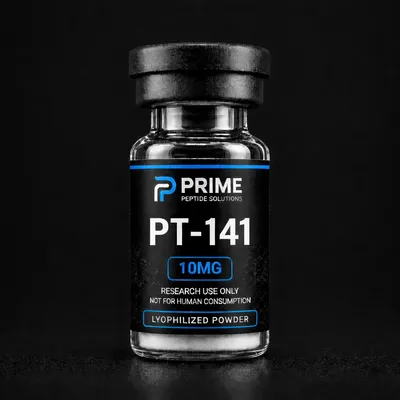
PT-141, also known as Bremelanotide, is a metabolite-derived peptide related to Melanotan II. The structural relationship is direct, but PT-141 is studied with a narrower receptor focus, particularly around MC4R-associated central pathways.
Proposed Mechanisms in Research
PT-141 research centers more specifically on MC4R-associated pathways rather than the broader receptor engagement of Melanotan II. This narrower emphasis is the main reason the two peptides, despite their close structural relationship, occupy different research niches.
Current Research Areas
Shared research areas
- Melanocortin receptor signaling studies
- Comparative research on broad versus narrow receptor engagement
- Structure-activity research examining how the derivative differs from the parent
Distinct research emphases
Melanotan II appears more often in pigmentation-pathway research due to MC1R engagement, while PT-141 appears more often in research framed around MC4R-associated central pathways. The fact that one is derived from the other makes the pair a useful case study in how small structural changes shift receptor emphasis.
Conclusion
Melanotan II and PT-141 are among the most closely related peptides in any research comparison, since one is derived from the other. Yet that close relationship makes their differences instructive. Melanotan II engages a broad set of melanocortin receptors and is associated with pigmentation research, while PT-141 carries a narrower MC4R-associated emphasis. For laboratories, the pair illustrates how a structural derivative can shift a peptide's receptor profile and research applications.
This article is a summary of publicly available scientific literature and does not constitute medical advice. Melanotan II, PT-141, and all peptide compounds sold by Prime Peptide Solutions are intended strictly for laboratory research and are not for human consumption, in-vivo human use, or therapeutic application. Researchers are responsible for compliance with all applicable regulations governing peptide use in their jurisdiction.
Frequently Asked Research Questions
How are Melanotan II and PT-141 related?
PT-141 is a metabolite-derived peptide based on Melanotan II. They are closely related structurally, which makes their differing research emphases a useful comparison.
What is the main research difference between them?
Receptor emphasis. Melanotan II engages a broader set of melanocortin receptors, including MC1R associated with pigmentation, while PT-141 is studied with a narrower MC4R-associated focus.
Is PT-141 the same as Bremelanotide?
Yes, PT-141 and Bremelanotide refer to the same research peptide.
Are either of these approved for human use?
These are research compounds sold strictly for in-vitro laboratory study and are not for human consumption or in-vivo human use. Where approved formulations of related compounds exist, they are separate from research material and not equivalent.
What purity should research-grade material have?
High purity verified by HPLC and confirmed by mass spectrometry, stated on a batch-specific Certificate of Analysis.
Shop these products

- Ships the same business day
- Free US shipping on $199+
- 14-day money-back guarantee